


The fourth day of the AI Impact Summit in New Delhi reached a crescendo on Thursday, February 19, as global technology leaders and policymakers convened for what Prime Minister Narendra Modi hailed as “the most historic AI Summit of the world.”
The high-profile gathering featured a powerhouse lineup of industry titans, including OpenAI CEO Sam Altman, Reliance Industries Chairman Mukesh Ambani, and Wipro Executive Chairman Rishad Premji. However, it was the political leadership that set the tone for the day, with addresses from French President Emmanuel Macron and Prime Minister Modi himself.
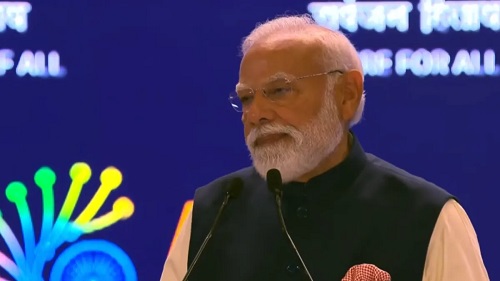
Inaugurating the day's proceedings, PM Modi described the summit’s location in India as a defining moment for developing nations. “I welcome you all to the most historic AI Summit of the world... It is a matter of pride for the Global South that the AI summit is being organised in India,” he stated, emphasizing that the country is not merely a participant in the technological shift but is actively shaping its trajectory.
“India is not just a part of the AI revolution, but is leading and shaping it,” Modi asserted, pointing to the nation’s vast tech talent pool. “India is the centre of the world's largest tech pool. This summit is a shining example of Indian people's power and capabilities.”
During his keynote, the Prime Minister laid out a comprehensive and groundbreaking vision for global AI governance, introducing the acronym MANAV (meaning ‘human’ in Hindi) to define India’s ethical approach to the technology.
He broke down the concept as follows:
Moral and ethical systems
Accountable governance
National sovereignty (with every individual being the owner of their own data)
Accessible and inclusive (to multiply knowledge, not create monopolies)
Valid and legitimate
Modi stressed that India’s approach to AI is deeply rooted in the summit’s theme of welfare and happiness for all. He warned against the dangers of dehumanization in the digital age, stating that in the era of AI, “humans must not be reduced to mere data points or treated as raw material.” Instead, he argued, technology must serve people and enhance human capabilities.
The Prime Minister called for the democratization of artificial intelligence, insisting it must become a tool for inclusion and empowerment, particularly for nations in the Global South. “This is our benchmark in shaping AI policy and development,” he added.
Earlier in the day, French President Emmanuel Macron set the stage with a stirring endorsement of India’s digital infrastructure. Addressing the summit, Macron highlighted the unprecedented scale of India’s technological achievements, which he said serve as a model for the world.
“India built something that no other country in the world has built,” Macron said. “A digital identity for 1.4 billion people. A payment system that now processes 20 billion transactions every month. A health infrastructure that has issued 500 million digital health IDs.”
Macron praised what is globally known as the India Stack—a set of open APIs and digital public goods—calling it a sovereign and interoperable system that demonstrates the power of digital inclusion. “Here are the results. They call it the India Stack. Open. Interoperable. Sovereign. That is what this summit is about,” he remarked.
The presence of CEOs like Sam Altman and industry stalwarts like Mukesh Ambani and Rishad Premji underscored the summit’s importance as a global platform for shaping the future of AI. Their discussions alongside policymakers signaled a strong push for collaboration between the public and private sectors.
The AI Impact Summit, which was inaugurated by PM Modi on February 16, has drawn unprecedented global participation. Organizers reported that the event has brought together more than 500 AI leaders, including nearly 100 founders, 150 academicians, and hundreds of chief technology officers and philanthropists from across the world.
As the summit enters its final days, the message from New Delhi is clear: in the quest to harness artificial intelligence, the principles of humanity, inclusivity, and sovereignty must guide the way forward.




















Leave Your Comment