


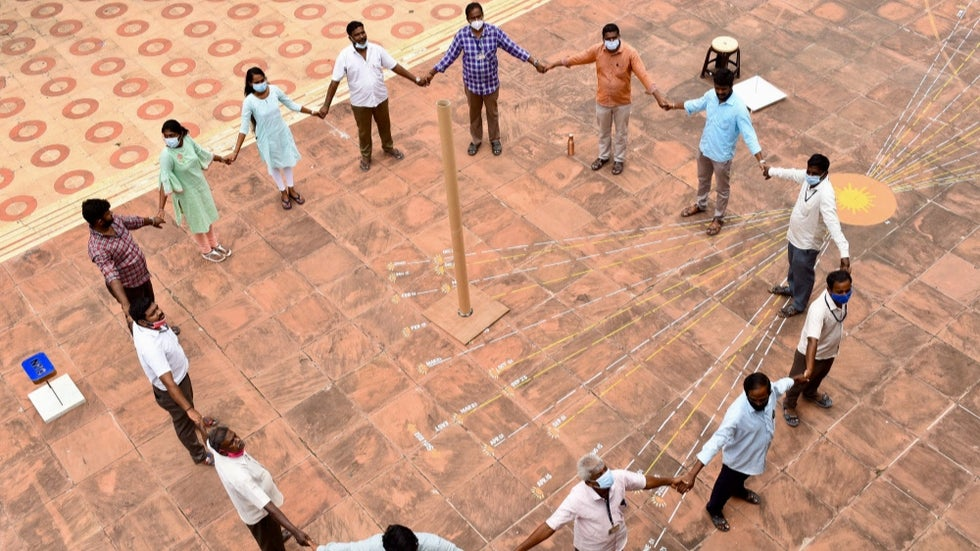
On April 25, Bengaluru will experience a rare celestial phenomenon known as "Zero Shadow Day" in which none of the city's vertical objects would cast a shadow for a brief period of time. Reports state that the event will start at 12:17 PM. As a result, the Koramangala campus of the Indian Institute of Astrophysics (IIA) in Bengaluru will host celebrations to commemorate the milestone. "Join us to celebrate Zero Shadow Day #ZSD on April 25 from 10 AM to 1 PM at our Koramangala campus. At 12:17, the sun will be directly overhead, the IIA tweeted.

Have you ever noticed that at certain times of the day, your shadow appears longer or shorter than usual? This is due to the position of the sun in the sky, and it is why we experience what is known as a shadow. However, there are certain times of the year when something fascinating happens – a day with zero shadows.

Known as Zero Shadow Day, this phenomenon occurs twice a year in certain parts of the world, specifically in places that lie between the Tropic of Cancer and the Tropic of Capricorn. During these two days, the sun is positioned directly overhead, which means that objects on the ground do not cast any shadows.
In the northern hemisphere, Zero Shadow Day occurs twice a year, around March 20th (the spring equinox) and September 22nd (the autumn equinox). In the southern hemisphere, Zero Shadow Day occurs around December 21st (the summer solstice) and June 21st (the winter solstice).

The reason why Zero Shadow Day occurs is due to the tilt of the Earth's axis. The Earth rotates on an axis that is tilted at an angle of 23.5 degrees relative to the plane of its orbit around the sun. This tilt causes the angle at which the sun's rays hit the Earth's surface to change throughout the day and throughout the year.
On Zero Shadow Day, the sun is positioned directly overhead at noon, which means that the angle of the sun's rays is exactly perpendicular to the Earth's surface. This causes objects on the ground to not cast any shadows.
Zero Shadow Day has cultural and historical significance in many parts of the world. In India, for example, Zero Shadow Day is celebrated as Bhaaskara Jayanti, in honor of the Indian astronomer Bhaskara II. In Iceland, it is celebrated as Sumardagurinnfyrsti (First Day of Summer), which marks the beginning of the summer season.
In conclusion, Zero Shadow Day is a fascinating phenomenon that occurs twice a year in certain parts of the world. It is caused by the position of the sun in the sky and the tilt of the Earth's axis. This unique day has cultural and historical significance in many parts of the world and is a reminder of the beauty and complexity of our planet and its relationship with the sun.



















Leave Your Comment