


In this highly surcharged atmosphere of the electioneering in West Bengal, it was a pleasant surprise to come across a news item the other day that the state’s Principal Secretary, Department of Micro, Small and Medium Enterprises (MSME) and Textiles, Rajesh Pandey, saying, while addressing a seminar, that the state’s MSME sector can play a pivotal role in giving a boost to productions for the defence sector in the coming days.
"The Ministry of Defence took a policy decision that the MSME sector would participate in the defence sector in a big way, including start-ups, and this has given the state's MSME sector a huge opportunity to manufacture a wide range of defence products, including specialised equipment and participate in research and development activities," he said.
Pandey is right that the MSMEs can play a big role in India’s defence industry. In fact, his speech reminded one of what Defence Minister Rajnath Singh had highlighted last month at a national seminar. Singh had noted that local entrepreneurs, start-ups and innovators were playing a crucial role in enhancing India’s technological capabilities and contributing significantly to the national economy. He highlighted that several MSMEs are actively working in emerging areas such as Artificial Intelligence, automation, robotics and other advanced technologies.
The Defence Minister had underlined the importance of innovations for the Defence sector, which needs collaboration between industry, start-ups and research institutions to promote cutting-edge defence technologies. In this context, he had said how the MSME is becoming the backbone of the economy and why integrating small industries into large defence programmes was essential to accelerate the pace of innovation.
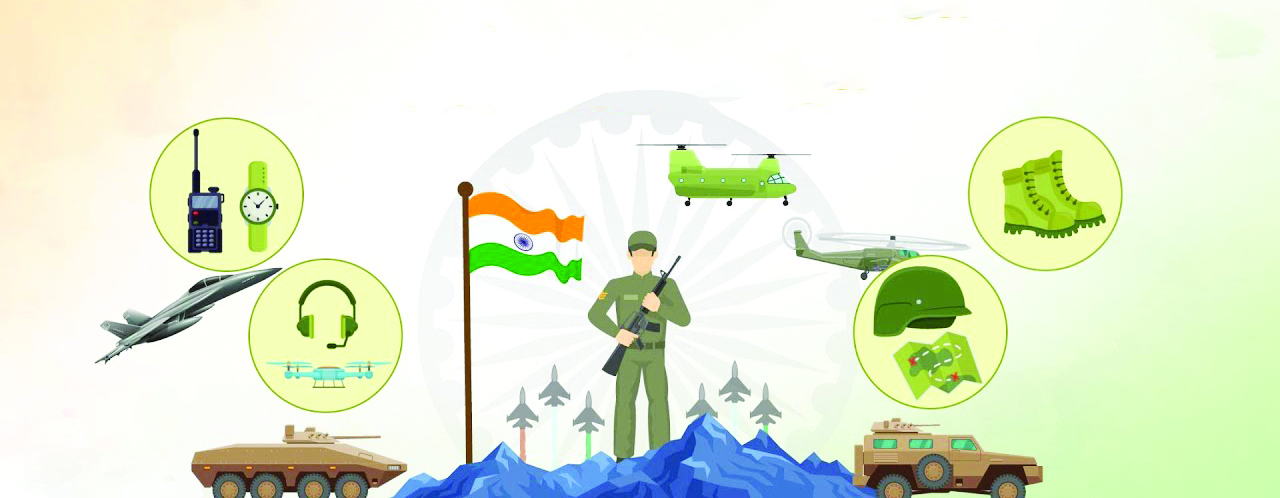
Against this background, it is heartening to note that with around 16,000 MSMEs actively contributing to defence production, this sector has really become a cornerstone for achieving India's goal of becoming not only self-reliant in defence but also a global defence exporter.
MSMEs now supply components, subsystems, and niche tech that larger primes integrate into platforms like Tejas, Arjun, warships, and missiles. As India moves from import dependence to “Atmanirbhar Bharat” in defence, MSMEs have become the fastest-growing tier of the industrial base. Defence PSUs are now becoming increasingly dependent on the MSMEs’ contributions.
In fact, this is how things should be. For instance, in the UK, BAE Systems, GKN, GESC and Rolls-Royce, etc., which are major players, have supply chains in which the MSMEs are important parts.
In India, now the MSMEs are the Tier-2 and Tier-3 suppliers. Over 16,000 MSMEs, registered on the Ministry of Defence’s Srijan portal, make everything from precision gears and avionics harnesses to composite panels and software modules. Startups and small firms dominate in drones, AI, cybersecurity, and space tech. iDEX, or Innovations for Defence Excellence, has signed 400+ contracts with MSMEs since 2018 to solve specific service problems.
MSMEs handle maintenance, repair, and overhaul for legacy systems where OEM ( Original Equipment Manufacturers) support is costly or unavailable. This keeps older fleets flying and cuts foreign exchange outflow.
There are various options for the MSMEs today. Prominent among these are: utilised by the existing and new MSMEs:
• Partner with a Prime Contractor - There are many prime contractors in the Indian Defence Sector today who have orders to manufacture or assemble major items in all the three Services. These could also be private players or even foreign OEMs.
• Another offshoot is to supply to DPSUs like HAL, BDL, BEL, shipyards, etc.
• Yet another way is to partner with DRDO for various projects and become a partner in iDEX programs or DcPP.
• Opportunities in the defence sector are not only manufacturing but also include the provision of technical support and integration services in information technology, maintenance, repair, and overhaul, communication and navigation, among other areas.
• MSMEs which can develop the capacity to manufacture defence equipment can be part of the global supply chain (e.g. manufacturing of airframes for helicopters, Boeing aircraft, etc.).
Of course, all these are possible today, thanks to various policy changes that the government of Narendra Modi has made over the last 12 years. For instance, under the DAP 2020 ( Defence Acquisition Policy), certain categories for Indian vendors are reserved for the MSMEs. Under “Positive Indigenisation Lists”, 509 items have been banned for import. MSMEs fill many of those gaps. The Defence Ministry also earmarked 75% of the 2024-25 capital acquisition budget for the domestic industry. Of that, 25% is set aside specifically for private industry, including MSMEs.
Then there are now “Defence Corridors” in Uttar Pradesh and Tamil Nadu that offer land, testing infra, and clusters for MSMEs. Under “iDEX + ADITI” schemes, there are grants up to Rs 25 crore for critical tech, and 70% of winners are MSMEs or startups.
Because of these measures, there have been positive impacts. India’s defence exports hit Rs 21,083 crore in FY 2023-24. MSMEs contributed roughly 20% through components, thanks to the “Open General Export License” policy that has made export compliance simplified for MSMEs selling components and subsystems.
There has been substantial “Import substitution”. INS Vikrant naval carrier, for instance, used steel, cables, and fittings from 500+ MSMEs. The LCA Tejas program sources 65% of its parts by value from Indian industry, much of it MSME.
And many jobs have been created, and MSES clusters have come up in places like Hyderabad, Bengaluru, Pune, and Coimbatore. They are feeding HAL, BEL, DRDO, and private companies like L&T and Tata.
The Government is now funding 75% of test facility costs in corridors. MSMEs get pay-per-use access instead of building their own.
Besides, because of the “Offset reforms”, foreign OEMs now have stronger incentives to source from Indian MSMEs rather than set up their own subsidiaries.
All this is not to suggest that there are no challenges for the MSMEs. One comes across complaints of defence orders having long gestation and delayed payments. MSMEs struggle with cash flow despite advance payment provisions.
Secondly, approval processes of MSME products are proving costly and time-consuming. So much so that a single test can exceed an MSME’s annual R&D budget.
Thirdly, RFPs ( Requests for Proposals) often bundle requirements too large for small firms. The move to break orders into smaller packages is still uneven.
Fourthly, our armed services demand global standards. But our MSMEs do not have those skills at the moment and need constant upskilling and access to testing laboratories to stay relevant.
But then, as one pointed out, these are challenges, not problems. These have to be met with empathy, understanding and encouragement from the government and armed services. The MSME sector needs faster payments, shared testing, and design handholding from DRDO and DPSUs. If those gaps close, MSMEs will shift from being just vendors to becoming design partners. And they will play a big role in reaching the goals of Rs 3 lakh crore in defence production and Rs 50,000 crore in exports by 2028-29.

BY PRAKASH NANDA
(prakash.nanda@hotmail.com)



















Leave Your Comment