


During his State of the Union address to the US Congress, President Donald Trump doubled down on one of his most repeated foreign policy boasts: that his administration stopped eight wars in the first year of his second term. Chief among them, in Trump's telling, was averting a nuclear catastrophe between India and Pakistan.
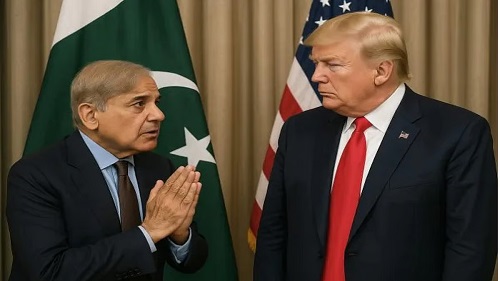
"Pakistan and India would have had a nuclear war," Trump told Congress, adding a striking figure attributed to Pakistani Prime Minister Shehbaz Sharif — that 35 million people would have died during India's Operation Sindoor had the United States not intervened to broker a ceasefire. "We're proudly restoring safety for Americans at home and abroad," Trump declared, framing the claim as a cornerstone of his foreign policy legacy.
It was not the first time Trump made the assertion. By his administration's own count, the president has claimed credit for stopping the India-Pakistan conflict more than 80 times since May 10 last year, when he announced on social media that the two nuclear-armed neighbours had agreed to a "full and immediate" ceasefire. He has also said he threatened both countries with 200 per cent tariffs if they did not stand down — a characteristically Trumpian blend of diplomatic pressure and economic muscle-flexing.
Beyond India and Pakistan, Trump used the address to signal continued ambitions on the global stage. His administration, he said, is "working very hard to end a ninth war" — the grinding conflict between Russia and Ukraine. "The killing and slaughter between Russia and Ukraine. This is a war that never would have happened if I were president," he added, reprising a line he has used throughout his political career.
The address also carried its more theatrical moments. Trump honoured a World War II veteran before quipping, with characteristic self-deprecation — or perhaps the opposite — "I've always wanted the Congressional Medal of Honour, but I was informed I'm not allowed to give it to myself."
New Delhi's position on Trump's ceasefire narrative has been consistent and unambiguous: India denies any third-party role in stopping the conflict. According to the Indian government, the understanding on cessation of hostilities with Pakistan was reached through direct military-to-military communication — specifically, talks between the Directors General of Military Operations (DGMOs) of the two armed forces.
India launched Operation Sindoor on May 7, 2025, striking terror infrastructure in Pakistan and Pakistan-occupied Kashmir in retaliation for the April 22 Pahalgam attack, in which 26 civilians were killed. New Delhi has framed the operation as a targeted, sovereign counterterrorism action, and has been careful to resist any framing that suggests it required American mediation to conclude.
The divergence between Washington's account and New Delhi's is more than a matter of diplomatic pride. For India, accepting Trump's version of events would implicitly acknowledge that its military decisions are subject to external pressure — a concession that cuts against its long-standing doctrine of strategic autonomy.
Trump's penchant for sweeping claims about foreign policy achievements is well-documented, and the "eight wars" framing has drawn scrutiny from analysts who question both the count and the causation. Conflicts are rarely "stopped" by a single actor, and the specific figure of 35 million potential deaths — cited as coming directly from PM Sharif — is impossible to independently verify.
What is clear is that the India-Pakistan flare-up in May 2025 was serious, escalating rapidly after the Pahalgam massacre before a ceasefire took hold. Whether American pressure was decisive, incidental, or irrelevant to that outcome remains genuinely contested — and is likely to stay that way, given how sharply the principal parties disagree.
For now, Trump appears content to keep claiming the credit. He has said it more than 80 times. Judging by the State of the Union, he is not close to stopping.



















Leave Your Comment