


Insolvency and Bankruptcy Amendment Act: The Insolvency and Bankruptcy Code (Amendment) Act, 2026 introduces targeted yet structural reforms aimed at eliminating delays, clarifying creditor hierarchy, and strengthening creditor control.
Key Amendments
14 days timelines:
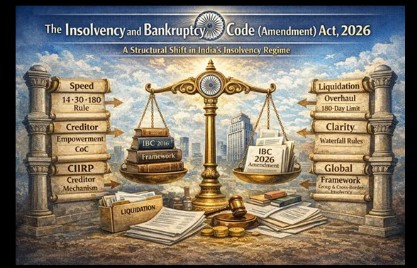
The amendment reinforces the 14-day timeline for admission of insolvency applications and mandates that any delay must be supported by written reasons, thereby introducing accountability at the entry stage. It also narrows the scope of admission by emphasising a default-based determination, limiting the use of preliminary objections and dilatory tactics.
CIIRP:
A significant structural change is the introduction of a creditor-initiated insolvency resolution process (CIIRP), enabling creditors to drive restructuring without necessarily undergoing the full CIRP framework. This is complemented by a stronger emphasis on the primacy of the Committee of Creditors (CoC), with reduced scope for judicial interference in commercial decisions.
Withdrawal:
The amendment further regulates the withdrawal of insolvency proceedings, ensuring that the process is not misused as a settlement tool.
Statutory dues:
Crucially, an Explanation to Section 3(31) clarifies that a “security interest” must arise from a contractual arrangement between parties and cannot be created solely by operation of law. As a direct consequence, government dues secured by statutory charges are excluded from the category of secured creditors under Section 53, thereby settling longstanding disputes on priority.
Implications:
First, the admission stage is transformed into a time-bound and disciplined gateway, reducing uncertainty and curbing procedural delays. The requirement to record reasons introduces a “comply or explain” framework, enhancing judicial accountability without imposing rigidity.
Second, the reforms significantly strengthen the position of financial creditors. With clearer priority rules and enhanced control through the CoC and CIIRP, creditors are now better equipped to drive resolution outcomes.
Third, the clarification on security interest brings certainty to the waterfall mechanism by eliminating competing claims based on statutory charges. Government dues are effectively repositioned as lower-priority claims, improving recovery prospects for secured lenders and reducing litigation.
TaxByte by CA Aniket Kulkarni



















Leave Your Comment