


The mercury is not merely rising; it is screaming. A chilling—or rather, blistering—statistic recently surfaced, revealing that among the fifty hottest locations on the planet, a staggering twenty are currently in India. As cities across Maharashtra, Chhattisgarh, and Uttar Pradesh record temperatures that push the boundaries of human endurance, the nation finds itself gripped by a heatwave that is as much a humanitarian crisis as it is a meteorological one. From the sweltering streets of Akola to the sun-baked plains of central India, the "heat-health" nexus is under unprecedented strain. Yet, as the country navigates a pivotal election season across states like Kerala, Tamil Nadu, Assam, West Bengal, and the Union Territory of Puducherry, a glaring, icy silence persists in the corridors of power. While the citizens are physically burning, the political manifesto—the very blueprint of future governance—remains remarkably indifferent to the existential threat of climate change.
The irony is as thick as the humid air in Kolkata or the dry heat of Chennai. In these crucial electoral battlegrounds, millions of voters are lining up under a relentless sun to cast ballots for leaders who will determine their fate for the next five years. However, a deep dive into the manifestos of major political parties reveals a landscape barren of green policies. We see promises of freebies, debates over identity politics, and grand infrastructure projects, but the mention of "Climate Change" or "Environmental Resilience" is relegated to a footnote, if it appears at all. This disconnect is not just a lapse in judgment; it is a fundamental failure of vision. If the very people vying to govern a nation that houses nearly half of the world's most heat-stressed cities do not prioritize environmental protection in their core agenda, one must ask: what exactly are they planning to govern in a future of uninhabitable landscapes?
The situation in states like Kerala and Tamil Nadu is particularly poignant. These regions have already begun to experience the erratic wrath of climate change, from devastating floods to coastal erosion and unpredictable monsoons. In Assam and West Bengal, the ecological fragility of the Sundarbans and the Brahmaputra basin is a ticking time bomb. One would expect that in such vulnerable geographies, political parties would compete to offer the most robust "Green Manifesto," detailing plans for urban cooling, water conservation, and renewable energy transitions.
Instead, the discourse remains trapped in the immediate and the populist. By failing to integrate climate action into their primary promises, these parties are effectively ignoring the "silent killer" that will outlast any single election cycle.
Governance is an act of stewardship, an agreement to protect the welfare of the people both today and tomorrow. When a political entity ignores the reality of a warming planet, it abdicates its most basic responsibility: the right to life and a healthy environment. The current heatwave is not a seasonal fluke; it is the manifestation of a global crisis that requires local, aggressive, and sustained political will. To have twenty of the world's hottest cities within our borders and yet have zero mention of climate adaptation in the heat of an election is a betrayal of the electorate. We are witnessing a peculiar phenomenon where the environment is treated as a "luxury issue" rather than a foundational survival issue.
Furthermore, the lack of environmental discourse in these elections sets a dangerous precedent for future governance. If a party does not feel the pressure to include climate change in its manifesto to win votes, it will feel even less pressure to implement green policies once in power. We are headed toward a future where "governance" might simply mean crisis management for the next drought or the next record-breaking heatwave, rather than proactive leadership. The political class seems to operate on the assumption that the environment can wait while "real" issues like the economy or social welfare are addressed. They fail to realize that there is no economy on a dead planet, and no social welfare in a city where the temperature exceeds the limits of biological safety.
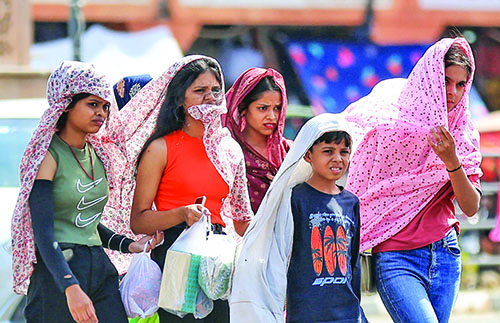
As we look at the long queues of voters in Puducherry or the bustling rallies in Assam, the physical toll of the heat is visible on every face. These citizens are entrusting their future to parties that, by their own admission in print, have no comprehensive plan to cool the rising temperatures or protect the natural resources that sustain us. It is a tragedy of priorities. The 20-out-of-50 statistic should have been a clarion call, a moment of national reckoning that forced every candidate to answer: "How will you keep us alive in this heat?" Instead, the silence continues, muffled by the loud rhetoric of traditional politics. If the environment is not on the ballot today, we will all pay the price tomorrow, in a world that is not just politically polarized, but physically unbreathable. The time has come for the Indian voter to demand that the climate be given a seat at the table, for a manifesto without a green heart is nothing more than a blueprint for a scorched future.

VIRAL DESAI
(The author is a known Environmentalist and the pioneer of Satyagraha Against Pollution movement, viraludayindia@gmail.com )
(The content of this article reflects the views of writer and contributor, not necessarily those of the publisher and editor. All disputes are subject to the exclusive jurisdiction of competent courts and forums in Delhi/New Delhi only)



















Leave Your Comment