


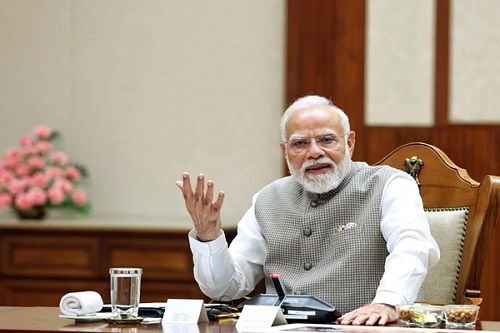
As the existing global order struggles to respond to mounting geopolitical tensions, technological disruptions and economic uncertainties, Prime Minister Narendra Modi has asserted that a new world order is taking shape, with India poised to play a decisive role in shaping its future. Emphasising collective human welfare, stronger international cooperation and reforms in multilateral institutions, Modi presented the vision of a developed India as one that would contribute not merely to national prosperity but also to a more stable, inclusive and resilient world.
Prime Minister Narendra Modi has said that the international system is undergoing a significant transformation because the established world order is increasingly unable to address the complex challenges confronting humanity. Delivering the keynote address on ‘A World Between Orders’ at a summit in New Delhi, he argued that the emergence of new powers, the rapid advancement of technology and the growing influence of previously underrepresented voices are reshaping global affairs. In this changing environment, India must strengthen its national capabilities while contributing to the collective progress of the international community.
The Prime Minister's message reflects India's ambition to move beyond the traditional role of a developing country seeking greater representation in global institutions. New Delhi increasingly seeks to participate in defining international priorities, influencing economic cooperation and contributing to solutions for shared challenges. Modi stressed that India's progress should be linked to the broader well-being of humanity, presenting national development and global responsibility as complementary objectives.
A central element of his address was the need to reform multilateral organisations so that their structures and decision-making processes reflect contemporary geopolitical and economic realities. Institutions established in an earlier era, he suggested, must become more responsive to present-day challenges. The Global South, whose countries account for a substantial share of the world's population, deserves a more meaningful voice in determining international policies. Greater representation, however, must be accompanied by institutions capable of delivering practical outcomes.
Modi also emphasised that international cooperation should not be confined to periods of stability and prosperity. Its real value becomes evident during wars, economic disruptions, humanitarian emergencies and other crises, when countries require coordinated responses rather than fragmented national approaches. His argument underlines the need for a global framework that can withstand geopolitical rivalries while continuing to address common concerns.
The Prime Minister linked India's growing international ambitions with its domestic economic transformation. Reiterating the goal of making India one of the world's three largest economies, he highlighted the country's performance as the fastest-growing major economy despite persistent global uncertainties. The vision of Viksit Bharat by 2047, he explained, should not be interpreted solely as a national development target but also as an opportunity to contribute to a better world.
His concept of “Power to Empower” places India's expanding economic and technological capabilities within a wider framework of shared progress. A stronger India, in this formulation, can help other countries through investment, innovation, technology partnerships and more resilient economic networks. The emphasis is on translating domestic growth into wider international benefits.
Self-reliance was another important theme of the address. Modi argued that India's efforts to expand domestic manufacturing and technological capabilities can strengthen global supply chains rather than isolate the country from international markets. This distinction is significant at a time when geopolitical tensions, trade restrictions and disruptions to critical supplies have prompted countries to reconsider their economic dependencies.
India's expanding role in technology and knowledge-based services illustrates this transition. Modi said the country is increasingly collaborating with the world not merely as a back office but as a brain office. He pointed to India's position as host to more than half of the world's Global Capability Centres (GCCs), which have evolved beyond routine support operations into sophisticated centres for artificial intelligence, cloud computing, engineering, data analytics and product development.
These centres reflect the growing importance of Indian talent in global innovation and decision-making. Their expansion also demonstrates how India's skilled workforce and technological ecosystem can contribute to international competitiveness. The challenge will be to sustain this progress through investment in research, education, infrastructure and advanced skills while ensuring that the benefits of technological growth reach a wider section of society.
Alongside his international outlook, Modi raised concerns about attempts to damage India's reputation. He cautioned that while the world searches for a new order, some people are seeking to create disorder within the country. Stressing the importance of projecting India as a strong and stable nation amid global turbulence, he accused political opponents of maligning the country's image, taking a swipe at the Congress over criticism voiced abroad.
The remarks introduced a domestic political dimension into an address largely focused on India's place in a changing international system. The Prime Minister's argument was that national stability and confidence are important to India's global standing, particularly when countries are competing for investment, technological partnerships and diplomatic influence.
Modi's address comes at a time when the international community is grappling with questions about the effectiveness of existing institutions, the distribution of global power and the future of economic cooperation. India's demographic scale, expanding economy, technological expertise and diplomatic relationships offer it an opportunity to influence these debates. Yet greater international influence also brings greater expectations.
The central message of Modi's speech was that India's rise should be measured not only by its economic size or geopolitical influence, but also by its contribution to humanity's shared future. His vision of Power to Empower seeks to connect national strength with international responsibility. Whether the emerging world order becomes more inclusive and stable will depend on the ability of major powers, including India, to turn such aspirations into practical cooperation.




















Leave Your Comment