


The Union Government has undertaken a significant reconstitution of the National Security Advisory Board (NSAB), appointing former Research and Analysis Wing (RAW) chief Alok Joshi as its new chairman. This move follows the recent Pahalgam terrorist attack, underscoring the government's focus on bolstering national security frameworks.
The revamped seven-member NSAB includes distinguished former officers from various branches of the armed forces and civil services. Notable additions to the board are former Western Air Commander Air Marshal PM Sinha, former Southern Army Commander Lt General AK Singh, and Rear Admiral Monty Khanna from the military services. Representing the Indian Police Service (IPS) are retired officers Rajiv Ranjan Verma and Manmohan Singh. Additionally, former Indian Foreign Service officer B Venkatesh Varma has been included, bringing a diverse range of expertise to the advisory board.
The NSAB plays a crucial role as a group of eminent national security experts from outside the government. Its members typically include senior retired officials, academics, and distinguished members of civil society with expertise in internal and external security, foreign affairs, defence, science and technology, and economic affairs.
The reconstitution of the NSAB comes in the aftermath of the tragic Pahalgam terrorist attack, which resulted in the loss of 26 lives, including one Nepalese national, and left many injured. This incident has prompted heightened scrutiny of national security measures and strategies.
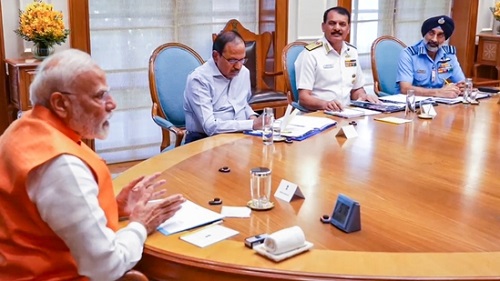
In parallel, Prime Minister Narendra Modi chaired a comprehensive Cabinet Committee on Security (CCS) meeting at his residence. The CCS meeting, along with concurrent sessions of the Cabinet Committee on Political Affairs (CCPA) and the Cabinet Committee on Economic Affairs (CCEA), underscores the government's multi-faceted approach to addressing security challenges post the Pahalgam attack.
The recent CCS meeting focused on enhancing security preparedness and reviewed detailed briefings on the Pahalgam incident. This session marks a critical step towards ensuring robust security protocols in light of evolving threats.
A cabinet briefing, scheduled for 3 pm, is expected to provide further insights into the outcomes of these deliberations, highlighting the government's proactive stance in safeguarding national interests and citizen security.
The reconstitution of the NSAB underlines India's commitment to leveraging strategic insights and expertise to fortify its national security architecture amidst evolving regional and global challenges.


















Leave Your Comment