


When India concluded its landmark AI Summit in New Delhi with 86 countries aligning with its broad vision for the future of artificial intelligence, the moment carried geopolitical as well as technological weight. It was not merely a conference of coders and policymakers; it was a declaration that India intends to shape the moral and regulatory architecture of the AI age. At the heart of this articulation was Prime Minister Narendra Modi’s M.A.N.A.V. framework for artificial intelligence — a five-point principle designed to ensure that technological advancement remains aligned with human values and national priorities. In that framework lies a crucial lens through which to examine whether AI will prove a bane or a boon for India.
Artificial intelligence, in its raw form, is neither savior nor saboteur. It is an amplifier. It magnifies existing strengths and exposes structural weaknesses. For India, a nation of immense demographic energy and deep socio-economic contrasts, AI represents both a development accelerator and a disruptive force. The decisive factor will be governance — and that is precisely where the M.A.N.A.V. principle becomes significant.
(Continued from page 24)
The first pillar, Moral and Ethical Systems, underscores that AI cannot operate in a vacuum of accountability. India’s social diversity demands algorithmic sensitivity. Biased datasets can reinforce discrimination; opaque systems can erode public trust. Embedding ethics at the design stage — rather than retrofitting regulation after damage occurs — is essential. For India, where technology often scales rapidly across hundreds of millions of users, ethical foresight is not optional. It is foundational.
The second pillar, Accountable Governance, recognizes that AI-driven systems increasingly influence decisions in finance, healthcare, law enforcement and public welfare. When algorithms guide credit approvals or detect fraud in welfare schemes, citizens must know who is responsible for errors or misuse. India’s expanding digital public infrastructure, from biometric identification to real-time payment platforms, offers fertile ground for AI integration. But scale must be matched by transparency. Accountability mechanisms will determine whether AI enhances state capacity or creates an opaque technocratic layer beyond democratic oversight.
National Sovereignty, the third principle, carries profound geopolitical implications. In the AI era, data is strategic capital. Nations that lack control over their data infrastructure risk becoming dependent on foreign platforms and computational ecosystems. India’s push for indigenous cloud infrastructure, domestic semiconductor capacity and homegrown AI models reflects a strategic understanding: sovereignty in the 21st century includes digital autonomy. By advocating this principle at the global level, India positions itself as a voice for developing nations wary of technological dependency.
Accessible and Inclusive, the fourth dimension of M.A.N.A.V., speaks directly to India’s developmental priorities. AI must not remain confined to elite urban ecosystems. Its transformative potential lies in empowering farmers through predictive agriculture tools, enabling rural healthcare diagnostics, and personalizing education for students across linguistic and socio-economic barriers. India’s multilingual landscape makes inclusive AI particularly critical. Developing language models that operate effectively in Indian languages is not only a commercial opportunity but a social necessity. Inclusion determines whether AI narrows or widens inequality.
The final principle, Valid and Legitimate, emphasizes trustworthiness. AI systems must operate within clear legal frameworks and societal norms. In a democracy, legitimacy is derived not only from technological performance but from public consent. As deepfakes and AI-generated misinformation proliferate, safeguarding electoral integrity and public discourse becomes urgent. Legitimacy ensures that innovation does not erode democratic foundations.
Viewed through M.A.N.A.V., AI’s promise for India is immense. Economically, AI can catalyze productivity gains across sectors. Manufacturing efficiency, supply chain optimization and fintech innovation can accelerate growth. Startups developing AI-driven solutions for global markets signal India’s growing foothold in the technology’s frontier. The country’s established IT talent pool provides a springboard for higher-value AI research and deployment. If nurtured strategically, AI could become the next major pillar of India’s export economy.
Yet risks remain tangible. Automation threatens employment in routine cognitive and service sectors. India’s workforce transition must be managed with foresight. Reskilling programs, digital literacy campaigns and industry-academia collaboration will determine whether displaced workers find new opportunities or face prolonged insecurity. AI-driven productivity gains mean little if they are not broadly shared.
There is also the question of societal resilience. AI-enhanced surveillance tools can strengthen security but also raise civil liberty concerns. Data misuse can undermine public trust. The line between efficient governance and intrusive oversight is thin. Here again, the M.A.N.A.V. emphasis on morality and legitimacy becomes a necessary safeguard.
India’s global outreach on AI governance reflects its aspiration to be a bridge between advanced economies and the Global South. Securing alignment from 86 countries indicates diplomatic influence, but it also places responsibility on India to demonstrate that ethical AI at scale is possible in a democracy of its size. By articulating principles rather than merely technological ambition, India seeks to differentiate its approach from purely profit-driven or authoritarian models.
The deeper question is not whether AI is inherently beneficial or harmful. It is whether India can institutionalize foresight. Can it invest sufficiently in high-performance computing and semiconductor manufacturing to sustain indigenous AI research? Can its universities produce not just coders but original thinkers in machine learning and ethics? Can policymakers stay ahead of technological velocity?
If India succeeds in embedding the M.A.N.A.V. framework into policy and practice, AI can become a powerful developmental engine. It can modernize agriculture, democratize healthcare access, enhance governance transparency and strengthen national security. If it fails to manage displacement, bias and misuse, AI could amplify inequality and strain democratic systems.
The Delhi AI Summit and the articulation of M.A.N.A.V. suggest that India recognizes the stakes. Artificial intelligence is not merely a technological wave; it is a structural transformation of economic and political life. In asserting that AI must remain human-centric, accountable and sovereign, India has offered a normative compass.
Whether AI becomes a bane or a boon for India will ultimately depend on how faithfully that compass is followed. In the unfolding AI century, India’s challenge is not only to innovate but to ensure that innovation remains anchored in human dignity, democratic accountability and inclusive growth.

India has taken a decisive and strategic step toward digital sovereignty by migrating its flagship language AI platform, Bhashini, from a foreign cloud provider to India’s own sovereign cloud infrastructure operated by Yotta Infrastructure. This is far more than a routine IT transition; it represents a structural recalibration of where India’s critical digital assets reside and under whose jurisdiction they are governed.
The scale of this migration under the Ministry of Electronics and Information Technology (MeitY) underscores its seriousness. Over 200 terabytes of data were transferred, comprising more than 3.5 billion files, with zero data loss reported during the process. Beyond safeguarding data integrity, the transition has delivered measurable operational gains, including a 40 percent performance boost and cost savings in the range of 20 to 30 percent. These figures demonstrate that sovereignty and efficiency are not mutually exclusive; in fact, the move suggests that localized infrastructure can outperform dependency models when properly executed.
Launched under India’s National Language Translation Mission, Bhashini was designed as a multilingual AI platform to power translation and language processing across India’s diverse linguistic landscape. It serves startups, MSMEs, innovators, and public digital services, making it a foundational layer in India’s expanding digital ecosystem. Until recently, however, its underlying data infrastructure was hosted on foreign cloud systems. That dependence has now formally ended, marking a significant milestone in India’s digital evolution.
The shift matters on multiple levels. First, it reinforces data sovereignty by ensuring that Indian data remains under Indian legal and regulatory control. In an era where data is often described as the “new oil,” jurisdiction over digital assets carries strategic implications. Second, it strengthens national security and privacy safeguards by reducing exposure to foreign legal systems and potential external access. Third, it provides a substantial boost to India’s domestic technology ecosystem, giving indigenous cloud providers scale, credibility, and validation at a time when global cloud markets are increasingly competitive.
A critical backdrop to this transition is the Clarifying Lawful Overseas Use of Data Act, commonly known as the CLOUD Act. This U.S. legislation allows American authorities to request data from U.S.-based cloud companies even if that data is stored outside the United States. For governments around the world, this extraterritorial reach has raised legitimate policy concerns about jurisdiction, sovereignty, and data control. India’s move must be viewed within this broader global debate over who ultimately governs digital infrastructure.
Notably, India is not alone in rethinking cloud dependencies. The European Union has announced plans to significantly scale up sovereign cloud investments, with spending projections expected to exceed $23 billion by 2027. Initiatives such as GAIA-X aim to create a federated, secure, and European-controlled data infrastructure to reduce reliance on U.S. hyperscalers. Countries like France have already begun replacing certain American software platforms due to concerns over security, compliance, and jurisdiction.
This global pivot carries implications for major U.S. cloud providers such as Google, Microsoft, and Amazon Web Services. Government contracts are typically stable, long-term, and high-margin. As more nations localize critical workloads, these firms could face revenue pressures and a gradual erosion of dominance in sensitive public-sector segments. The cloud industry, once defined by scale and centralization, may now enter an era shaped by jurisdictional boundaries and strategic autonomy.
India has made its move, positioning digital infrastructure as an element of national capability rather than merely a commercial service. Europe is accelerating its own efforts. Together, these developments signal that the global cloud order may be entering a new phase—one where sovereignty, security, and self-reliance are as important as speed and scale.(--NK)
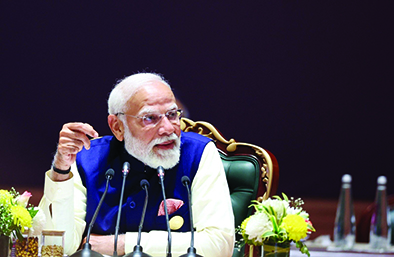
India once again demonstrated its thought leadership on the global stage when the Prime Minister presented a five-point framework for AI development called M.A.N.A.V. This was not merely a technical roadmap, but a moral manifesto for a 21st-century digital civilization. The signing of the 'Delhi Declaration' by 86 countries on this very platform is proof that India is no longer merely a consumer of technology, but a nation that sets its rules. But ironically, at the very moment India was demonstrating its intellectual maturity, some political elements within the country demonstrated their immaturity and lumpenism.
The actions of the Youth Congress workers at a global event like the AI Summit were not merely protests; they were organized imprudence and an attempt at cheap political sensationalism. This cannot be glorified as democratic dissent. This is the same 'lumpen politics' that chooses disruption over discussion, noise over thought, and drama over policy. When 86 countries are acknowledging India's leadership, damaging its international image in the name of domestic politics is not only irresponsible but also contrary to national interests.
The signatures of 86 countries on the 'Delhi Declaration' indicate that India's vision is gaining global support. This is the same India that once followed technical standards, but is now becoming a standard-setter. At such a time, it was the opposition's responsibility to debate policy, offer suggestions, and present alternative perspectives. But if the level of politics falls so low that even the global stage is turned into an arena for internal frustration, it is not a healthy tradition of democracy but a contempt for it.
Protest is the soul of democracy, but anarchy is its disease. The actions of the Youth Congress have raised the question: do some political parties view technological progress and national achievements solely through the lens of power struggles? If every national initiative is surrounded by distrust and obstruction, the message will resonate not only within the country but also globally.
India is adding a voice of ethics, sovereignty, and inclusion to the global AI debate. The M.A.N.A.V. vision embodies this confidence. What happened next couldn't challenge that confidence, but it certainly demonstrated how wide the chasm between a positive agenda and negative politics has become. The question is whether we will surrender 21st-century India to the politics of noise, or advance the politics of ideas and vision. Time will answer this, but for now, the picture is clear—the world is listening to India, and some are still busy obstructing.

Nilabh krishna
(The content of this article reflects the views of writer and contributor, not necessarily those of the publisher and editor. All disputes are subject to the exclusive jurisdiction of competent courts and forums in Delhi/New Delhi only)




















Leave Your Comment