


The battle for power in Tamil Nadu is shaping up to be one of the most closely fought contests in recent political history, with a latest opinion poll suggesting a razor-thin margin between the two major alliances. According to a survey conducted by Matrize, the National Democratic Alliance (NDA), led by the All India Anna Dravida Munnetra Kazhagam, holds a slight advantage over the INDIA bloc spearheaded by the Dravida Munnetra Kazhagam.
The Matrize opinion poll predicts that the NDA could secure between 107 and 120 seats in the 234-member Assembly, placing it marginally ahead of the DMK-led alliance, which is projected to win between 102 and 115 seats. Though the difference is narrow, it signals a potentially intense electoral showdown.
A notable factor in this election is the emergence of Tamilaga Vettri Kazhagam, led by actor-turned-politician Vijay. The party is expected to make a significant debut, winning anywhere between five and 12 seats, potentially influencing the final outcome. Other smaller parties may collectively secure one to six seats.
The vote share projections further underline the competitive nature of the race. The NDA is expected to garner around 40 per cent of the vote, closely followed by the DMK-Congress combine at 38 per cent. TVK may capture a substantial 16 per cent vote share, while others are likely to account for the remaining six per cent.
The opinion poll also highlights varied regional dynamics:
These figures suggest that while the NDA may have an edge in several regions, the DMK alliance retains strongholds, particularly in urban centers like Chennai.
The NDA coalition in Tamil Nadu includes the AIADMK, Bharatiya Janata Party, PMK, AMMK, TMMK, SIFB, Tamil Maanila Congress (Moopanar), IJK, PBK, and PNK. On the other hand, the DMK-led alliance comprises the Indian National Congress, DMDK, VCK, CPI(M), CPI, IUML, MDMK, among others.
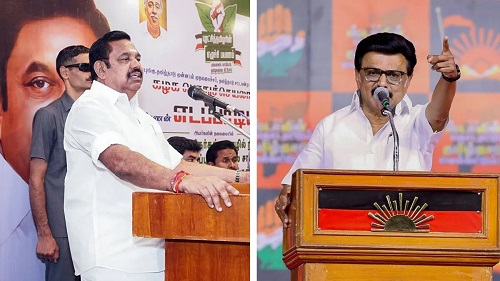
The election is poised to be a direct contest between the AIADMK-led NDA and the DMK-led INDIA bloc. Chief Minister M. K. Stalin remains confident of retaining power, aiming for a second consecutive term. Meanwhile, the NDA has intensified its campaign efforts, with top leaders including Prime Minister Narendra Modi and AIADMK leader Edappadi K. Palaniswami actively rallying support.
Voting for the Tamil Nadu Assembly elections will take place in a single phase on April 23, with results to be declared on May 4 by the Election Commission of India.
Tamil Nadu’s electoral history adds further intrigue to the upcoming contest. In 2016, the AIADMK secured a decisive victory with 134 seats, while the DMK won 89. The trend of alternating governments was broken that year.
However, in 2021, the DMK staged a strong comeback, winning 133 seats and ending the AIADMK’s rule. Its allies, including Congress and VCK, also performed well, while the AIADMK’s tally dropped significantly to 66 seats.
With both alliances nearly neck-and-neck and a strong third force in TVK, the 2026 Tamil Nadu elections promise high drama and unpredictability. As campaigning intensifies, the final outcome may hinge on regional swings, alliance cohesion, and voter turnout in what could be one of the closest contests the state has witnessed in decades.



















Leave Your Comment