


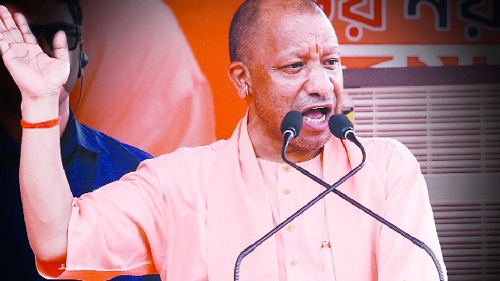
Uttar Pradesh Chief Minister Yogi Adityanath on Wednesday launched a sharp political attack on the Trinamool Congress (TMC), accusing it of presiding over a steep industrial and economic decline in West Bengal. Addressing an election rally in Burrabazar, he claimed that the state, once regarded as a national hub of industry, education, and culture, has significantly fallen behind due to years of alleged misgovernance.
Adityanath asserted that more than 7,000 large industries have shut down during the tenure of the TMC government led by Mamata Banerjee. He further alleged that thousands of Micro, Small and Medium Enterprises (MSMEs) have also ceased operations, resulting in job losses affecting nearly 30 lakh youth. Describing the situation in stark terms, he said the state has turned into a “graveyard of industries,” a claim likely to intensify political debate ahead of elections.
The Uttar Pradesh Chief Minister also invoked the legacy of Rabindranath Tagore, bringing cultural symbolism into the political discourse. Referring to Tagore’s ancestral home at Jorasanko Thakur Bari, Adityanath accused the ruling party of disrespecting Bengal’s heritage. He alleged that political posters featuring the Chief Minister were displayed within the historic premises, calling it inappropriate and an affront to the legacy of the Nobel laureate.
He argued that such iconic cultural spaces should celebrate national heritage and figures of historical significance rather than serve as platforms for political promotion.
Framing his speech around the theme of revival, Adityanath called for a change in government in West Bengal, suggesting that only a “double-engine government” — a term often used to describe the same party ruling both the state and the Centre — could restore the state’s lost economic prominence. He also invoked the 150th year of Vande Mataram, urging citizens to reclaim Bengal’s historic leadership in national development.
Beyond economic concerns, Adityanath raised issues related to cultural identity and religious practices. He alleged that Bengali traditions and linguistic heritage were being sidelined under the current regime. Additionally, he accused the TMC government of imposing restrictions on religious processions and festivals such as Durga Puja and Kali Puja.
He also criticized the party’s stance on matters of faith, referring to opposition over the construction of the Ram Temple Ayodhya, and questioned its approach toward religious sentiments.
Adityanath’s remarks signal an intensification of political rhetoric as elections approach in West Bengal. While the TMC has consistently rejected such allegations, highlighting its governance record and development initiatives, the exchange underscores the sharp ideological and political divide between the ruling party in the state and its challengers.
As the campaign unfolds, issues of industrial growth, cultural identity, and governance are expected to remain central to the political narrative, shaping voter discourse in one of India’s most politically dynamic states.



















Leave Your Comment