


Among the so-called controversial nominations for the top positions in his second Administration that will commence on January 20, 2025, one happens to be former Army National Guard major and former Fox News host Pete Hegseth , President-elect Donald Trump’s choice for the Secretary of Defense.
Hegseth happens to be a decorated veteran who served as an Army National Guard infantry officer with tours in Afghanistan and Iraq and at Guantánamo Bay, Cuba. Apart from being a television-host , he is a prolific writer. He has published five books since 2016, of which two particularly deal with the American defense - “ Modern Warriors” in 2020 and “ The War on Warriors: Behind the Betrayal of the Men Who Keep Us Free” in June this year.
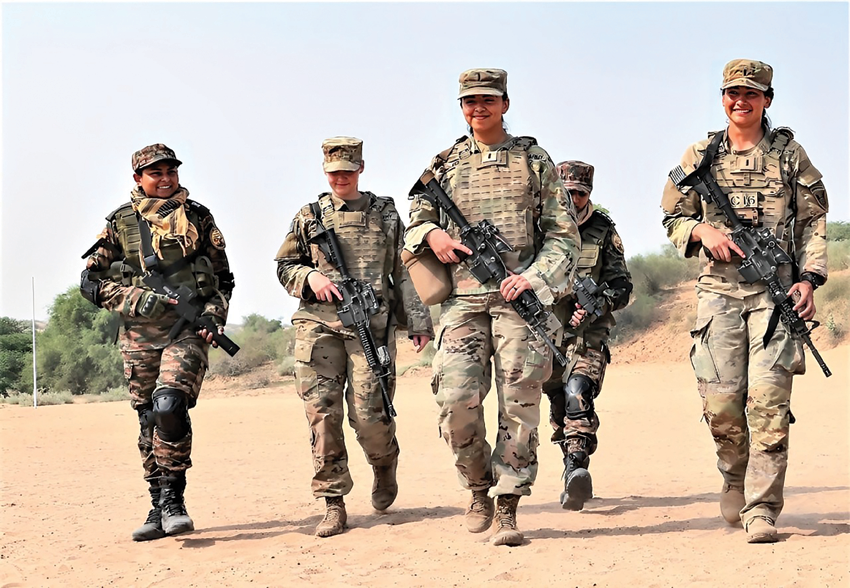
However, his critics, most of them being Left/Liberals and from Democratic party, are not impressed. And that is mainly because of his strong view that women soldiers should not be allowed to fight on the front lines. He seems to have reignited a debate on the topic of “the role of women in the armed forces” that many thought had been long settled under the principle of complete equality.
Incidentally, this topic has also resurfaced in India with a five-page letter last month on “command by women officers” — written by corps commander Lieutenant General Rajeev Puri to Eastern Army Commander Lieutenant General Ram Chander Tiwari. The letter cites an “in-house review” by the force’s Panagarh-based 17 mountain strike corps of a “pragmatic performance analysis” of eight women commanding officers (COs) under the Brahmastra Corps.
Lieutenant General Rajeev Puri’s recommendation is that the focus should shift from “gender equality” to “gender neutrality” as far as women warriors are concerned, given the increase in the number of officer management issues in units commanded by women officers in the last one year.
Predictably, women officers and many military analysts in India have found General Puri’s letter “highly disturbing”. And this is something Hegseth’s increasing critics in America also seem to share with. They are now urging the Republican Senators to reject the nomination of a “reactionary streak”like Hegseth as the Defense Secretary by Trump.
Let us see what Hegseth has said in his shows and interviews and written in his books to conclude that the military should not lower standards for women to enter combat jobs.
“Women shouldn’t be in combat at all,” Hegseth is reported to have said in a recent interview. “They’re life-givers, not life-takers. I know a lot of wonderful soldiers, female soldiers, who have served, who are great. But they shouldn’t be in my infantry battalion.”
For Hegseth, allowing women to fight has led to more casualties on the battlefield. “Everything about men and women serving together makes the situation more complicated, and complication in combat, that means casualties are worse”.
Of course, Hegseth’s ideas of women in armed forces can be said to go along with his overall thesis of his book, “The War on Warriors: Behind the Betrayal of the Men Who Keep Us Free” that the U.S. military has become “too woke, too effeminate, and too vaccinated to be fit for purpose” under the promotion of DEI( Diversity, Equity and Inclusion) project.
He dislikes transgender service members, and trans people and would like to restore “don’t ask, don’t tell (DADT),” the military’s former prohibition on people serving while openly gay, lesbian, or bisexual. “The establishment of DADT, and then ending of DADT, were just policy footholds for radical Leftists, hell-bent on even more radical social change — a full-frontal attack on almost every institution of the military,” he wrote in “The War on Warriors”.
However, it is to be noted that Hegseth is not opposed to the entry of women in non-combat roles but against their serving in jobs such as SEALs, Army Rangers, infantry, armor and artillery where he thinks “strength is a differentiator.” He disapproves of the decision of the then Defense Secretary Ash Carter’s order in late 2015 that the military should open all military jobs to women.
It is equally noteworthy that Carter’s decision was opposed by the Marine Corps, but in vain. Even “Special operations forces” in surveys done in 2015 and more recently, said women did not have the physical or mental strength to serve in elite commando units and doing so could hurt the units’ effectiveness and lower the standards.
If one goes back to history a little further , women have been in combat roles for the better part of three decades beginning in 1991 and 1993, when Congress repealed the law barring women from combat aircraft and ships, respectively. That was followed by the Navy in 2010 reversing its policy banning women from submarines, and the 2013 repeal of the Combat Exclusion Policy, allowing women to serve in ground combat units. And then came Carter’s decision in 2015 that opened all military combat positions to female service members.
Apparently, such progress has allowed women to fill about 220,000 jobs previously off-limits to them, such as special operations, infantry, armor, and reconnaissance units. Today, women account for about 17.5 percent of the military’s active-duty force, according to 2022 data from the Defense Department.
However, the women soldiers in America do need to qualify and meet the standards like their male counterparts. The Army and all of the branches still require women to pass strict fitness tests if they want to take on the most physically challenging specialty jobs, like an Army Ranger or Green Beret. And here, only a small number of women have been able to meet the rigorous physical requirements to join those elite ranks.
Reportedly, only about 4,800 women in the U.S. are currently qualified for Army infantry, armor, and artillery jobs. The standard still demanded of the most elite combat roles means that the Navy’s Special Warfare combat crew has only two women and the Air Force’s special-operations team has three.
Here, the Indian counterparts of the American women warriors are luckier. In 2023, the Indian Supreme Court decided that fitness of women officers could not be equated with that of the men. India’s top court said that the requirement that the women officers must have the same fitness standards which are mandated for 25-year-old male officers is “based on gender stereotypes and societal notions on gender roles that men are physically stronger while women are weak and submissive”. In the process, it allowed permanent commission in the armed forces to women officers who were disqualified earlier because of lack of fitness that the men-officers displayed.
Accordingly, the Indian Army has broken the glass ceiling by assigning women officers to command roles outside the medical stream for the first time. The Indian Air Force(IAF) and the Navy also allow its officers the command roles in fighter planes and submarines.
As per the available data , the total number of women serving in the Indian Army is 7093, of which 6993 happen to be officers. The IAF, where women join only as officers, the number is 1636. The Navy also recruits women only as officers. The strength of women officers in the Indian Navy is 748, including Medical and Dental officers.
Obviously, the number of women serving in the Indian armed forces is a miniscule, given its total military manpower that is said to be the fourth most potent military force of the world, estimated to be 1.4 million.
The same seems to be the case of the U.S., the world’s foremost military power, too. Women make up about 17 percent of the total force in the United States military that is estimated to be 1.5 million, and they are said to be underrepresented in many branches.
Viewed thus, the number of women warriors, whether in India or in the U.S. or in any other is not something that is as worrisome as the critics make out to be. In fact, as Gary Anderson,who lectures on Alternative Analysis at the George Washington University’s Elliott School of International Affairs, has pointed out , the number of women who seek combat roles and meet the physical qualifications is itself very low. So giving women a combat role is not a big issue unless they are “forced into combat units involuntarily in large numbers”.
Even the critics, mostly conservatives, whether in the United States or in India, are not opposed to the entry of women officers into the military as such. They are particular about the combat -roles the women officers should play . As it is, the doors of the military were always open for women doctors and nurses for permanent services. Gradually more and more were co-opted into what are called passive roles, not active combat duty as seems to be the propagated case now.
Their argument is that combat duties for women in remote, inhospitable and uncongenial areas is not desirable as only physically fit and tough troops can survive here. Besides, there are other issues like the vulnerability of captured female soldiers to rape and sexual torture.
In this context, analyst Mrinal Suman, a retired Major General of the Indian Army, makes an interesting point. According to him, the need for physical effort is dictated by two factors - level of technological development and nature of military’s involvement. Requirement for physical prowess undoubtedly reduces as the armed forces advance technologically.
In other words, the quantum of physical effort needed is inversely proportional to technological progression. Thus, as a military evolves technologically, more high-tech jobs get generated where technically qualified women can be gainfully employed. In a high-tech force, a woman sitting in a secure urban centre can effectively guide drone attacks in places or countries that are thousands of kilometers apart.
On the other hand, low-tech militaries are always human-power intensive and depend on extensive physical ground effort, and hence do not lend themselves to useful employment of women, Suman argues.
Viewed thus, even if Hegseth’s nomination for US Defence Secretary is confirmed by the Senate, ever-rising technological modernization of the U.S. military will have enough space for its women officers to determine the course of wars that Washington will be fighting.

By Pakash Nanda
(prakash.nanda@hotmail.com)














Leave Your Comment