



Suresh Manchanda
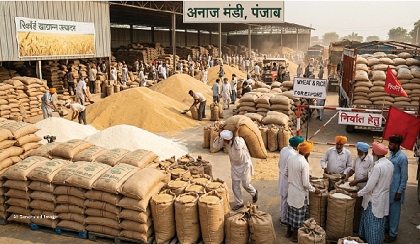
India has today emerged as one of the world’s largest foodgrain economies. Over the last few years, the country has consistently achieved record production of wheat, rice, and maize, sending a strong message to the world that India is no longer merely a nation capable of feeding its 1.4 billion people, but is now also in a position to play a decisive role in global food security. However, the key question remains — does record production alone guarantee food security?
Can situations such as global wars, El Niño, climate change, rising crude oil prices, and worldwide economic instability once again push India toward banning wheat and rice exports?
This question becomes even more significant because after achieving record production in
2025-26, India fully reopened rice exports and, in 2026, also permitted the export of 5 million tonnes of wheat along with 1 million tonnes of wheat-based products. Simultaneously, the government removed stock limits on wheat, signaling to the market that India was in a
completely secure foodgrain position. Yet, the developments currently unfolding in global markets are sending serious warning signals for the future.
Russia-Ukraine War and the First Major Shock to Global Food Markets
When the Russia-Ukraine war began in 2021-22, the world faced not only an energy crisis but also a major disruption in foodgrain supplies. Russia and Ukraine are among the world’s largest wheat exporters. Due to the conflict, wheat shipments from the Black Sea region were severely disrupted, leading to a historic surge in global wheat prices.
India also witnessed a direct impact. Domestic wheat prices rose sharply and touched ₹3,300 per quintal. For the first time, Indian farmers and traders felt that Indian wheat could compete effectively in international markets. As a result, India exported a record 7.2 million tonnes of wheat during 2021-22. This was a major achievement because India had historically played only a limited role in global wheat trade.
However, another concern simultaneously emerged. Wheat flour and wheat prices in the
domestic market began rising rapidly. The government feared that continued exports could fuel food inflation within the country, directly affecting poor consumers. This was the primary reason why India suddenly banned wheat exports in 2022-23. Later, several restrictions were also imposed on rice exports.
At that time, the government’s decision was both politically and economically significant because food inflation in India is not merely an economic issue; it is closely linked to social stability and political sentiment.
Rising Concerns Despite Record Production
India once again created history in 2025-26. Rice production crossed 154 million tonnes, making India the world’s largest rice producer. Wheat production crossed 120 million tonnes, while maize production exceeded 44 million tonnes. At first glance, it appeared that India had become a fully food-secure nation.
Based on these production figures, the government reopened rice exports, allowed wheat exports, and removed stock limits. However, at the same time, several worrying signs began emerging in global markets.
Weather conditions started deteriorating in many major producing countries. Nations such as the United States and Australia began facing the impact of El Niño and weak monsoon conditions, raising fears of lower production. Estimates suggested that wheat output in these countries could decline by 15-20 percent. Russia too began facing uncertainty regarding production levels.
In India, meteorologists projected an 82 percent probability of El Niño conditions, increasing fears of a weak monsoon. Lower rainfall would directly impact kharif crops, especially paddy. And if rice production suffers, wheat production in the following rabi season could also come under pressure.
The biggest concern is that this year’s El Niño is being described as a “Super El Niño,” meaning its impact may not remain limited to a single season but could continue affecting agricultural production until 2027.
Is India Heading Toward Another Crisis?
The biggest question before India today is whether it is wise to leave exports completely unrestricted merely because current production is at record levels. Or should the government remain cautious considering future risks?
At present, India’s buffer stock is almost three times the required level. Warehouses of the Food Corporation of India are overflowing. Yet history shows that food crises emerge suddenly. The global food crisis of 2007-08 remains the biggest example, when rice prices surged dramatically worldwide and food riots were witnessed in several countries.
If India aggressively exports foodgrains and production declines over the next one or two years, the government could once again face a difficult situation.
The Threat of El Niño and Climate Change
Indian agriculture still remains heavily dependent on the monsoon. Although irrigation infrastructure has improved significantly in many regions, rainfall continues to play a crucial role, especially for crops like paddy, pulses, oilseeds, and maize.
During El Niño years, India generally experiences weak monsoons, lower rainfall, rising
temperatures, and drought-like conditions. This impacts not only crop production but also crop quality.
If rice and wheat production decline even by 10-15 percent, the consequences will not remain limited to domestic markets. India is the world’s largest rice exporter. Any reduction in Indian exports could trigger an explosive rise in global prices.
Similarly, wheat is increasingly being affected by rising temperatures. Over the past few years, unusual heat during March has damaged wheat crops. Hot winds have arrived earlier than
normal, resulting in smaller grain size and lower yields.
If such conditions continue over the next two years, India’s record production levels could fall sharply.
Impact of Global Wars and Economic Instability
Foodgrain markets are influenced not only by weather but also by geopolitical developments. Today, tensions between Iran and the United States, along with instability in the Gulf region, are beginning to impact the global economy.
Crude oil prices are rising. The US dollar is strengthening. Transportation costs are increasing. All of this will inevitably affect foodgrain markets.
Costlier diesel means higher farming costs. Fertilizers become more expensive. Transportation expenses rise. Eventually, food prices increase.
Russian wheat prices have already touched their highest levels in a year. The United States is reportedly witnessing one of its weakest production periods since 1980. Australia continues to struggle with adverse weather conditions.
Under such circumstances, if India continues large-scale exports, domestic markets may also come under inflationary pressure.
Will the Government Impose Export Restrictions Again?
This is currently one of the biggest questions among traders, farmers, and importing nations.
If the monsoon remains weak in the coming months, paddy sowing gets affected, and international prices continue rising sharply, the government may be left with very limited options.
The government will need to control inflation, provide subsidized food to millions, and maintain a strong public distribution system.
In such a situation, wheat and rice exports may once again face restrictions, or at least a quota- based export system may be introduced.
India has taken such decisions before, and if conditions deteriorate again, similar measures may become unavoidable.
Rising Inflation in Pulses and Edible Oils
The issue is not limited only to wheat and rice. Prices of chickpeas, pulses, and edible oils are also rising rapidly.
In just one month, wholesale prices of several pulses have increased by more than 15 percent. Edible oil prices are already elevated.
If weather conditions worsen and production declines, the government may again be forced to reduce or remove import duties on essential commodities.
This means that the coming years could pose challenges not just to foodgrain security but to the entire food economy.
Growing Concerns Among Gulf Countries
The Iran-US conflict is having a particularly strong impact on Gulf nations. These countries have always remained serious about food security because of their limited domestic agricultural capacity.
However, Gulf nations are now moving beyond short-term imports and focusing on long-term food security strategies.
They are purchasing agricultural land overseas, increasing investments in India, Africa, and Asia, and expanding food storage infrastructure.
This clearly indicates that the world is beginning to view foodgrains not merely as tradable commodities but as strategic assets.
(The content of this article reflects the views of writer and contributor, not necessarily those of the publisher and editor. All disputes are subject to the exclusive jurisdiction of competent courts and forums in Delhi/New Delhi only)



















Leave Your Comment