



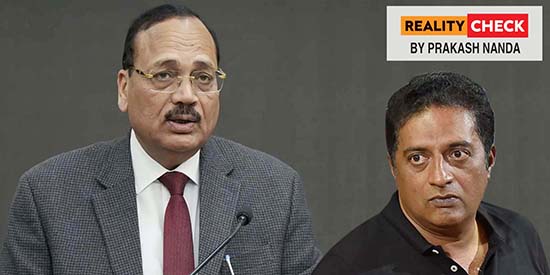
I have great respect for our Chief Justice Surya Kant, though I have had serious differences with some of his judgments and remarks in the past. One such occasion was his decision, along with Brother Judge J.B. Pardiwala, on July 1, 2022.
But now that his decision is a landmark, my simple request to him is that he should apply the same yardstick and take a similar decision on a person, a leading actor, this time.
In 2022, Justice Kant and Justice Pardiwala were hearing a case pertaining to the former BJP spokesperson Nupur Sharma. She had gone to the Supreme Court demanding that FIRs registered against her across the country should be clubbed together and transferred to Delhi.
The two Justices not only refused her plea but also said that Nupur Sharma's "loose tongue" had "set the entire country on fire", and that her comments were either for cheap publicity, a political agenda, or some "nefarious" activities.
However, many thinking citizens of the country were shocked by the decision of Justices Kant and Pardiwala. Fifteen ex-judges, 77 former bureaucrats, and 25 retired officers of the armed forces had written a letter to the then Chief Justice C V Ramana, criticising the Court’s comments against Nupur Sharma.
What was the “crime” of Sharma? During a May 2022 Times Now debate on the Gyanvapi Mosque dispute, she had made remarks about Prophet Muhammad and his wife Aisha, citing Islamic texts in response to taunts about the Hindu deity Shiva. When a Muslim participant in the debate made a nasty description of “Shiva Linga”, Sharma referred, in reply, to the fact that Prophet Muhammad married Aisha when she was six and consummated the marriage when she was nine. She also made remarks about Islamic doctrines, including a reference to the flying horse (Buraq) and a comment regarding the earth being flat.
Her point was that we should respect basic beliefs about every religion, but if you question others’ religion, be prepared to hear things about yours.
However, the two justices seemed to go by the narrative that in this country, those who practiced Islam were deeply hurt by what Nupur said, though what she had said was written in the Hadith, and apologised if her words hurt religious sentiments, subsequently withdrawing her statement.
And that brings me to what the other day actor Prakash Raj said in a literature festival in Kerala. Talking of what he said, “fiction” Ramayana, he portrayed Ram and Lakshman as North Indians eating fruits from South Indian tribal leader Ravana's land without permission. His speech, aimed at criticising North-South political divides, included satirical references to a "₹2000 GST bill" and, in another comment, he suggested people in the South should eat beef, causing outrage and allegations of insulting Hindu sentiments.
There is no two opinions that Prakash Raj has been relentlessly, in the past few years, mocking at Hindus, North Indians, and the BJP.
Prakash Raj, incidentally, is a Christian.
Now that he is the Chief Justice, will Justice Surya Kant measure Prakash Raj by the same yardstick that he did in the case of Nupur Sharma? I doubt whether he will.
As I have written over the years, “secularism” as an idea in India has become so perverse that there is one set of rules for the majority Hindus and another set of rules for minorities—one can lambast Hindu beliefs, but he or she has to be very sensitive when matters pertain to minorities. The government can make and regulate laws for Hindus and their places of worship, but it cannot dare to touch the minorities, particularly the Muslims.
Indian “secularists” can demand that Nupur Sharma should be hanged for saying that the Prophet had married a 6-year-old girl, but their friend Zubair Mohammad must be admired for asserting his freedom of expression or opinion of ridiculing “Shiva Linga” (which prompted Nupur to say about the Prophet). They find almost everything associated with Sanatan Dharma abhorrent to the extent that they applaud or are conspicuously silent when some politicians call for its obliteration or “eradication” like “mosquitoes, Dengue, Malaria, fever, and Corona”. But for them, heaven will fall if one points out a word of criticism against other regions.
According to Professor Geoff Haddock at Cardiff University, UK, who specialises in Social Psychology, the rise of progressivism is an “era-defining shift” within the political left. “Until recently, left-wing ideology had been dominated by traditional liberalism, which advocates for equality through persuasion and consensus-building across voting blocs. More recently, progressivism has challenged this view, emphasising political activism within, for example, racial and cultural identities. Differences between these factions have played out across social media (e.g., “cancel culture”), academics (e.g., “de-platforming” campus speakers), and electoral politics (e.g., “Establishment Democrats” vs. “The Squad” in the U.S. Congress)", he wrote.
Indian progressives are also displaying the same mindsets. For them, Muslims and Dalits can never be wrong, and Modi or any proud Hindu and nationalist can never be right. They can never accept that despite severe challenges, India has progressed on many fronts in the last few years. They do not believe in unity and consensus. This intolerance manifests as a professed preference for avoiding others with different values, a stance entirely antithetical to liberal values.
Progressives explicitly endorse the view that free speech can harm “marginalised” groups and often will impede progress toward equality. And ironically, the best way they justify all this is by calling all those holding divergent views from them as fascists and right-wingers. It is like a whore extolling the virtues of chastity!
In fact, I have heard many so-called progressives openly say that free speech is a dangerous thing, as right-wingers can cause great harm to the poor and underprivileged by using this right. Like this – “See the way they are criticising the caste census and reservations for the Muslims. See how they are against same-sex marriage. See how they are against opening India’s borders for the Rohingyas. See how they are against the restoration of Article 370”.
No wonder why it is becoming increasingly common for such progressives to shut down public discourse, disrupt speeches, tear down posters, censor, and deplatform those with whom they disagree. Even in social media such as YouTube tends to block and silence anything that is pro-Hindu, anything that criticises anti-Hindu remarks, and anything that is perceived( not the reality) to be against Islam and Christianity.
I hope and pray that our Chief Justice is not such a progressive and will take suo moto action against Prakash Raj.
---------


















Leave Your Comment