



Shekhar Iyer
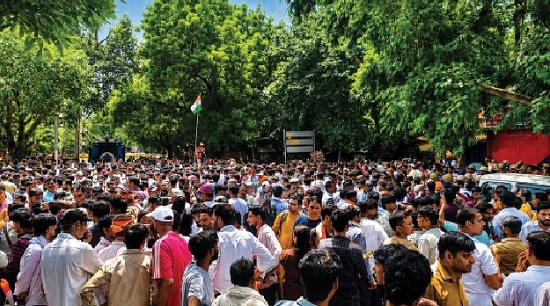
On August 21, hundreds of protesters gathered at Jantar Mantar in New Delhi under the banner of "Reservation Hatao Andolan (RHA)." It was a Cockroach Janata Party-style mobilisation of anger against the reservation policy. As it was an Instagram-page-led move, many people, including the police, were again taken by surprise.
On the Instagram page, the RHA posted five demands. These were: income-based reservation; one family, one reservation — arguing reservation should only be available for one generation of a family; minimum qualifying marks for examinations and de-reserving unfilled reserved seats; a freeze on the 50% cap on reservations, a ban on political parties promising increased reservation, and periodic review of lists of communities that can qualify for quotas; and a sunset clause that provides an end date for reservations.
The protesters also called for an overhaul of the reservation system, demanding that quotas in public education and employment be based solely on income rather than socio-economic categories.
They also called for the government to roll back the UGC’s 2026 caste-equity rules, which were seen as biased against the non-reserved categories of students.
Apparently, the anti-quota stir began when a student, Harsh Dubey, started the RHA Instagram page. Later, Dubey handed over control of the anti-reservation Instagram page to other anti-reservation and general category activists -- Anuradha Tiwari, Ajeet Bharti, and Neha Das, taking cues from the student movement led by the Cockroach Janta Party, which succeeded in securing the resignation of Education Minister Dharmendra Pradhan-- for the leakage of the NEET examination papers. Soon after,
rallies surfaced across cities including Lucknow, Jaipur, and Nagpur, drawing attention to perceived flaws in the existing quota framework.
New avatar of anti-Mandal movement?
The new avatar of the anti-reservation outbursts has emerged amid competitive politics in India over securing reserved-category votes. The Modi government has often reiterated that reservations for socio-economic categories such as Scheduled Castes, Scheduled Tribes, and Other Backward Classes were not just a poverty alleviation scheme. They were an affirmative step meant to ensure representation for marginalised communities that have suffered social, economic, and educational backwardness for generations. The BJP has been wooing OBCs and Dalits aggressively ever since Rahul Gandhi steered the Congress to secure better numbers in the 2024 Lok Sabha polls, playing a pro-OBC-Dalit card to the hilt.
In fact, after the BJP suffered a setback in recent bypolls in August, the Union government told the Supreme Court it was rethinking the 2026 UGC equity regulations, which had sparked a wave of protests on campuses in January this year.
Non-reserved category students were upset that the government bowed to CJP founder Abhijeet Dipke, who arrived in India from the US to become the face of a national movement after the outrage over the leakage of the NEET examination papers.
The anti-reservation leaders now say reservation was introduced in India to rectify social wrongs. In older times, those at the lowest level of the social hierarchy were the most exploited and disadvantaged. Because of the social norms of the time, they found it difficult to overcome their state. To encourage them to grow and bring them on par, reservations in education and jobs were given to them. But the situation has improved a lot over the years. The once-discriminated castes have gained from what was meant for them through these reservations. Now they have acquired strong political clout and are on par with, or even better than, people from the general category.
On the other hand, they hold that people outside the reservation ambit are now at a disadvantage. Since society has reached an equilibrium in terms of caste status, the government should provide financial aid based on BPL or any other income line.
No political party will support any anti-quota talk
These anti-quota leaders know very well that, unlike in the case of the CJP movement, no political party will dare to be with them. Decades of political mobilisation by leaders of backward, Dalit and tribal groups have made it impossible for anyone to outright question the need for caste-based reservation without inviting massive backlash. Yet, they chose to voice their views, which may be deemed politically incorrect. Since the unreserved category does not command much influence as a voting bloc, they can only articulate what many youths feel: that they are out of the race for seats in educational institutes or government jobs—even though their scores are higher than those of the reserved category.
But, by doing so, they hope to stir the unreserved sections of society to unite and give voice to their plight in the race for diminishing numbers of seats in educational institutions and jobs.
It is no surprise that senior political leaders, whose support base depends entirely on the reserved sections, are alarmed by the developments. Congress President Mallikarjun Kharge accused the BJP-led NDA government of trying to indirectly dismantle reservation provisions. BSP chief Mayawati criticised the agitation, stating that replacing or undermining constitutional reservations for Scheduled Castes (SCs), Scheduled Tribes (STs), and Other Backward Classes (OBCs) harms the goal of an egalitarian society. She urged governments not to protect or shelter anti-reservation elements. She also targeted Congress leader Rahul Gandhi, alleging that the party showed an "anti-reservation mindset" by failing to engage with or reason against the protesters at Jantar Mantar, which is located close to Parliament.
On the NDA side, Union Minister Chirag Paswan said caste-based reservations cannot be abolished on demand, adding that the government remains open to dialogue if anti-quota protesters present their concerns systematically. Regarding calls to prioritise economic status over caste, Paswan pointed out that the government already addresses economic disadvantage via the 10% Economically Weaker Section (EWS) quota. EWS quota applies to people not already covered by any other reservation.
Uttar Pradesh Deputy Chief Minister Brajesh Pathak met with student delegations to assure them that their concerns regarding quota reforms would reach the party's central leadership. In a joint press conference with the delegation, Pathak said, “Our government is with each and every youth. We are committed to fulfilling all their dreams. We will place their demands before the party’s central leadership. In the next two days, we will arrange a meeting of their delegation with a Union minister.”
-Ahead of the 2019 Lok Sabha polls, the Modi government enacted the Constitution (One Hundred and Third Amendment) Act, 2019, which inserted Articles 15(6) and 16(6) into the Constitution, enabling reservation of up to 10 per cent for Economically Weaker Sections (EWS) in admissions to educational institutions and appointments in civil posts and services.
Persons whose family has a gross annual income below ₹8.00 lakh are identified as EWS for the purpose of reservation, provided they are not covered under the existing reservation schemes.
However, irrespective of family income, persons whose family owns or possesses five acres or more of agricultural land, a residential flat measuring 1,000 square feet or more, or a residential plot of 100 square yards or more are excluded from being identified as EWS. That condition excludes many lower-middle-class families.
The Supreme Court’s judgement of November 7, 2019 upheld the constitutional validity of 10% reservation for EWS. It was a 3-2 majority verdict. Soon after, the DMK-ruled Tamil Nadu government decided not to implement the EWS quota. Then Chief Minister MK Stalin said the order was a setback to the century-long struggle for social justice. The DMK's reasoning was simple: voters in the non-reserved category did not matter for any poll outcome. So there was no need to placate them. In 2020, the Centre said it was the states’ prerogative whether to implement the EWS quota. Some BJP-ruled states like Chhattisgarh have not implemented the EWS quota till date.
Flashback: the first anti-quota agitation in 1985
The Mandal Commission, established in 1979, was tasked with identifying socially and educationally backward classes and recommending measures for their upliftment. In 1980, the commission proposed reserving 27% of government jobs and educational seats for OBCs in addition to the existing 22.5% reservation for Scheduled Castes (SCs) and Scheduled Tribes (STs). This would bring the total reservation to nearly 50%, a move which sparked fierce opposition, particularly among communities that won't enjoy any quota. Indira Gandhi, as the then PM, chose not to open a Pandora's Box and put it in cold storage.
However, in 1985, pressure mounted to announce reservations for OBCs based on the Mandal Commission report.
That is when we witnessed the first protest against the implementation of the Mandal Commission’s recommendations for Other Backwards Classes (OBC) quota. It soon snowballed into a nationwide agitation.
The Rajiv Gandhi-led Congress government was caught off guard by the intensity of these protests and initially delayed implementing the Mandal Commission’s recommendations. As a result, so-called upper-caste voters, feeling alienated, began shifting their allegiance to the BJP, which projected itself as a party opposing caste-based reservations. In the 1984 general elections, held after the assassination of Indira Gandhi, the Congress party won 414 out of 543 seats, largely due to the sympathy wave following her killing. The demand for an OBC quota was drowned in the sympathy wave.
The Rise of Backwards Caste Politics
The anti-quota stir by upper-caste students, however, speeded up the political mobilisation of OBCs. Leaders like Mulayam Singh Yadav in Uttar Pradesh, Lalu Prasad Yadav in Bihar, and Karpoori Thakur emerged as champions of OBC rights. Regional parties like the Samajwadi Party (SP) and Rashtriya Janata Dal (RJD) gained prominence, consolidating the OBC vote bank.
By 1989, the Rajiv Gandhi-led Congress, plagued by the Bofors scandal, lost ground. The Congress’s seat share plummeted to 197, reflecting growing discontent among both upper-caste and OBC voters.
In the 1991 general elections, the Janata Dal, a party representing OBC interests, won 59 seats, a significant increase from its previous performance. In Uttar Pradesh, the combined vote share of the SP and Bhujan Samaj Party (BSP) rose from 15% in 1989 to over 40% by the mid-1990s.
Mandal: A Turning Point
In 1990, Prime Minister V.P. Singh announced the implementation of the Mandal Commission’s recommendations, reserving 27% of government jobs for OBCs. This decision turbo-charged the political mobilisation of backward castes and the pressure built up over the delay in implementing the OBC quota. By 2000, the OBC representation in Central government jobs rose from 12% to nearly 27%. In educational institutions, the share of OBC students in premier institutions like the Indian Institutes of Technology (IITs) and Indian Institutes of Management (IIMs) increased from less than 10% in the 1980s to over 25% by the 2000s.
Once a middle-class darling, the BJP too switched to a pro-OBC mould
In the early 1990s, the BJP projected itself as the darling of the middle class. Voters from the non-reserved category rallied behind Atal Bihari Vajpayee and L K Advani as the BJP advocated for Hindutva and opposed caste-based reservations. Meanwhile, backward castes consolidated behind regional parties. In the 1991 general elections, the BJP’s seat count jumped from 85 in 1989 to 120, largely due to upper-caste support. In Uttar Pradesh, the BJP’s vote share among upper castes increased from 20% in 1989 to over 50% by the mid-1990s.
The success of Mandal politics forced the BJP to redraw its social-political strategy.
By 2014, when Narendra Modi became PM and secured a full majority for the BJP, the party leadership saw the need to woo the OBC votes across North India. Thus began the consolidation of "Mandalisation" of the BJP, where a pro-OBC tilt was given to the choice of leaders, policies, programmes and projections. However, the "Hindutva factor" ensured that the upper-caste votes remained with Modi through the 2019 elections and, to a great extent, in 2024.
Conclusion: Should reservations continue forever?
No doubt, the CJP's protest against paper leaks has provided impetus for an anti-reservation movement. This is why the protests over the NEET-UG paper leak have reopened the debate on the quota system.
Many anti-reservation agitation leaders argue that ending the reservation itself would help end caste discrimination. As the political parties have weaponised caste distinctions and differences for their electoral benefits, they cannot allow or join any public debate on the efficacy of the current quota system.
Of course, many commentators have contrasted India's reservation system with China's merit-based model and wondered whether Vikshit Bharat by 2047 is possible. Supporters of reservations have rejected arguments against caste-based reservation outright. They hold that quotas are constitutional tools intended to address centuries of caste-based exclusion. They also point out that the Supreme Court has repeatedly upheld reservations as instruments of substantive equality.
Solution: Must do the doable!
If there is political will, the problems of the reservation system can be solved by refining selection criteria to target the truly needy, limiting benefits to a single generation, and improving basic education for all. Ideally speaking, restrict reservation benefits to one or two generations per family.
All parties can agree on a few measures. Ensure that a single household does not monopolise quotas across multiple decades, allowing the advantages to spread more widely. Divide broad reserved groups (like OBCs or SCs) into smaller sub-categories. Direct benefits to the most backward sub-castes who have received little to no representation so far.
Most importantly, we must focus on primary education and skill building. Reduce inequalities at the primary and secondary school levels rather than relying only on college and job quotas. We must provide free or subsidised high-quality coaching, remedial classes, and financial aid to disadvantaged students early on so they can compete fairly on merit.
The government must also improve healthcare, housing, and educational infrastructure in all communities-- instead of relying solely on government job quotas.
At the same time, we must not forget that, while economic criteria may help address poverty, social discrimination based on caste in our country still requires active legal protection and institutional intervention.
One must bear in mind that the debate over quotas must not be allowed to divide our society. That would benefit the forces of chaos waiting to unleash their toolkits. Any meaningful debate must take into account the social and economic realities and arrive at solutions that serve India as a whole. (end)
(The content of this article reflects the views of writer and contributor, not necessarily those of the publisher and editor. All disputes are subject to the exclusive jurisdiction of competent courts and forums in Delhi/New Delhi only)




















Leave Your Comment