


The State That Once Led India Now Risks Losing Its Way

Nilabh Krishna
Punjab is not merely another state facing a difficult political cycle. It is a state standing at a crossroads. The land of Guru Nanak, Guru Gobind Singh, Maharaja Ranjit Singh, Bhagat Singh and countless farmers and soldiers who built modern India is today confronting a crisis that is deeper than any single election or government. The questions being asked on Punjab’s streets are uncomfortable but unavoidable: Where is Punjab heading? What is happening to its law and order, its economy, its youth and, ultimately, its social and cultural identity?
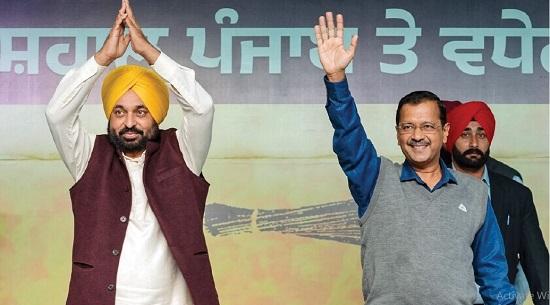
The rise of the Aam Aadmi Party in 2022 was accompanied by enormous expectations. Bhagwant Mann’s government promised a political transformation—clean governance, jobs, an end to corruption, action against drugs and a new economic direction. But nearly four and a half years into the AAP government, Punjab’s problems have not disappeared. Indeed, critics argue that several old problems have acquired new dimensions, while populism and political theatrics have increasingly replaced the hard work of structural reform.
This is not to suggest that every problem in Punjab began in 2022. It did not. Punjab’s debt, drug menace, agrarian distress, industrial stagnation, unemployment and migration have accumulated over decades and under successive governments. But that is precisely why the performance of the present government deserves scrutiny. A government that sought votes by promising to change the system cannot forever blame the systems it inherited.
The real question is therefore not simply whether the AAP government has failed in one department or another. The larger question is whether Punjab is being governed with a long-term vision—or merely managed from one political announcement to another.
When Law and Order Becomes a Question of Public Confidence
For any government, the first responsibility is brutally simple: make the citizen feel safe. Economic packages can be revised. Schemes can be expanded or withdrawn. Political slogans can be forgotten. But when ordinary people begin wondering whether criminals, gangsters and drug networks have become powerful enough to challenge the state, something fundamental begins to break.
Punjab has long battled organised crime, narcotics networks and gangsterism. The problem is complicated by the fact that several Punjabi criminal networks have developed international links. The gangster ecosystem today does not necessarily operate from a hideout in a Punjab village; it can operate through encrypted communications, foreign handlers, extortion networks and associates spread across countries. That makes policing far more difficult—but it also makes political leadership more important.
The repeated appearance of extortion threats, gangster-related violence and illegal weapons in public discourse has created an atmosphere in which law and order has become a political battlefield. In May 2026, for instance, AAP MLA Manwinder Singh Giaspura himself sought enhanced security after allegedly receiving death threats from a gangster. When even a ruling-party legislator publicly raises such concerns, the government cannot dismiss public anxiety as mere opposition propaganda.
More disturbing is the question of the police itself. A state cannot defeat organised crime if criminals are perceived to be several steps ahead of the police. Nor can public confidence survive if allegations emerge that elements within the police machinery itself have become compromised. In July 2026, a former Punjab police SHO was arrested in an extortion case connected to an international investigation into gangster networks. Such incidents do not prove that the entire police force is compromised—but they demonstrate why institutional integrity must be treated as a matter of national importance.
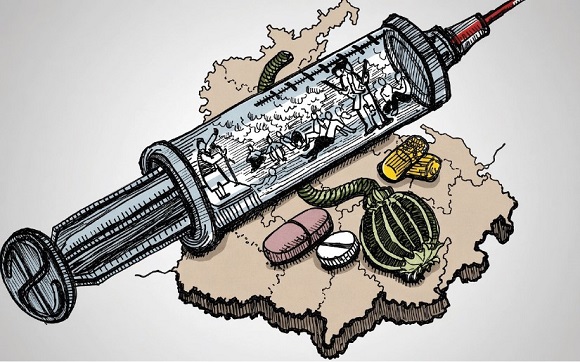
The government has also made visible efforts against drugs. Its Yudh Nasheyan Virudh campaign, launched in 2025, has involved arrests, seizures, property demolitions and rehabilitation initiatives. The government reported thousands of arrests and large narcotics seizures, while it has also introduced anti-drug education in government schools. These efforts deserve acknowledgement. But Punjab cannot be governed through campaigns alone.
Every few years, Punjab witnesses another grand declaration that the drug menace will be eliminated. Yet the deeper ecosystem—supply chains, addiction, unemployment, cross-border trafficking, political patronage and social vulnerability—requires sustained institutional action. The state has to demonstrate that the fight against drugs is not another publicity exercise but a permanent war against the criminal economy.
The same principle applies to public safety during festivals, religious gatherings and ordinary civic life. Punjab's identity is deeply rooted in its religious and cultural traditions. When violence, threats or communal tension interfere with ordinary social life, the damage is not merely physical. It attacks the confidence of society itself.
And here lies the first major question for the AAP government: Can Punjab’s citizens trust the state to protect them without political favour, selective enforcement or administrative hesitation? If the answer is uncertain, the government has a problem far larger than an opposition press conference.
A State Drowning in Debt While Its Youth Search for an Exit
Punjab’s second crisis is economic. The state that once became synonymous with India’s Green Revolution now faces the uncomfortable reality of fiscal constraints, high debt and limited economic dynamism. Punjab cannot indefinitely sustain an economy in which governments distribute more and invest less.
Welfare is not inherently wrong. A democratic government has a responsibility to support the poor, farmers, elderly citizens, women and vulnerable sections of society. But there is a fundamental difference between welfare that empowers citizens and populism that creates permanent dependency.
That distinction matters enormously in Punjab. The 2026-27 budget, for example, provides ₹9,300 crore for the Mukh Mantri Mawan Dhian Satikar Yojana, ₹6,132 crore for social assistance programmes, ₹7,715 crore for subsidised agricultural power and ₹5,771 crore for free electricity to domestic consumers. These are substantial commitments in a state already struggling to expand its productive revenue base.
The question is not whether these benefits should exist. The question is: what is the long-term economic architecture behind them?
Punjab cannot distribute its way to prosperity. According to PRS analysis of Punjab's budget documents, outstanding debt was projected at around 44.5 per cent of GSDP in 2025-26, compared with 39.9 per cent in 2019-20. The state has also carried persistent revenue and fiscal deficits. The Comptroller and Auditor General have separately maintained detailed scrutiny of Punjab's state finances and budgetary management.
This is where the politics of freebies becomes dangerous. A free electricity connection may provide immediate relief. A cash benefit may bring temporary comfort. A subsidised service may help a household today. But if government expenditure grows faster than the productive economy, somebody eventually pays the bill.
And that somebody is the next generation. Punjab's young people understand this contradiction perhaps better than its politicians. They see government announcements on one side and shrinking opportunities on the other. They see public debt increasing while private investment and high-quality employment remain inadequate. They see an economy historically dependent upon agriculture struggling to provide sufficient opportunities outside farming.
The consequence is visible in one of the most dramatic social phenomena in contemporary Punjab: the great exodus of its youth. For thousands of families, the question is no longer, “What career can my child build in Punjab?” It is, “Which country can my child go to?”
Canada, Australia, Britain, the United States and other destinations have become symbols of escape. Academic research on Punjabi student migration to Canada has found that education and immigration aspirations have become deeply intertwined; in one 2025 study, 31 of 34 interviewed students said they did not plan to return to India after completing their studies.
That is not simply a migration statistic. It is a vote of no confidence in the future. When a young Punjabi spends lakhs of rupees to obtain a foreign degree, works exhausting hours abroad and begins building a life thousands of kilometres away, the economic loss to Punjab is not merely the departure of one person. It is the departure of ambition, entrepreneurship, technical skill and demographic energy.
The tragedy becomes even greater when families sell land or borrow heavily to finance overseas education and migration. Reports of Punjabi youth being deceived by overseas employment agents have continued to surface, including a recent case involving dozens of youths stranded abroad after allegedly being promised jobs in Australia.
Punjab should be a destination for opportunity, not merely a departure lounge for its children. This is where the AAP government's record deserves especially hard scrutiny. Its defenders can point to welfare measures, recruitment drives, anti-drug campaigns and infrastructure announcements. But the ultimate test of governance is not how many schemes are announced. It is whether a young Punjabi believes that his or her future is better in Punjab than in Toronto, Melbourne, London or Vancouver. If the answer continues to be no, Punjab is losing its most valuable resource—not land, not water, but people.

Beyond Politics: The Fight for Punjab’s Future and Its Cultural Soul
Punjab’s crisis is therefore not merely administrative. It is cultural and civilisational. Punjab has always possessed a distinct social character—brave, hardworking, entrepreneurial, deeply religious and fiercely attached to its language and traditions. Punjabi culture was never simply entertainment. It was a living expression of community, faith, sacrifice, humour, music, agriculture and national service.
Today, however, critics increasingly accuse the AAP government of presiding over a period in which Punjab's traditional political and cultural institutions have weakened while a new culture of political populism has flourished.
The charge that the AAP government has spent the last four-and-a-half years “destroying Punjab” is politically charged and should not be treated as an uncontested fact. But it captures a genuine anxiety among many Punjabis: is Punjab being strengthened—or merely politically managed? The answer cannot be found in slogans.
Punjab needs industrial revival. It needs modern agriculture rather than perpetual dependence on subsidies. It needs food processing, technology, manufacturing, logistics and start-ups. It needs universities that can compete globally. It needs vocational education that gives young people reasons to stay. It needs a war against drugs that attacks both traffickers and addiction. And above all, it needs governance that is predictable, transparent and free from the culture of political patronage. Instead, Punjab's political class too often remains trapped in a cycle of blame.
The Congress blames AAP. AAP blames previous governments. The BJP blames both. Regional parties invoke federal discrimination. Everyone has an explanation for Punjab's decline—and almost everyone has an enemy. But Punjab does not need another enemy. It needs a strategy.
The political debate should therefore move beyond the childish question of who inherited what from whom. A government that has completed more than four years cannot continue indefinitely using its predecessors as a shield. At the same time, previous governments cannot escape responsibility for decades of accumulated structural weaknesses. The voter deserves something more serious: an honest audit of Punjab.
How much debt has accumulated? How much is being spent on subsidies? How much is reaching the intended beneficiary? How many sustainable private-sector jobs have been created? How many young people leave every year? How effective are anti-drug operations? How many organised criminal networks have been dismantled? How many industrial investments have actually materialised? What is being done to revive Punjabi language and culture? What is the state's ten-year economic roadmap? These are the questions that matter.
Punjab's cultural crisis also cannot be separated from its youth crisis. A generation that increasingly consumes global culture through social media while leaving its homeland behind can gradually become detached from its own linguistic and cultural inheritance. If Punjab wants its young people to remain connected to their roots, it must offer them something more than nostalgia. It must offer them a future.
That future cannot be built through free electricity alone. It cannot be built through political spectacles, endless accusations or election-season announcements. It cannot be built by converting every economic problem into a Centre-versus-State argument. And it certainly cannot be built by allowing the politics of grievance to replace the politics of development.
The AAP came to power promising a new Punjab. It now has to answer whether that promise has been fulfilled. The state has seen welfare expansion, anti-drug campaigns and various governance initiatives, but these must be judged against the larger indicators: fiscal sustainability, investment, jobs, public safety, demographic confidence and social cohesion. The final verdict belongs to the people of Punjab. But one warning should be unmistakable.
A Punjab whose youth leave, whose debt rises, whose criminals become emboldened, whose industries struggle and whose politics remains trapped in blame cannot call itself a model of governance merely because its government announces more schemes.
Punjab has already given India soldiers, farmers, entrepreneurs, sportspersons, artists and revolutionaries. It gave India a spirit of sacrifice that cannot be measured in GDP figures.
The tragedy would be if the land that once sent its sons and daughters across India to build the nation now sends them abroad because they no longer see a future at home. So, where is Punjab heading? That depends on whether its political leadership finally understands that Punjab does not need another promise—it needs a course correction.
It needs security without fear, welfare without bankruptcy, development without dependency, politics without permanent polarisation, and modernisation without cultural amnesia. The state still has the resources, talent and social capital to turn itself around. But time is not unlimited.
Punjab cannot afford to become a state remembered for what it once was. It must once again become a state known for what it is becoming. And for that transformation, the governsment of the day cannot keep asking who destroyed Punjab. It must answer the far more difficult question: What are you doing to save it?
(The content of this article reflects the views of writer and contributor, not necessarily those of the publisher and editor. All disputes are subject to the exclusive jurisdiction of competent courts and forums in Delhi/New Delhi only)




















Leave Your Comment