


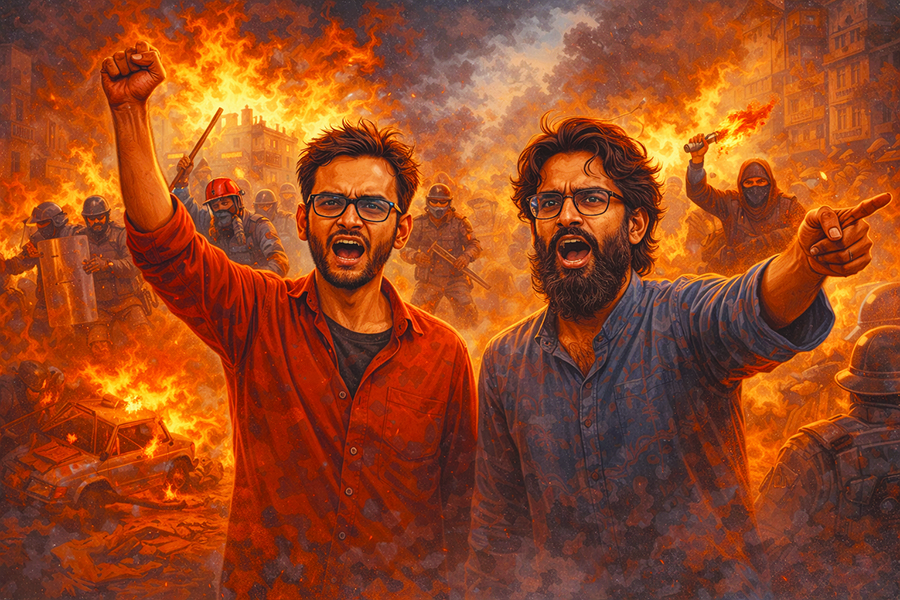
There are moments in a nation’s political life when events strip away layers of posturing and rhetoric, leaving behind an unvarnished truth. The Supreme Court’s decision to deny bail to Umar Khalid and Sharjeel Imam—accused conspirators in the 2020 Delhi riots—is one such moment. It is not merely a legal milestone; it is a moral and political litmus test. And for the INDI Alliance, this test has revealed more than it would have liked the country to see.
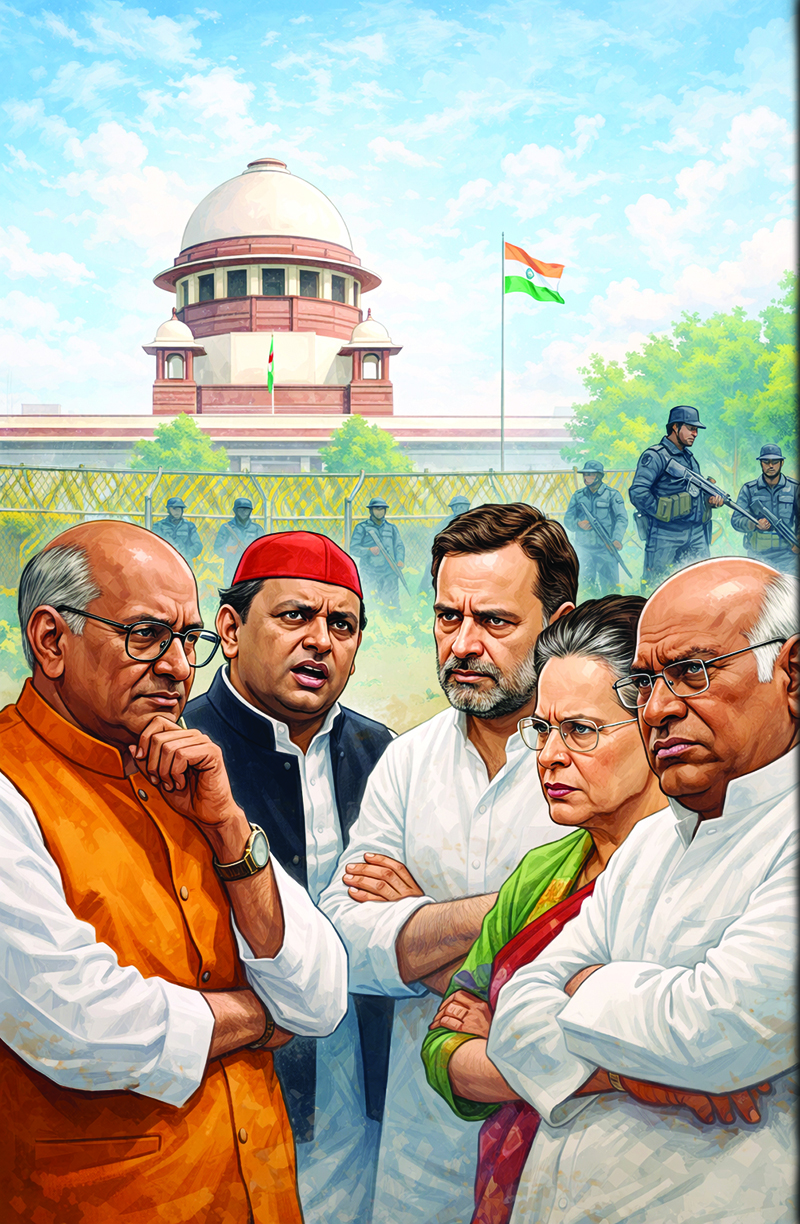
As much of India welcomed the apex court’s reaffirmation of the rule of law and national security, prominent leaders from the Congress and its allies reacted with visible discomfort, even disappointment. Statements by figures such as Digvijaya Singh and Akhilesh Yadav did not focus on the judiciary’s reasoning or the gravity of the allegations. Instead, they conveyed an unease that bordered on indignation—an emotional response that raises troubling questions about political priorities in times of internal security challenges.
This cover story is not about celebrating the incarceration of individuals or pre-judging guilt. It is about examining a political reflex that consistently places ideological alignment and vote-bank considerations above the nation’s collective conscience. When the Supreme Court speaks in the language of evidence, conspiracy, and threat to public order, political leaders have a choice: uphold institutional authority or undermine it through selective outrage. The INDI Alliance, once again, chose the latter.
A Judgment Rooted in Constitutional Responsibility
The Supreme Court’s refusal to grant bail was neither abrupt nor casual. It was based on detailed assessments of material placed before the court, the seriousness of the charges, and the broader implications for public order and national security. The court emphasised that alleged conspiracies leading to large-scale violence cannot be treated lightly, especially when they involve coordinated efforts to incite unrest.
In mature democracies, such judgments are typically met with restraint by political actors. Disagreement, if any, is expressed through legal critique, not emotional denunciation. Yet, in India’s opposition ecosystem, the reaction followed a predictable script—one that portrays accused individuals as victims first and institutions as oppressors later. This pattern is not accidental; it is strategic.
Selective Sympathy and
Political Signalling
The reactions from INDI Alliance leaders reveal a deeper malaise: selective sympathy. Over the years, opposition politics has increasingly relied on framing accused individuals as symbols of resistance rather than subjects of legal scrutiny. In doing so, leaders send subtle but powerful signals to their political constituencies—signals that suggest ideological loyalty matters more than constitutional process.
This is dangerous territory. Democracies survive not just on dissent, but on responsible dissent. When leaders appear more agitated by judicial firmness against alleged rioters than by the riots themselves, it distorts public discourse. It also sends an unintended message to radical elements—that political cover may exist, even when institutions close ranks.
The issue is not whether Umar Khalid or Sharjeel Imam deserve sympathy as individuals. The issue is why political leaders rush to express anguish over a bail denial while remaining conspicuously silent about the victims of violence, the loss of life, and the trauma inflicted on ordinary citizens during the riots.
Undermining Institutions by Delegitimising Outcomes
One of the most corrosive trends in contemporary Indian politics is the casual delegitimisation of institutions when outcomes are inconvenient. The same leaders who laud the Supreme Court when it checks the government suddenly question its wisdom when it upholds a strong national security posture.
This inconsistency chips away at institutional credibility. Courts do not operate in ideological silos; they operate within constitutional frameworks. When political actors cast aspersions on judicial intent without substantive legal critique, they contribute to a culture of cynicism. Over time, this weakens public faith—not in governments alone, but in democracy itself.
Ironically, the INDI Alliance positions itself as the guardian of constitutional values. Yet, constitutionalism demands respect for due process even when verdicts discomfort one’s political worldview. You cannot claim allegiance to the Constitution selectively.
The National Security Blind Spot
India’s internal security challenges are complex and evolving. From urban riots to radicalisation networks, the threats are no longer confined to borders or conventional battlefields. They manifest in campuses, social media narratives, and coordinated street violence. Addressing these challenges requires political unity at the level of principle, even amid electoral competition.
The opposition’s reaction to the Supreme Court verdict exposes a glaring blind spot. By framing alleged conspirators as victims of state excess, leaders risk normalising a narrative that downplays organised violence. This not only demoralises law enforcement agencies but also emboldens those who believe chaos can be politically negotiated.
National security is not a “right-wing” or “left-wing” concern. It is a civilisational necessity. Any political formation aspiring to govern must demonstrate clarity on this front. Ambiguity is not nuance; it is abdication.
Why These Moments Matter
Moments like these matter because they clarify choices. They tell citizens who stands where when the Republic is tested. Elections are fought on promises and manifestos, but governance is judged by instinctive reactions to crises. The instinct displayed by sections of the INDI Alliance suggests an alarming comfort with narratives that relativise violence and question institutions.
For India, however, this exposure may be a blessing in disguise. Democracies function best when political positions are transparent. The public deserves to know not just what leaders promise during campaigns, but how they react when the Supreme Court asserts the primacy of law over ideology.
A Contrast with Public Sentiment
Across the country, there was palpable relief at the court’s decision. For many citizens—especially those affected by the Delhi riots—it signalled that the wheels of justice, though slow, are moving. It reaffirmed faith that conspiracies to tear apart social fabric will face serious scrutiny.
The disconnect between this public sentiment and the opposition’s response is striking. It underscores a widening gap between political echo chambers and lived realities. When leaders fail to read this gap, they risk political irrelevance—not because of electoral arithmetic alone, but because of moral misalignment.
Democracy Is Not Anarchy
A recurring argument from opposition voices is that strong legal action threatens dissent. This is a false equivalence. Dissent is protected speech; conspiracy to incite violence is not. Democracies draw this distinction clearly, and so does the Indian Constitution.
By blurring this line, political leaders weaken genuine dissent. They turn it into a shield for those accused of orchestrating unrest, thereby discrediting legitimate voices of protest. In the long run, this harms the very freedoms they claim to defend.
The Bigger Picture for India
India today is asserting itself—economically, strategically, and institutionally. A confident nation requires a responsible opposition, one that challenges policy without compromising security, that questions power without undermining law. The current posture of the INDI Alliance, as revealed by its reaction to the Supreme Court verdict, falls short of this ideal.
This is not about silencing opposition. It is about demanding maturity from it. The Republic cannot afford political gamesmanship on matters of internal stability. History is unforgiving to those who normalise disorder for short-term gains.
Conclusion: Exposure Is a Form of Accountability The denial of bail to Umar Khalid and Sharjeel Imam will continue to be debated in legal circles. But politically, it has already delivered a verdict of its own—one that exposes fault lines in opposition politics. For India, this exposure is instructive. It allows voters to see beyond slogans and assess instincts.
In that sense, this moment is indeed good for India. It reaffirms institutional resolve and clarifies political positions. It reminds the nation that democracy thrives not just on opposition to power, but on allegiance to the Republic.
When the mask slips, what remains is truth. And truth, however uncomfortable, is the foundation of a resilient democracy.
The Riot Conspiracy
The Delhi riots were completely pre-planned, with preparations beginning even before the Kejriwal government was formed. In fact, these riots were a conspiracy to push India towards Ghazwa-e-Hind (a war by Muslims against Hindus). These riots were carried out systematically, under a well-thought-out plan. Preparations for this had been underway for several days before the riots began. Looking at the beginning, for 75 days before the riots, people from the Muslim community were protesting in Shaheen Bagh against the Citizenship Amendment Act, where slogans were being raised against Hindu communities, such as "Hindus' graves will be dug," "We want freedom," "Freedom from Hindus," "Freedom from Amit Shah (India's Home Minister)," "Freedom from Modi (India's Prime Minister),"... While their people were giving anti-India speeches, Sharjeel Imam of JNU presented the concept. He said in a speech, "Can't our people block traffic in India? If we blow up the flyover where we are, won't it make news? It will, because this is Delhi, and we will be in the headlines because all the media is here, the entire government machinery is here." Similarly, at Aligarh Muslim University, he spoke about separating Assam from India, saying that if our people block the Chicken Neck (the narrow corridor connecting India to the Northeast), the army won't receive help, and we can hold it for at least 2-3 months because our people are in the majority there. They warned Hindus, asking them to join them, and said that Hindus have to decide whether their graves will be two feet deep or ten feet deep. And this is where Sharjeel Imam's troubles began.
Anyway, now see how the rest of the conspiracy unfolded. The then AAP councilor Haji Tahir Hussain became the mastermind of this conspiracy, with the silent support of Amanatullah Khan and Kejriwal. On February 24th, Tahir Hussain started gathering people from 11 AM onwards. By 12 PM, all the Muslim parents had started taking their children out of school. When asked, they said that riots were going to happen, but the principal didn't take their concerns seriously because they didn't explain anything clearly. The principal thought they were probably going to participate in a protest against the Citizenship Amendment Act. By then, only Hindu children were left in the school, and Muslim shopkeepers had closed their shops and gone home. After this, at around 2 PM, a mob of thousands of Muslims entered the Hindu-majority streets and first set fire to a petrol pump. Then, they looted and burned only Hindu shops, leaving the Muslim shops untouched because they were identified by Hindu names, while the Muslim shops had "NO CAA, NO NRC, NO NPR" written on them. These rioters did not spare even the girls returning from school and coaching classes. They subjected the girls to "Taharrush Gamea" (mass molestation and rape of infidel girls), tearing their clothes and attempting to rape them, or perhaps even succeeding in raping them. In the same area, some women were worshipping in a temple when 20-30 Muslims entered, locked the door from the outside, and set it on fire. At that time, there were 10 people inside the temple, including the priest and 8-9 women, two of whom were young girls.
The rioters continuously attacked the gate with stones for two hours, and the entire temple was vandalized. They had to stay inside for about seven hours, and when the situation calmed down a little around 7-8 pm, a neighbor took them out and brought them to their home.
Initially, the police tried their best to stop these people and were somewhat successful, but when the number of rioters suddenly increased, the police force became separated and so overwhelmed that they were forced to run for their lives, as their numbers were only 200 (two companies) while the rioters numbered in the thousands. During this time, Delhi Police Head Constable Ratan Lal was killed while fighting the rioters, becoming a martyr after being shot.
The rioters were so well-prepared, as if they had planned this for months. Large slingshots had been prepared every 10-15 houses to throw stones over long distances. People were continuously attacked with petrol bombs, bricks, and stones for hours, and acid-filled plastic bags were thrown. Women and girls were forcibly taken from their homes. When the rioters were taking Muslim girls towards Tahir Hussain's house, Ankit Sharma, an officer of the Indian Intelligence Bureau returning from duty, immediately went with three of his friends to rescue them, heading towards Tahir Hussain's house. They were never seen again.
When their families searched for them, some people reported seeing two bodies being thrown into a drain behind Tahir Hussain's house. When the drain was searched, Ankit Sharma's body was found first. Partially burnt clothes of a woman were found near Tahir Hussain's house, suggesting that she had been raped and then thrown into the same drain where Ankit Sharma's body was found. According to Ankit Sharma's post-mortem report, his body had been stabbed 400 times over a period of six hours. There was no part of his body without stab wounds. Both his eyes had been gouged out, his intestines were pulled out, his throat was slit, and his face and body were burned with acid. The doctors said they had never seen such a case in their entire careers. Was all of this done suddenly? No, this clearly shows that it was all done according to a plan!
Nilabh Krishna
(The content of this article reflects the views of writer and contributor, not necessarily those of the publisher and editor. All disputes are subject to the exclusive jurisdiction of competent courts and forums in Delhi/New Delhi only)

















Leave Your Comment