



VIRAL DESAI
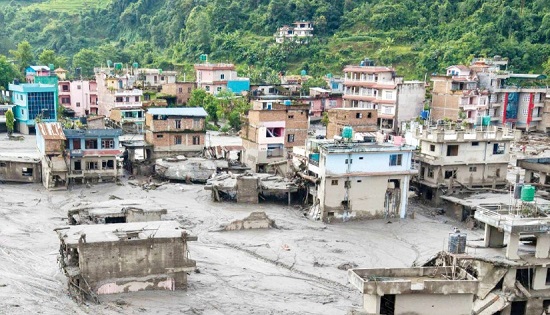
The recent devastating disaster in Nepal has once again drawn the attention of the global commu-nity, particularly South Asia, towards the growing vulnerability of the Himalayan region in an era of climate change and accelerating environmental degradation. The loss of lives, destruction of set-tlements and disruption of infrastructure cannot be viewed merely as another unfortunate en-counter with the forces of nature. It should compel us to examine a much larger question: are cli-matic extremes increasingly turning into human catastrophes because we are pushing fragile eco-systems beyond their capacity to absorb them?
The Himalayas have always been geologically young, dynamic and vulnerable to landslides, floods and extreme rainfall. What is changing, however, is the climatic environment within which these natural vulnerabilities operate. Rising temperatures, changing precipitation patterns, retreating glaciers, expanding glacial lakes and increasingly intense episodes of rainfall are creating multiple and interconnected risks across the Himalayan arc. When these climatic pressures interact with de-forestation, poorly planned construction, destabilised slopes and settlements in vulnerable loca-tions, the consequences can become devastating.
This distinction is important. Climate change does not create every flood or landslide, nor can every individual disaster automatically be attributed to global warming without rigorous scientific assess-ment. But scientific evidence increasingly tells us that a warmer atmosphere can hold more mois-ture and can intensify heavy precipitation. Across a region as fragile as the Himalayas, even a rela-tively small alteration in temperature or rainfall intensity can significantly magnify existing geologi-cal and hydrological risks.
One of the most serious concerns is the changing condition of the Himalayan cryosphere the glaci-ers, snowfields and frozen landscapes that regulate some of Asia's most important river systems. Rising temperatures are contributing to glacier retreat and, in many locations, the expansion of gla-cial lakes. These changes can increase the danger of Glacial Lake Outburst Floods, or GLOFs, while simultaneously creating long-term uncertainty over the water security of communities dependent upon Himalayan rivers.
At the same time, rainfall patterns are becoming increasingly difficult to manage. Mountain com-munities traditionally adapted to seasonal precipitation, but extreme volumes of rain falling within short periods can overwhelm natural drainage systems and destabilise already vulnerable slopes. Water mixed with loose soil, rocks and construction debris can rapidly become a destructive flow capable of damaging roads, bridges, houses and entire settlements.
The lesson, therefore, is not that every Himalayan disaster is caused by climate change. The deep-er lesson is that climate change is becoming a powerful risk multiplier in a landscape that was al-ready fragile.
There is another uncomfortable lesson that Nepal and indeed the entire Himalayan region must confront. Economic development is essential for mountain communities. Roads provide connectivi-ty, hydropower provides energy, tourism creates employment and infrastructure improves access to healthcare, education and markets. The choice cannot simply be between development and conservation.
The real question is: what kind of development can the Himalayas safely sustain?
Road widening without adequate slope stabilisation, indiscriminate hill cutting, removal of vegeta-tion, construction along riverbanks, alteration of natural drainage channels and infrastructure built without sufficient consideration of cumulative ecological impacts can dramatically increase disaster vulnerability. A road, hotel, hydropower project or settlement may appear safe under normal con-ditions, but climate resilience requires us to ask whether that infrastructure can withstand the ex-treme conditions that are becoming increasingly plausible.
Environmental Impact Assessments, therefore, cannot remain procedural formalities. In ecological-ly sensitive landscapes they must become fundamental instruments of public safety. Carrying-capacity studies, geological assessments, watershed-level planning and climate-risk modelling must precede major infrastructure decisions rather than follow them.
Development that repeatedly requires rebuilding after every extreme event cannot ultimately be called sustainable development.
South Asia must also move beyond a predominantly reactive approach to disasters. Emergency rescue operations will always remain necessary, but in an age of increasing climate risk, saving lives must begin long before a cloudburst, flood or landslide occurs. Modern disaster management re-quires dense weather-monitoring networks, satellite observation, real-time river and rainfall moni-toring, landslide susceptibility mapping, glacial lake surveillance and reliable early-warning systems.
Technology alone, however, cannot protect communities unless information reaches the last per-son at risk.
A sophisticated warning generated in a national control room has limited value if a family living in a remote mountain village does not receive it in time or does not know what action to take. Local governments, schools, community organisations and citizens therefore need clearly identified evacuation routes, periodic disaster drills, safe shelters and communication systems that continue functioning when conventional networks fail.
Disaster resilience must become part of everyday governance rather than an emergency activity undertaken after tragedy has already struck.
There is also a lesson that extends far beyond Nepal's national borders. The Himalayas do not rec-ognise political boundaries. The glaciers, forests, rivers and weather systems of this region form an interconnected ecological network extending across several nations. What happens in one part of a river basin can eventually affect communities hundreds or even thousands of kilometres down-stream. Nepal, India, Bhutan, Bangladesh and other countries connected through Himalayan river systems therefore have a profound shared interest in strengthening scientific and institutional co-operation.
Real-time sharing of hydrological and meteorological information, coordinated monitoring of glacial lakes, transboundary flood-warning mechanisms, collaborative scientific research and integrated river-basin management can become powerful instruments of climate adaptation.
Climate change is a transboundary challenge. Our response to it cannot remain confined within na-tional boundaries.
For India, the warning from Nepal deserves particular attention. Our Himalayan states face many of the same pressures: expanding infrastructure, growing tourism, rapid urbanisation, changing rain-fall patterns, glacier retreat, landslides and increasing human presence in environmentally sensitive landscapes. Events across Uttarakhand, Himachal Pradesh, Sikkim and other Himalayan regions have repeatedly demonstrated how quickly extreme weather can interact with ecological vulnera-bility and produce enormous human and economic losses.
India's development ambitions and environmental security need not be opposing objectives. In fact, in the twenty-first century they must become inseparable. Climate-resilient roads, scientifical-ly planned settlements, restoration of forests and watersheds, protection of natural drainage sys-tems, responsible tourism and stronger building regulations are not obstacles to development; they are investments in the durability of development itself.
The economics is equally important. Preventing ecological degradation and building resilience may require expenditure today, but rebuilding destroyed infrastructure, rehabilitating communities and recovering lost livelihoods after repeated disasters will invariably cost far more.
The tragedy in Nepal ultimately presents us with a larger philosophical and developmental ques-tion. For generations, modern civilisation has behaved as though technology could continuously expand the limits imposed by geography and ecology. The climate crisis is demonstrating the limita-tions of that assumption. Engineering can help us adapt to nature, but it cannot permanently sub-stitute for functioning forests, stable slopes, healthy watersheds, unrestricted floodplains and re-silient ecosystems.
We therefore need a new understanding of progress—one in which ecological security is consid-ered an essential component of economic security and human security.
The Himalayan region is not merely a spectacular geographical landscape. It is an ecological lifeline supporting rivers, biodiversity, agriculture, livelihoods and water security for hundreds of millions of people. Protecting its ecological integrity must consequently become a strategic priority for South Asia.
The most meaningful tribute to those who lose their lives in such tragedies is not merely sympathy after disaster. It is the courage to learn before the next one occurs.
Nepal's tragedy should remind us that extreme weather may sometimes be unavoidable, but ex-treme weather becoming an extreme human disaster is not always inevitable. Scientific planning, responsible development, ecosystem restoration, regional cooperation and climate preparedness can substantially reduce that risk.
The message emerging from the Himalayas is therefore not one of fear, but of responsibility. We still possess the knowledge, technology and institutional capacity to build safer and more resilient societies. What we require now is the collective will to place ecological wisdom at the centre of de-velopment.
Because ultimately, development without ecological resilience is not progress; it is vulnerability being built for the future.
(The author is a known Environmentalist and the pioneer of Satyagraha Against Pollution movement, viraludayindia@gmail.com )
(The content of this article reflects the views of writer and contributor, not necessarily those of the publisher and editor. All disputes are subject to the exclusive jurisdiction of competent courts and forums in Delhi/New Delhi only)



















Leave Your Comment