


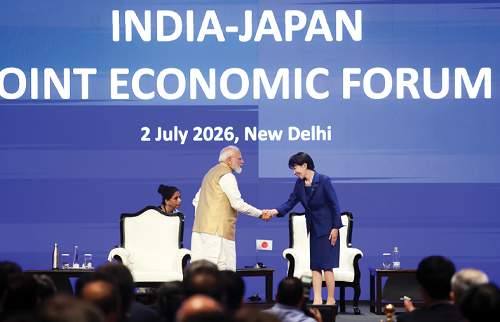
When Prime Minister Narendra Modi addressed Japanese Prime Minister Sanae Takaichi as “meri chhoti behen” at Hyderabad House on 2 July 2026, the gesture was received as warmth. It was warmth. But warmth does not explain sixteen agreements signed in a single summit. Warmth does not explain ten trillion yen committed over a decade. Warmth does not explain the first defence co-development project in the bilateral history of two nations that have known each other, through Buddhist transmission and democratic affinity, for centuries. Something deeper is at work; and that something has less to do with civilisational sentiment than with civilisational survival.
The Demographic Abyss
Japan is in trouble. Not the kind that makes headlines; the kind that makes demographers lose sleep. Approximately thirty per cent of its population is aged sixty-five or older. Its fertility rate hovers at 1.3 births per woman. Its population, having peaked at 128.1 million in 2008, is projected by the OECD to decline to approximately 96 million by 2060 and to below 70 million by 2100. A study published in Humanities and Social Sciences Communications (Nature, 2026) projected that more than half of Japan’s geographic grids may become uninhabited by the end of this century, with population concentrating in a narrowing band around Tokyo. Japan’s public debt stands at approximately 246 per cent of GDP, the highest among major economies. The IMF has warned that the shrinking population will depress GDP growth by nearly a percentage point annually for decades to come.
The Ground Beneath Their Feet
And then there is the geography. Japan sits at the intersection of the Pacific Plate, the Philippine Sea Plate, and the Eurasian Plate along the Pacific Ring of Fire. Over one hundred active volcanoes punctuate the archipelago; Sakurajima alone erupts several hundred times annually. The Earthquake Research Committee of Japan’s Headquarters for Earthquake Research Promotion estimates a seventy per cent probability of a magnitude-7-or-higher earthquake striking the southern Kanto area, including Tokyo, within the next thirty years. The Nankai Trough, running along the Pacific coast, poses a catastrophic earthquake and tsunami risk that Japanese officials discuss not as a possibility but as a certainty whose timing remains unknown. Climate change intensifies these vulnerabilities: typhoons are becoming more frequent and more severe; sea levels are rising; coastal communities that include some of Japan’s most densely populated and industrially significant zones face growing inundation risk. The 2011 Great East Japan Earthquake and Tsunami, which killed nearly 20,000 people and triggered the Fukushima Daiichi nuclear disaster, demonstrated that even the world’s most prepared society cannot engineer its way out of geological fate.
Japan, in short, is an ageing civilisation on a shrinking, shaking archipelago. Its capital must go somewhere safe. Its industrial inheritance must be preserved somewhere stable. Its technological capability must be banked somewhere that will still be standing, growing, and thriving when the archipelago’s own future is no longer certain.
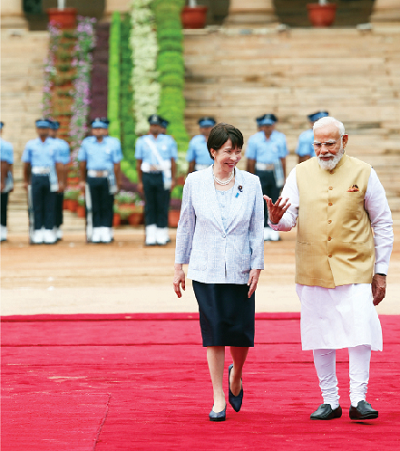
PM attends the Ceremonial Reception of the Prime Minister of Japan, Ms. Sanae Takaichi at
Rashtrapati Bhavan, in New Delhi on July 02, 2026.
Why India, and Only India
India is that somewhere. Not because India volunteered for this role; but because India’s continental reality, its demographic vitality, its industrial ambition, and its civilisational relationship with Japan make it the only credible candidate. No other nation in the Indo-Pacific offers this combination. Australia has the landmass but not the demographic scale. Southeast Asian nations have the growth but not the continental depth or the civilisational trust. The United States is an alliance partner, not a civilisational vault. China is the threat against which the insurance is needed; it cannot simultaneously be the insurer. India alone stands at the intersection of geographic stability, demographic expansion, democratic governance, industrial aspiration, and civilisational affinity with Japan. It is argued that this convergence of conditions is not coincidental; it is structural, and it is irreplaceable.
The Ark Being Built
This is the argument that neither summit communiqué nor joint press briefing will state explicitly but that the structure of the partnership makes unmistakable. The Mumbai-Ahmedabad High Speed Rail project does not merely build a corridor between two cities; it transfers Shinkansen technology, engineering systems, safety protocols, and manufacturing capability to Indian continental soil. The UNICORN (Unified Complex Radio Antenna, also designated NORA-50) naval antenna co-development does not merely produce a radio system; it banks Japanese defence electronics on Indian ground through co-production. The semiconductor cooperation does not merely diversify supply chains; it replicates Japanese chip-making knowledge within India’s Semiconductor Mission 2.0. The RIKEN-IIT Bombay AI partnerships, the C-CAMP deep-tech collaboration, the NCBS-TIFR neuroscience research, the critical mineral processing cooperation, the battery manufacturing agreements, the clean ammonia project in Odisha, the Next Generation Mobility Partnership spanning railways, automotive, aviation, shipbuilding, logistics, and ports: each of these is a node in a distributed resilience network. Together, they constitute what this author terms a continental ark; a systematic programme through which Japan’s critical infrastructure ecosystems, strategic manufacturing ecosystems, and supply chain ecosystems are gradually transferred, preserved, banked, partnered, and maintained on Indian continental ground, with a desire to ensure their survival and operational continuity regardless of what the future holds for the Japanese archipelago.
The Numbers Behind the Logic
India satisfies every condition that a continental ark requires. It is geologically stable; the Indian tectonic plate is not subject to the seismic and volcanic violence that defines Japan’s geography. It is demographically expansive; where Japan contracts, India grows. It is economically ascending; India’s domestic market is among the fastest-expanding in the world. It is democratically governed; institutional stability reduces the political risk inherent in long-term asset distribution. And it is civilisationally trusted; the Anujā-Onii-san Bonhomie is not decoration but the political permission that enables the deep asset-sharing the ark requires.
The numbers confirm this structural logic. Bilateral trade reached USD 27.47 billion in FY 2025-26. Cumulative Japanese FDI equity inflow from April 2000 to March 2026 stood at approximately USD 48.14 billion, ranking Japan fifth among source countries. Approximately 1,500 Japanese companies with nearly 5,000 business establishments operate in India; manufacturing firms account for roughly half the total. India ranked first in the Japan Bank for International Cooperation’s 2025 survey as the most promising overseas investment destination for the fourth consecutive year, with 61.8 per cent of respondents identifying India as the preferred market. A JETRO survey found that 81.5 per cent of Japanese firms plan to expand their Indian operations over the next one to two years. Capital does not flow in these volumes on the basis of sentiment; it flows on the basis of survival.
The Compass India Must Not Surrender
Yet India must examine what it is being offered with the same analytical precision with which Japan has calculated what it needs.
Japan’s deepening engagement with India does not occur in a strategic vacuum. It occurs within a context of unresolved strategic positioning that this author terms the “confusion cardinals”: three directional possibilities that Japan is pursuing simultaneously without having resolved which one governs the others. The first cardinal is sustained US alliance primacy; Japan’s security architecture has rested upon the US-Japan Security Treaty, approximately 54,000 US military personnel on Japanese soil, and extended nuclear deterrence for eight decades, yet the Trump administration’s transactional approach and periodic questioning of alliance commitments create uncertainty. The second cardinal is strategic sovereignty; Japan’s National Security Strategy of December 2022, its 43-trillion-yen (approximately USD 322 billion) five-year defence buildup programme, Prime Minister Takaichi’s acceleration of the two per cent GDP spending target, and the Global Combat Air Programme (GCAP) with the United Kingdom (BAE Systems) and Italy (Leonardo) all signal a Japan that is diversifying beyond single-point dependency on Washington. The third cardinal is the co-construction of a new security architecture that is, by design, oriented against Chinese assertiveness and that requires Indian participation for geographic breadth, strategic legitimacy, and civilisational diversity; the Quad is the most visible expression, but bilateral defence partnerships with India, Australia, the Philippines, and Vietnam extend the architecture further.
The India partnership serves all three cardinals simultaneously. It supplements the US alliance by adding an Indian dimension to joint exercises and maritime domain awareness. It advances Japanese strategic sovereignty by developing indigenous defence technology through co-development on non-alliance terms. And it contributes to the new architecture by integrating India into a web of relationships that collectively constrain Chinese freedom of action in the maritime domain. The Anujā-Onii-san Bonhomie is thus not merely a bilateral phenomenon; it is a product of Japan’s unresolved strategic positioning. The warmth is real. The structural driver is uncertainty.
Advantage and Constraint
For India, this creates both advantage and constraint. The advantages are substantial: defence technology that Japan would not transfer to a partner it did not consider strategically essential; financial commitments of a scale that reflects strategic investment rather than commercial calculation; diplomatic support on terrorism and UN reform; investment in the North Eastern Region; and a maritime partner whose FOIP vision aligns with MAHASAGAR. But the constraints are real. India-China bilateral trade reached USD 151.1 billion in FY 2025-26, with China overtaking the United States to re-emerge as India’s largest trading partner; the trade deficit with China widened to a record USD 112.6 billion. India’s approach to the Indo-Pacific, articulated through SAGAR, MAHASAGAR, and the Indo-Pacific Oceans Initiative, is explicitly “free, open, and inclusive”; it is not and has never been an anti-Chinese alliance. India participates in the Quad; yet it has consistently resisted its characterisation as a military bloc. India maintains defence relationships with Russia. India leads the Voice of the Global South. Every joint exercise, every defence co-development project, every joint statement on freedom of navigation contributes to a cumulative signalling pattern that shapes how third countries, particularly Beijing, interpret India’s strategic orientation. The deeper India integrates into Japan’s evolving security architecture, the more it risks being perceived as having joined an exclusionary coalition whose design logic serves Japanese and American objectives rather than Indian ones.
The diplomatic art, therefore, lies in a dual operation: accepting the ark while preserving the compass.
The Ark and the Compass Together
India must accept what Japan offers because what Japan offers is genuinely valuable. Technology, capital, industrial capability, manufacturing ecosystems, and supply chain diversification serve India’s own developmental ambitions under Atmanirbhar Bharat and its own aspirations for Viksit Bharat 2047. Japan preserves its civilisational inheritance; India accelerates its industrial transformation. The reciprocity is real and it is deep.
But India must preserve its strategic compass because the compass is the civilisational inheritance that India itself cannot afford to bank elsewhere. Strategic autonomy, multi-alignment, independent engagement with all major powers on terms that serve Indian national interests, Global South leadership, and the freedom to define its own Indo-Pacific vision rather than adopting someone else’s: these are not luxuries. They are the conditions under which India remains India rather than becoming a node in an architecture designed by others.
The Anujā asks for trust. The Onii-san offers continuity. The earthquake, the volcano, the shrinking population, and the rising sea remind both that the offer is existential. But the sister’s wisdom lies not in accepting everything the brother offers without question; it lies in knowing what to take, what to hold at arm’s length, and what to keep entirely her own.
The Sea Between
The maritime dimension reinforces both the ark and the compass. India’s SAGAR doctrine of 2015, evolved into MAHASAGAR (Mutual and Holistic Advancement for Security and Growth Across Regions) in 2025, positions India as a provider of maritime security, capacity building, and cooperative engagement across the Indian Ocean and the Global South. Japan’s FOIP vision, which Takaichi explicitly linked to MAHASAGAR at the 2026 summit, provides the complementary framework. The sea lanes connecting the two countries carry two-thirds of the world’s oil shipments, one-third of its bulk cargo, and half of its container traffic. Maritime security is thus the arterial system through which the ark’s contents travel and through which both countries’ economic survival flows. The bilateral naval exercise JIMEX, the maritime domain awareness cooperation through satellite capabilities, the naval maintenance, repair, and overhaul arrangements, and the UNICORN co-development are all maritime. The oceans are the connectors; and the connectors must be protected by both, not owned by either.
The Tidal Turn
The tidal turn in diplomacy that the 2026 summit represents is real. The civilisational bridge is real. The strategic convergence is real. The continental ark is being built. The only question that remains is whether India will board the ark as a co-architect or as a passenger. The answer to that question will define not merely the India-Japan partnership but the shape of the Indo-Pacific for the remainder of this century.
India must be the architect. That is the national interest. That is the civilisational imperative. The ark carries both; but the compass must remain in Indian hands.
Dr. Padmalochan Dash
(The content of this article reflects the views of writer and contributor, not necessarily those of the publisher and editor. All disputes are subject to the exclusive jurisdiction of competent courts and forums in Delhi/New Delhi only)




















Leave Your Comment