


India’s ambitious high-speed rail network is poised to expand further, with Union Railway Minister Ashwini Vaishnaw announcing a proposed bullet train corridor that will connect Delhi to Siliguri via Lucknow, Varanasi, Patna and West Bengal. The announcement has generated excitement among passengers and infrastructure enthusiasts, as the project promises to drastically cut travel time between northern India and the eastern region.
Addressing a gathering at the West Bengal Secretariat, Nabanna, in Kolkata on Saturday, Vaishnaw said that the proposed bullet train corridor would bring West Bengal into India’s emerging high-speed rail network. According to the Railway Minister, once operational, the bullet train will reduce the travel time between Siliguri and the national capital to just six hours, offering a transformative travel experience for millions of passengers.
“A bullet train project will come to West Bengal. It will connect Delhi and Siliguri via Lucknow, Varanasi and Patna. The journey will take only six hours by bullet train,” Vaishnaw said while outlining the Centre’s vision for modern railway infrastructure in the state.
Highlighting the Centre’s investment in West Bengal’s railway sector, Vaishnaw noted that the state has witnessed a significant increase in railway funding under the Narendra Modi government. He said that during the UPA era, when Chief Minister Mamata Banerjee served as Railway Minister, West Bengal received around ₹4,000 crore for railway projects. In contrast, the state has been allocated ₹14,205 crore for the financial year 2026-27 under the current government.
The Railway Minister also announced a major expansion plan for Kolkata Metro, stating that 60 next-generation metro trains will be introduced over the next five years. He expressed confidence that railway and metro development projects in West Bengal would gain further momentum under what he described as a “double-engine government.”
Vaishnaw pointed out that West Bengal was among the first states to receive advanced rail services such as the Vande Bharat Sleeper and Amrit Bharat trains. He added that more railway projects and infrastructure initiatives are likely to be announced in the coming years. He also highlighted that nearly 45 kilometres of metro lines have been completed in Kolkata during the Modi government’s tenure, significantly enhancing urban mobility in the city.
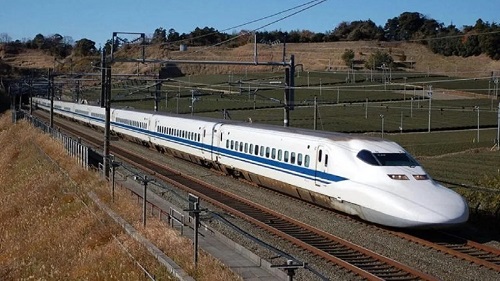
The announcement comes amid rapid progress on India’s first bullet train project—the 508-kilometre Mumbai-Ahmedabad High-Speed Rail Corridor. The corridor, being developed between Sabarmati in Ahmedabad and Mumbai, is designed to operate trains at speeds of up to 320 kilometres per hour. Once completed, the journey between the two cities will take just 2 hours and 17 minutes, compared to the considerably longer travel times currently required.
Vaishnaw recently revealed that India’s first operational bullet train service is expected to begin with a 100-kilometre stretch between Surat and Vapi in Gujarat by August 2027. Earlier plans had envisaged the inaugural run on a shorter 50-kilometre section between Surat and Billimora.
According to the Railway Minister, express services on the Mumbai-Ahmedabad corridor will be capable of covering the distance in just 1 hour and 58 minutes with limited stops, while trains halting at all 12 stations will complete the journey in approximately 2 hours and 17 minutes.
Although the Mumbai-Ahmedabad project has faced delays due to land acquisition and other logistical challenges, it remains a cornerstone of India’s high-speed rail ambitions. The Railway Ministry has already awarded contracts for advanced signalling systems and is simultaneously promoting indigenous capabilities. Bharat Earth Movers Limited (BEML) has been tasked with developing a high-speed train capable of operating at speeds of up to 250 kmph, marking another step toward self-reliance in rail technology.
If the proposed Delhi-Siliguri bullet train corridor materialises as planned, it could become one of the most significant transportation projects in eastern India, boosting connectivity, tourism, trade and economic development across multiple states while bringing high-speed travel within reach of millions of passengers.



















Leave Your Comment