


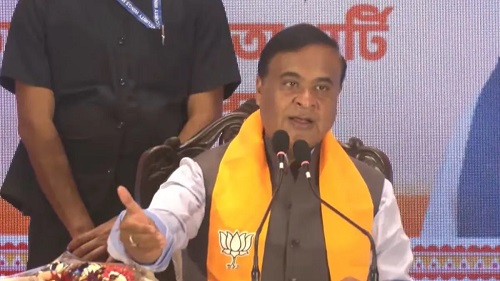
Himanta Biswa Sarma on Saturday asserted that the ongoing assembly elections in West Bengal hold significant implications not just for the state but also for Assam and the broader northeastern region. Addressing a press conference in Kolkata, the Assam Chief Minister reiterated concerns over demographic changes allegedly driven by illegal immigration from Bangladesh.
Sarma expressed strong confidence in the electoral prospects of the Bharatiya Janata Party (BJP), predicting a sweeping victory in the state. “I won't be surprised if the BJP wins over 200 seats. The support received in the first phase has changed the atmosphere—it’s a tsunami,” he said.
Launching a sharp attack on West Bengal Chief Minister Mamata Banerjee, Sarma accused the Trinamool Congress (TMC) government of encouraging infiltration for vote-bank politics. He alleged that the state administration has failed to provide adequate land to the Border Security Force for fencing the India-Bangladesh border, thereby compromising national security.
“If one aims to safeguard India, a BJP government in West Bengal is essential,” Sarma stated, warning that unchecked infiltration could have far-reaching consequences for eastern and northeastern states. He cautioned that demographic shifts, once entrenched, would be irreversible and could alter the region’s socio-political fabric.
Highlighting the geographical sensitivity of the issue, Sarma pointed out that the India-Bangladesh border spans five states—West Bengal, Tripura, Meghalaya, Mizoram, and Assam. “Even if one state leaves its borders vulnerable, the impact will be felt across the region, including Bihar and Jharkhand,” he said.
The Assam Chief Minister further claimed that Assam is already witnessing rapid demographic changes, estimating the population composition at 60 per cent Hindus and 40 per cent Muslims. He warned that if current trends continue, Hindus could lose majority status in both Assam and West Bengal within the next two decades. “Assam will fall first, followed by West Bengal, and then the impact will spread further,” he added.
Sarma also accused Banerjee of downplaying demographic concerns by limiting political discourse to urban centres like Kolkata, while ignoring ground realities in border districts. He urged voters to support the BJP in the upcoming second phase of polling, framing the election as a decisive moment for the region’s future.
The West Bengal Assembly elections began with the first phase of polling on April 23, with the second phase scheduled for April 29. Meanwhile, Assam completed its polling in a single phase. The results for both states will be announced on May 4, setting the stage for a politically significant outcome in eastern India.



















Leave Your Comment