


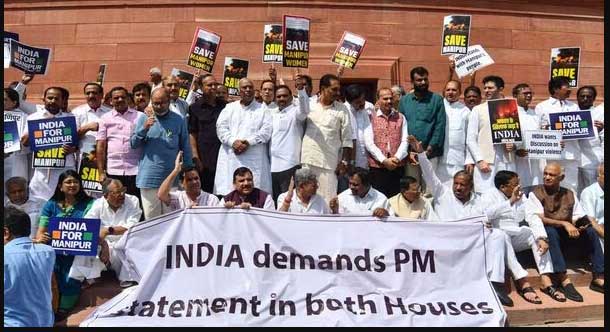
In the bustling arena of parliamentary politics, a no-confidence motion is often considered a potent weapon in the arsenal of the opposition. It serves as a litmus test of the ruling government's popularity and efficacy while providing the opposition an opportunity to showcase its strength and rally public sentiment against the incumbent government. However, in a recent turn of events, the opposition's performance on a no-confidence motion against the Modi government has left much to be desired, raising questions about their strategy and cohesion. The no-confidence motion is a parliamentary procedure, wherein members of the legislature express their lack of confidence in the ruling government. If the motion passes, it can lead to the fall of the government, potentially triggering snap elections or a change in leadership. The process is not just a procedural formality, it's a critical demonstration of the opposition's unity, strength, and its ability to present a compelling case against the government's policies and actions. In the case of the recent no-confidence motion against the Modi government, the opposition's lackluster performance was evident from the outset. The motion was tabled with much fanfare by Gaurav Gogoi, promising a scathing critique of the government's handling of various issues, ranging from Manipur to economy and foreign relations. However, as the debate unfolded, it became increasingly apparent that the opposition's arguments lacked substance, coherence, and a unified voice. One of the major pitfalls of the opposition's performance was Rahul Gandhi's failure to present a cohesive narrative. Different opposition parties seemed to be pursuing their own agendas, causing confusion and diluting the impact of their collective efforts. While some parties focused on Manipur and economic concerns, others veered into social issues, and a few even resorted to personal attacks against the Prime Minister. This lack of coordination not only weakened their overall argument but also undermined their credibility in the eyes of the public. And to top it all, they left the House when PM Modi was still delivering his speech, not asking any question after the speech.
Against this backdrop, Prime Minister Narendra Modi in his speech against the no-confidence motion in Lok Sabha ripped the opposition apart. In a riveting display of political prowess, Prime Minister Narendra Modi orchestrated a compelling rebuttal against the opposition's no-confidence motion in the Parliament. With a blend of eloquence, facts, and conviction, PM Modi delivered a resounding response that left the opposition in disarray. The no-confidence motion, which sought to challenge the stability of the government, turned into a stage for Modi to showcase his exceptional leadership and communication skills. As the opposition rallied to question the government's performance and policies, PM Modi seized the opportunity to articulate his administration's accomplishments, vision, and commitment to the nation's progress. With the nation's eyes glued to their television screens, the Prime Minister took the floor to deliver a speech that would not only secure his government's position but also highlight his unwavering dedication to the country. PM Modi's speech was marked by its masterful oratory, commanding presence, and a deep connection with the audience. He eloquently recounted the various initiatives, reforms, and welfare programs undertaken by his government. Modi's ability to seamlessly weave anecdotes, statistics, and relatable examples painted a vivid picture of the transformational journey India had embarked upon under his leadership. By combining data-driven arguments with an inspiring vision for the future, Modi not only refuted the opposition's allegations but also reaffirmed his government's commitment to progress and development. The no-confidence motion debate stands as a testament to PM Modi's ability to navigate the intricacies of Indian politics and emerge as a formidable leader who commands respect both domestically and on the
global stage.

By Deepak Kumar Rath



















Leave Your Comment