


It has happened in the past. And it is happening again. Relatively underreported, water, not oil, is fast turning out to be the most important strategic weapon in the ongoing but widening conflict involving Iran, Israel, and the United States.
Desalination plants in the Middle East, which provide up to 90% of drinking water for several Gulf nations, are now being directly targeted or collateralized in the conflict.
On March 7, Iranian Foreign Minister Abbas Araghchi claimed a freshwater desalination plant on Iran’s Qeshm Island was attacked by the United States, saying, “Water supply in 30 villages has been impacted. Attacking Iran’s infrastructure is a dangerous move with grave consequences. The US set this precedent, not Iran.”
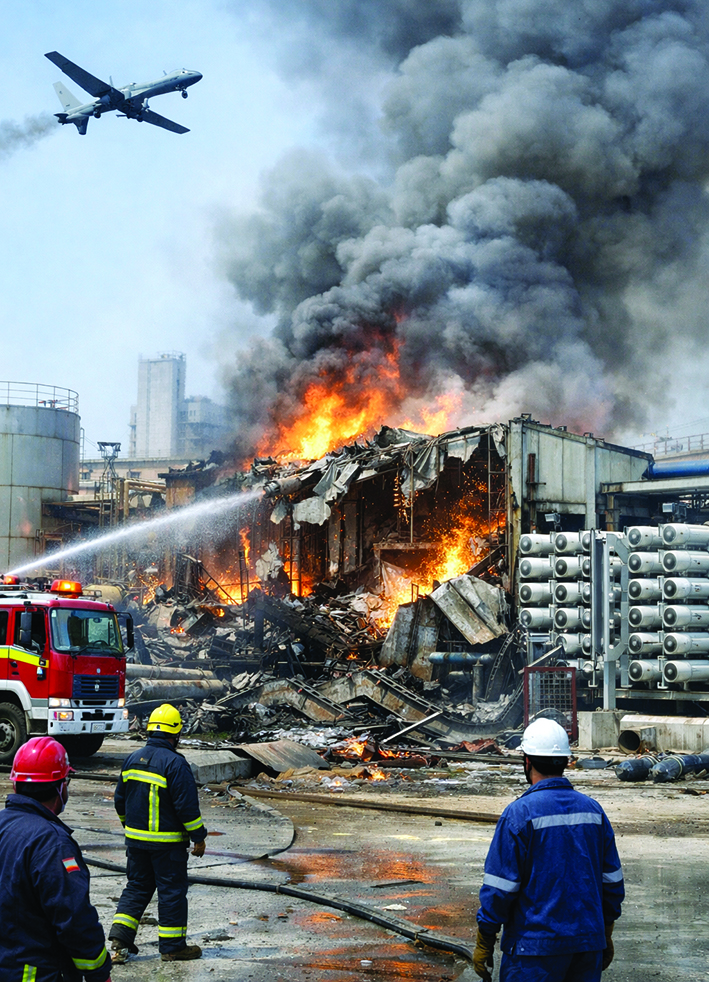
The next day, the government of Bahrain alleged that an Iranian drone attack “ had caused material damage” to one of its water desalination plants. Fortunately, the country’s water and electricity authority assured that this Iranian attack had “no impact on water supplies or water network capacity.”
It may be noted that all the Arab Gulf countries - Saudi Arabia, Kuwait, Bahrain, Qatar, the United Arab Emirates, and Oman - are now under Iranian attack. And all of them, for all practical purposes, are highly dependent on the desalination plants, particularly for metropolises such as Dubai. Saudi Arabia, and especially its capital, Riyadh, also relies heavily on them.
In Kuwait and Oman, nearly 90 percent of drinking water comes from desalination; in Saudi Arabia, 70 percent of water is desalinated. Even half of Israel’s potable water is said to come from five large coastal desalination plants.
As regards Iran, the country is supposedly less reliant on desalination as it gets most of its water from rivers, reservoirs, and underground aquifers; but these are becoming fast depleted after five years of drought. So it is also now investing in desalination plants.
As it is, the Earth’s freshwater resources are limited and unevenly distributed. At many places, the availability of water is becoming inadequate to satisfy the demands of growing populations and economies. And here in the highly water-scarce regions like the Middle East, conversion of seawater into drinkable water by removing salt, minerals, and impurities either by heating it up or pushing it through membranes at high pressure, is tried as a remedy. That it is a highly costly and energy-intensive process is a different matter.
What is pertinent here is that desalination plants in the region are now increasingly becoming vulnerable to military attacks. Water is being used both as a target and a weapon of war.
Now declassified CIA documents reveal how officials in the Middle East are perceiving water to be more important than oil for their national well-being.
The Iran-Iraq war in the early 1990s drove home to Persian Gulf countries the vulnerability of many of their industrial facilities, including their national water supplies. The Iranian destruction of Iraq's Persian Gulf oil export facilities and a Kuwaiti gas/oil separation plant early in the war provided the Arab governments with graphic evidence of the ease with which their own industrial facilities could be destroyed by hostile forces. Kuwait had to call on Turkey, Saudi Arabia and others to provide hundreds of water tankers and trucks to deliver bottled water.
“The failure of the Arab governments of the Gulf region to prepare for the possible loss of desalination facilities, in our judgment, is a significant strategic oversight. Although the consequences will vary with the extent of each country's dependence on desalination and the damage inflicted during an attack, the absence of well-developed security and emergency planning increases the likelihood of a disastrous outcome.
“Although the loss of a single plant would likely cause only local hardship, successful attacks on several plants in the most dependent countries could generate a national crisis that could lead to panic flights from the country and civil unrest. Continuing hostilities would compound the Arab government's difficulty in coping with these domestic problems”, one such CIA report declassified in 2010 had pointed out.
Apparently, in 2008, a diplomatic cable sent from the U.S. Embassy in the Saudi capital, Riyadh, and later released by WikiLeaks, had warned that an attack on a single desalination plant providing Riyadh with more than 90 percent of its drinking water at the time would make the city evacuate all its people within a week.
“Riyadh would have to evacuate within a week if the plant, its pipelines, or associated power infrastructure were seriously damaged or destroyed,” according to the aforesaid cable. “The current structure of the Saudi government could not exist without the Jubail desalinization plant,” it added.
Since the cable became public, the Saudis have reportedly reinforced their water network.
But then, Saudi Arabia itself has been accused of bombing desalination plants in Yemen in 2016 and 2017. In return, Houthi rebel forces allegedly fired missiles at desalination plants in Saudi Arabia in 2019 and 2022.
Likewise, in October 2023, Israel was said to have damaged, destroyed, or shut down much of Gaza’s water system, including its desalination plants. By mid-2025, approximately 85% of Gaza's water and sewage facilities were reported to be partially or completely destroyed. The largest remaining plant in South Gaza has faced repeated shutdowns due to power cuts and fuel blockages, leaving hundreds of thousands without safe water.
As Marwa Daoudy, an Associate Professor of International Relations at Georgetown University’s School of Foreign Service, who specializes in climate, water security, and negotiation in the Middle East, points out, water infrastructure has become a target and weapon of war in the region.
Viewed thus, the latest reports from Iran and the Gulf only reinforce the seriousness of this trend. Water desalination plants in the region, which remain essential for the region, are increasingly becoming military targets.
If the attacks on desalination plants in Gulf countries continue, the situation could very quickly devolve into a “massive humanitarian catastrophe for the people living in the Gulf,” according to Annelle Sheline, a research fellow in the Quincy Institute’s Middle East Program.
Sheline wouldn’t be surprised if more facilities were attacked in the future, despite international humanitarian law prohibiting the targeting of civilian infrastructure that is crucial to the survival of the population, which includes drinking water plants.
After all, Article 54 of the 1977 Additional Protocol I to the Geneva Convention states: “It is prohibited to attack, destroy, remove or render useless objects indispensable to the survival of the civilian population, such as foodstuffs, agricultural areas for the production of foodstuffs, crops, livestock, drinking water installations and supplies and irrigation works, for the specific purpose of denying them for their sustenance value to the civilian population or to the adverse Party, whatever the motive…”
Similarly, the Berlin Rules on Water Resources have codified customary international law, setting out regulations for protecting water resources during conflicts, including the principle that nations may not take actions that cut off water supplies to civilians.
There are also resolutions of the United Nations, making it clear that there must be a distinction between military and civilian targets. Even if a military objective is nearby, an attack is unlawful if the "reverberating harms" to civilian health and survival are disproportionate to the military advantage.
UNSC Resolution 2573 (2021) “ condemns attacks on civilian infrastructure and highlights the severe consequences of damaging objects indispensable to civilian survival”. UNSC Resolution 2417 (2018) “underscores the link between protecting water systems and addressing conflict-induced food insecurity”. And the UN General Assembly (Resolution 64/292) “recognizes access to safe drinking water as a fundamental human right essential for the enjoyment of life”.
Considering this, many experts and human rights activists are understandably arguing that any attack on desalination plants and other water systems/ supplies, deliberately or by accident due to a stray missile or drone, is not acceptable. They make enormous sense when they say that “Oil is essential, but water is irreplaceable”.
Water should never be a target or weapon of war.
(prakash.nanda@hotmail.com)

Prakash Nanda


















Leave Your Comment