


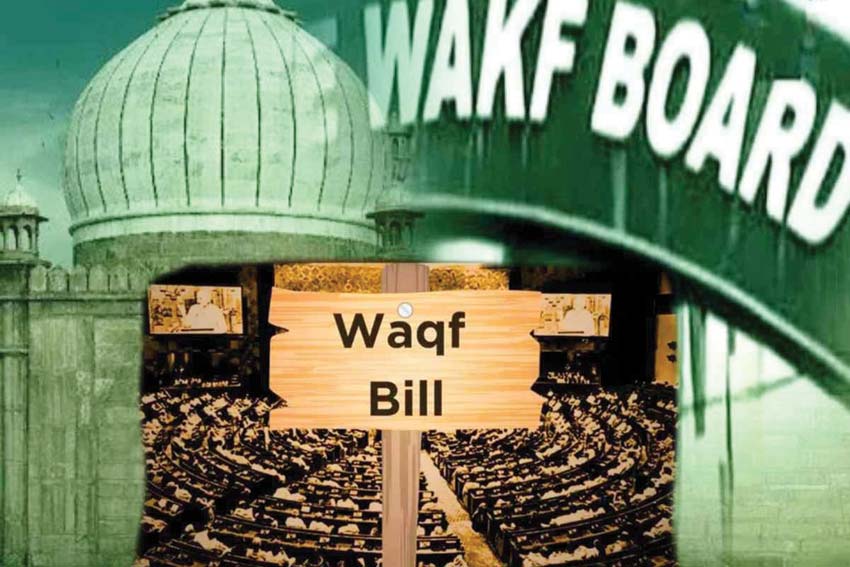
The nation has witnessed a year full of accusations, hostility and deliberation on the issue of waqf management.The Joint Parliamentary Committee committee discussed it in detail, submitted its report and then the bill was tabled in parliament. Again debated and passed by both the houses and duly approved by the president. As the nation has seen the debate live on television, Therefore nothing is left to imagination or to be analysed. However, the parties defending the old bill have filed Multiple pleas in the Supreme Court, challenging the constitutional validity of the newly enacted Waqf Bill. Last week, Congress MP Mohammad Jawed and AIMIM president Asaduddin Owaisi moved the Supreme Court, challenging the constitutionality of the Waqf (Amendment) Bill.
Centre has reportedly filed a caveat in the Supreme Court, seeking hearing before orders are passed on pleas challenging validity of Waqf (Amendment) Act, 2025.
Hindustan times have published the news with the headline:
“The new Waqf law is a much-needed reform”
Syed Zafar Islam. April 6 2025.
As per the news, Bill doesn’t target any religious group,It aligns Waqf governance with the principles applied to other religious trusts. But it is far from the truth! The Waqf board enjoys a sacred status which is not available to any other religious trust. During the debate, both the ruling party and the opposition were promising at top of their voice that the sacred status of the waqf properties. No Indian political party has given any such assurance for the properties owned by the temples. To the contrary Hindu temples and other religious bodies are facing takeover by the government, encroachment from the land mafia and other antisocial elements. To set the facts right, as per information available on net the Jagannath temple owned 1.75 lac hectare land ( 432434.418 acres) in 1947. The freedom of the country and secularism hit it so hard that its ownership has been reduced to less than 20 percent.

“Records of Lord Jagannath's over 60,000 acre of land in seven States to be digitised
The Hindu September 28, 2022. It
This is only possible in India where we see two different sets of rules, temples are losing their land and waqf land is multiplying. Where is the equity? Why are we so eager to exploit temples? Why erstwhile government in Odisha destroyed the centuries old mutt in puri and it could not make news despite having clear title. In the same country Mazar on a railway track is a non issue. Is it just because Hindus have respected the law and the constitution?
During the debate the home minister informed the parliament.
● From 1913 to 2013, the Waqf Board had a total of 18 lakh acres of land.
● Between 2013 and 2025, after the Congress-led UPA amended the Waqf Act in 2013, 21 lakh acres were added to it.
● There are 30 Waqf Boards across India, according to the official website of the Waqf Asset Management System of India.
Why did this multiplication happen, that too after 2013 ?
The Waqf (Amendment) Act, 2013 introduced several changes to the original Waqf Act, 1995, it was controversial for multiple reasons:
1. Unlimited powers to Waqf Board.
2. Lack of Clear Mechanism for Disputes.
3. No Role for State Governments.
4. Retrospective Effect.
5. No scope for Transparency and Accountability.
The amendment eliminated the role of state governments in waqf matters by centralizing power with the Central Wakf Council and the Waqf Boards. This led to suspicion and fear, particularly in states where land disputes involving waqf properties were common. The amendment allowed the Waqf Board to claim properties retrospectively, even if the land had been in private hands for decades. In some cases, even lands acquired by the government were later claimed as waqf. Major irregularities were:
● The process for determining waqf status lacked fairness, leading to a situation where properties were declared waqf on the basis of vague historical records.
● Once land was designated waqf, it became extremely difficult for individuals or institutions to reclaim or contest.
As a result, the 2013 amendment was seen as troublesome because it gave too much power to Waqf Boards which lacked proper dispute resolution mechanisms, and had retrospective effects that created land ownership conflicts. The amendment granted the Waqf Board more control over properties, making it easier for them to claim land as waqf property. This led to concerns that legitimate private and government-owned lands could be wrongfully classified as waqf without proper evidence.
While the basic tenets of the waqf concept was receiving donations, the act empowered waqf boards to claim land. The corrupt leadership was on a land grabbing spree. The Hindu post, news portal published details in its news dated.
“11 incidents of temple and public land grab by Waqf Board”
May 30, 2024.
The worst thing about the misuse was that it acted without showing any consideration for private or public property. It treated the government, temples, Muslim property with equal contempt.As per allegations the waqf board recklessly kept claiming everything on assumptions, from the kumbh mela ground in Prayagraj to parliament in Delhi nothing was left to chance. One of the alleged reasons for leader of opposition Rahul Gandhi refraining from taking any stand on Waqf bill, is dispute of Kerala church property with Waqf board there.
Pain continues despite getting independence.
India has landed itself in such a situation where some sections of the minorities have been exploiting the law in such a way that the majority is feeling helpless and exploited. One may call it taking an extreme position but the fact is conversion, extremism or anti national movements find support from these sections. The violence in Kashmir and Northeast are proof that wherever the majority community is in minority, life is not safe. It is a pity that no Hindu politician has any probability of becoming chief minister in these states.
Reckless empowerment and then bringing new laws is not the only solution.
The government is enacting new laws to curb coercion infused conversion, love jihad or to eliminate Waqf law anomalies but nobody has ever bothered to investigate why India is facing these issues. The draconian laws enacted by invaders to humiliate the native citizens are not only continuing but being given more teeth. Fundamental right of equity has become a mockery. As a result an ordinary citizen can work hard to create wealth but has no courage to fight injustice. People sell their house and migrate as soon as life becomes challenging or risky. The exodus from Sambhal was not caused by Waqf but was due to the risk involved in living there. This is the area where governments have to work.
Making new laws may allow the legislature to take credit for reforms but these laws have failed to bring the desired results. To the contrary mostly these have perpetuated the situation. Let’s take the example of the Supreme Court banning the use of loudspeakers from religious places. Before the ruling all religious places were using loudspeakers but now the majority of misuse is reported from one community only. Same is true for the legal age for marriage of women or the dress code in schools. Only one community has refused to accept the law. The unfortunate part is courts have refrained from ensuring implementation of their bold decisions.
In view of past experience the author believes that the present amendment will definitely provide protection to government properties but individuals will find it impossible to get justice using judicial support. The organizations like PFI, SIMI and other outfits have ensured that they remain in attacking mode with issues like sabarimala, hijab etc. Today nobody remembers the real name of the Hindu girl in Hadiya case. The poor father won the case till high court and lost it in the Supreme Court where a team of top lawyers was hired using huge money provided by PFI. It changed the outcome. The NIA investigation and its report were not considered. It is a pity that PFI and its money was found illegal and was banned but the justice earned by using the same money is legal.
If the amendment to Waqf board law 2013 is positive then why cry foul.
Getting a judicial remedy for wrongdoing in India is costly, time consuming and tiring. Until unless the victim has sound financial resources, deep Knowledge of law and iron will to fight the law remains on paper only. Indian culture relied more on moral values than on judiciary. Independent India has failed to imbibe moral values through education. For all practical purposes power was retained by congress and education was abandoned for communist ideology to take over. Education ministers have ensured exclusion of Indian heritage, art and culture from the textbooks. The history book jumps from Mughal empire to East India company ignoring the rise of Marathas, Sikhs and Jats rulers. It gives an impression that India had no scientific temperament before the arrival of the East India Company. Children sing in school ‘Rain rain go away’ as if it is our national anthem. National Educational policy ( NEP) 2020 provides some hope but implementing it is taking time.
Temples can play a major role in developing the mind set.
The huge number of pilgrims attending the Maha Kumbh have surprised the world. Deep state is licking its wounds as no major accident took place. It is high time that the government takes initiative to use such events for transforming India. The temple should be made free from state control and mismanagement. It is suggested to create a regulatory body on the lines of The Gurdwara Parbandhak Committee Act, to control malpractices if any. Temples should be given freedom to promote Hinduism by promoting scientific research, community health, knowledge of scriptures, legal remedies for protecting the temple property( it will be truly democratic if all religious land should have similar protection), and to help poor people in Hindu community to seek legal remedies against injustice. If channelised in the right spirit temples can outperform the work done by the CSR initiative of Indian industries.
Researchers and scholars have written extensively on channelising the power of temples in transforming India. The present government has built temple corridors successfully and has multiplied tourism. Until unless the tourists visiting these temples are converted to pilgrims having true civic sense these events will end up as melas only. A platform is available to imbibe moral values through lectures and other modes of communication. Awareness can be spread about community services, better health, education and nourishment. In recently held Maha Kumbh corporates have successfully provided quality food to pilgrims using the services of ISCON. Netra kumbh improved the vision of millions of pilgrims by providing eye care and spectacles.
Empowered citizens can check misuse of power by miscreants, rogue players or the administration. Empowered temples working with transparency and accountability can achieve this Herculean task. Hindus have been on the receiving end for centuries and it is high time that the government should stop squandering temple money. If done now the nation will benefit from elimination of rouge/fake babas as well.
Conclusion
Indian culture has never chosen the path of confrontation. It has worked on empowering the self. From Nanak to Vivekanand and from Dayanand to Aurobindo Ghosh, every spiritual person has inspired Indians to transform the self. The prime minister recently said, “ The youth should be encouraged towards the concept of greatness as embodied in the philosophy of Nar to Narayan to create a MahaManav as propounded by Sri Aurobindo” The question is how to do it and the answer is education, empowerment and by providing role models. Let the government stop controlling temples and let the wealth and credibility of temples be allowed to transform the nation, protect itself and devotees from exploitation. The true test of democracy will be providing protection similar to what has been provided to Waqf boards. It will stop the land mafia from attempting and will reduce the interfaith conflict on account of encroachment. It will allow all the communities to seek improvement together.

By RAKESH KUMAR
(The content of this article reflects the views of writers and contributors, not necessarily those of the publisher and editor. All disputes are subject to the exclusive jurisdiction of competent courts and forums in Delhi/New Delhi only)















Leave Your Comment