


With some election taking place in one state or the other regulariy, the wizards analysing these states have reached a state where one has to say, "It's not the voting that's democracy; it's the counting." - Tom Stoppard
I have visited three districts of Maharashtra during the recently held election. In Thane district my host was talking to her maid about how she was doing. The maid told her that life is much better after she is getting assistance under Uddhav Thakre’s Mukhyamantri Majhi Ladki Bahin Yojana and she is going to vote for him. The landlady showed the Marathi newspaper to clarify that it is Eknath Shinde who has launched the scheme. Later I asked the landlady why she took so much pain to clarify the matter. The landlady told me that the election results are decided by these people and we suffer for their ignorance therefore it is important to explain the truth. I asked her is it exception or she is doing it as a regular practice. What she told me was a big surprise! She told me that many residents of the cooperative housing societies are doing this. I further asked her what is the reason for this charity, then she told many things have improved post Eknath Shinde and Fadnavis, have taken charge. Our complaints are being addressed therefore we want this regime to remain in opposition.
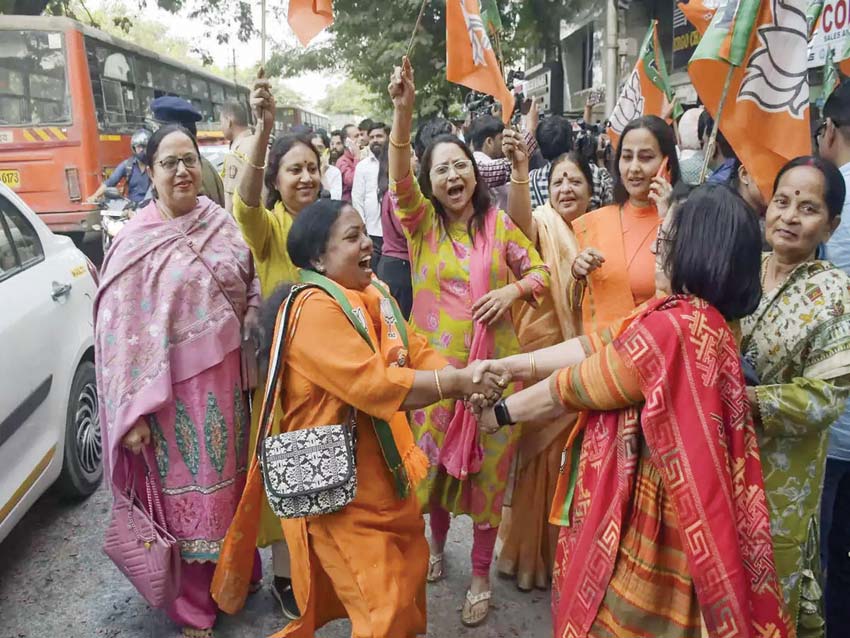
I do not know whether this was a one district phenomenon or an all Maharashtra syndrome but the results indicate that voters were very clear that BJP Shiv Sena (original) combine deserves to be in power, Ajit Pawar reaped the benefit of being in the right alliance.
It is difficult to analyse election results every second month yet Maharashtra results indicate fresh insight.
● The Shiv Sena as a Party promoted Marathi chauvinism throughout Maharashtra and especially in Bombay, a tactic which kept it in limelight. Despite being in alliance for decades nationalist BJP and Shiv Sena were representing two different classes of voters. Uddhav Thakre failed to control anti –UP, Gujrati undertones in his party. In the past people coming to take railway exams were attacked. However, present election campaign has broken this stereotype.
● Yogi Aditya Nath the chief minister from U.P has connected well with the state voters. If pursued in the right spirit then Marathi, Hindi and Gujarati speaking people can jointly take the state to the next level. It may also help the nation in resolving language based chauvinistic biases. The formation of states on the basis of languages was for enriching the culture. The dwarf politicians have used it to divide people. It is high time that Indians must be encouraged to practice their mother tongue while respecting other languages. Indian languages are like sisters and have many things in common with other languages prevalent in the nations. Many have common script and use words which are same or similar in other languages. There are many other issues in Maharashtra or elsewhere which can see resolution including the one given below.
“How Amit Shah reined in Maharashtra, Karnataka warring over Belagavi
The Union home minister met the CMs of both states to tone down the rhetoric ahead of the Karnataka legislature's winter session in the border city of Belagavi” India Today. Dec 20 2022.
● This election result may end the self-proclaimed invincibility of Sharad Pawar. The Ajit Pawar led split over NCP has emerged as the true NCP. This has shocked the naysayers who were assigning it the sixth position on the basis of exit poll.
● Better harmony between BJP and RSS. Falling short of a majority in the last general election helped BJP in correcting its strategies. The loud mouth local leaders were restrained from their unauthorised utterances.
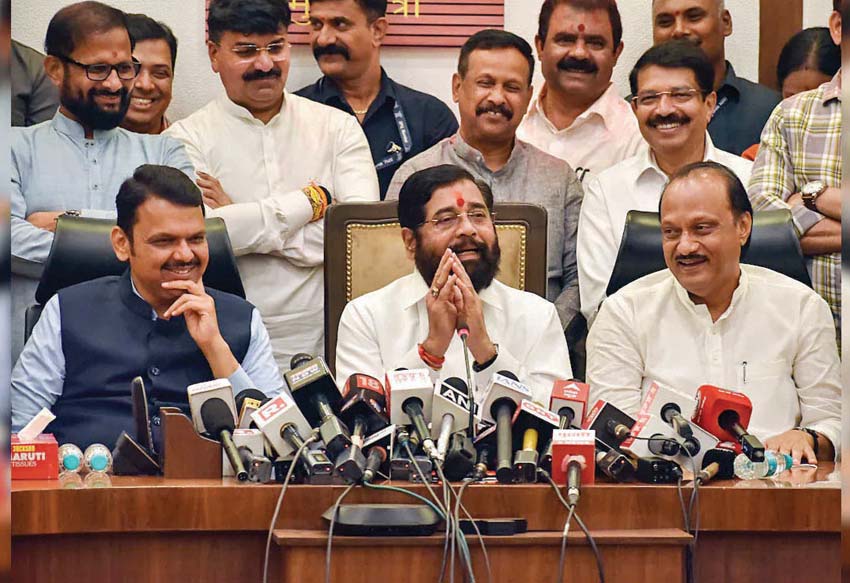
● Good governance matters. Eknath Shinde and Devendra Fadanvis have learnt to work in harmony. They have implemented many good welfare measures and promoted targeted welfare schemes like the Mukhyamantri Majhi Ladki Bahin Yojana, which provided direct cash benefits to women. These initiatives resonated deeply with rural voters.
● Shiv Sena Split: BJP successfully encouraged the dissenting MLas of the erstwhile Shiv Sena leading to the division within the Shiv Sena which further weakened the Maha Vikas Aghadi (MVA). The election results have trounced the faction led by Uddhav Thackeray (Shiv Sena - UBT) as it was decisively outperformed by the Eknath Shinde-led Shiv Sena, which aligned with the BJP.
MVA’s bad strategies helped Maha Yuti.
I.N.D.I alliance not learning from the Haryana election, The MVA's continued campaign strategies emphasizing a caste census and protecting the Constitution which failed to gain widespread traction. In contrast, the Mahayuti successfully combined welfare measures with targeted messaging to consolidate its voter base. Other factors which led to this debacle are:
Not controlling Sanjay Raut.
Shiv Sena used to take pride in Hindutva Politics. Shiv Sena chief Bal Thackeray was one of the first leaders of a political party to own up to his party role in the demolition of the disputed structure at Ram Janm Bhumi, claiming that it was his Shiv Sainiks who had struck the blow that brought down the domes of the masjid. When Sanjay Raut managed support from NCP and Congress to ditch BJP and form government, it did not go well with Shiv Sena workers at grass roots. At times Sanjay Raut acted as if he was the spokesperson of NCP. The general election has made it loud and clear that Indian voters do not appreciate arrogance.
Fight for supremacy among constituents of MVA.
all the three constituents were busy in ensuring that no other faction should get enough seats to dominate the alliance, it led to
● Prolonged negotiations for distribution of seats.
● Delay in declaring candidates.
● Not declaring the CM candidate.
● Friendly fights at places where no agreement could take place.
It demoralised the candidates, leaving little time for campaigning and division of votes.
“Friendly fights bled MVA heavily in the assembly polls, while Mahayuti managed to shield itself from heavy losses” TOI Nov 23 2024.
Consequences of Jharkhand election result.
The BJP vote share remained almost the same as in 2019 (33.37 %), while the JMM and Congress got more than five years ago (32.6%). Here the JMM rides the success of the similar welfare schemes meant for women.
The BJP campaign to “Protect roti, maati, beti (food, land and daughters)” of the tribals did not bring the desired result in the tribal belt. Is it because it is not coming from an insider, or the tribals converted to Christianity took it as an attack on them itself. Whatever may be the reason not getting support in the tribal belt is a reason to be worried abo ut. Jharkhand, being a state with a significant tribal population, elections pivot around tribal issues. Policies affecting tribal welfare, land rights, and forest conservation might be influenced by the results.
At least in 11 seats the votes polled by the Jharkhand Loktantrik Krantikari Morcha JLKM, which was floated only a few months ago, were more than the winning margin. This benefitted JMM. While BJP managed to avoid such divisions in Maharashtra, it failed to do so in Jharkhand.
Infiltration has reached alarming levels and time is not far away when BJP will face challenges similar to West Bengal where the high court, the media and the public are expressing concerns yet policy appeasement is winning elections. Right to pursue one's own religion is under threat when doing aarti, doing Durga Visarjan and taking out Shobha Yatra is coming under attack.
Political Realignment:
The election results could shift the balance of power between parties in the state. The results showed that the BJP did not open its account in Santhal Parganas, though its narrative appears to have worked to some extent in the North Chotanagpur region – a majority of which is urban – with the BJP and its allies winning 14 of the 25 seats here.
BJP ally All Jharkhand Students’ Union Party, which ended up with just one seat while it won just two in 2019, that time it had contested alone. Does it mean it suffered by aligning with BJP? Political think tanks have to analyse why the alliance failed to increase the vote share. Had All Jharkhand Students’ Union Party could have garnered a few more seats and added few percent more votes to BJP candidates the results would have been better. Not being able to bridge a small gap of vote percent has cost heavily as happened in Himachal Pradesh last time. It is surprising that electing a santhal woman as president of India has not been projected as empowerment of tribal causes.
Social and Tribal Impact:
Electoral outcomes could lead to enhanced representation and focus on marginalized communities. Given the strategic importance of Jharkhand in Indian politics as it has a significant tribal population. As BJP's performance doesn't meet expectations, the party may revisit its strategies on tribal welfare, land rights, and forest-related policies to rebuild support in tribal regions. The party may introspect and may attempt to strengthen alliances with regional parties or social groups, tailoring its policies to appeal to diverse electorates.
Election Strategy Refinement:
The results could lead the BJP to rethink its campaigning strategies, leadership choices, and local outreach programs in other states with similar demographics. The BJP might adjust its national messaging, emphasizing or de-emphasizing certain issues to align with regional sentiments, especially as Jharkhand's results reflect broader trends in voter expectations.
The road ahead.
The BJP’s performance in the recent Maharashtra and Jharkhand elections have created a unique position. Big leaders planning to join rajya sabha have no option other than looking to TMC. This has reduced the bargaining power of Congress creating disruption in I.N.D.I alliance. The election highlights critical areas for correction and strategy refinement to strengthen its appeal, especially in regions where opposition alliances like the INDIA bloc are gaining traction. Another area is Ajit Pawar opposing the ‘Batenge to Katenge’ slogan of BJP. With a not so clean image he has already given BJP a setback in public image when allegedly his name emerged in manipulating the Pune accident by a drunk neo rich during Parliamentary election.
The election highlights critical areas for correction and strategy refinement to strengthen its appeal, especially in regions where opposition alliances like the INDIA bloc are gaining traction. Another area is Ajit Pawar opposing the ‘Batenge to Katenge’ slogan of BJP. With a not so clean image he has already given BJP a setback in public image when allegedly his name emerged in manipulating the Pune accident by a drunk neo rich during Parliamentary election.
Key Areas for Correction:
1. Regional Focus and Local Leadership:
The BJP's reliance on national-level leadership and central campaigns needs balancing with strong local leaders who can resonate with regional and cultural identities.
A more nuanced understanding of state-specific issues, such as tribal rights in Jharkhand and farmer grievances in Maharashtra, is essential
2. Coalition Management:
Building and nurturing alliances with regional parties that complement BJP's agenda could be crucial. As already discussed above, the BJP alliance in Jharkhand neither increased the vote share of BJP nor the partner won more seats.
3. Social Welfare and Economic Policies:
● The success of the JMM-led alliance in Jharkhand underscores the importance of visible, impactful social welfare initiatives. The BJP must enhance its focus on delivering statespecific welfare schemes with measurable outcomes.
● Economic issues like unemployment and rural distress need targeted interventions to rebuild trust among rural voters.
4. Countering Opposition Alliances:
● The INDIA bloc's growing influence in smaller states demands a robust counter-strategy. This includes addressing allegations of centralization and ensuring that regional grievances are heard and resolved effectively.
Campaign Narrative:
● Overemphasis on polarizing issues like migration (as in Jharkhand) might have alienated moderate voters. A shift to inclusive narratives centered on development, education, and health could bring better results.
Improved Grassroots Engagement:
● Strengthening booth-level organization and direct voter engagement, particularly in tribal and rural areas, will help bridge the disconnect perceived in some regions.
5. Policy Execution and Communication:
● Effectively communicating the impact of central schemes, like PM-KISAN and Ayushman Bharat, at the local level is critical. Ensuring these schemes reach the intended beneficiaries without bureaucratic hurdles could regain voter trust.
Addressing these areas proactively could help the BJP regain lost ground and adapt to the evolving political landscape in states like Jharkhand.
By Rakesh kumar
(The content of this article reflects the views of writers and contributors, not necessarily those of the publisher and editor. All disputes are subject to the exclusive jurisdiction of competent courts and forums in Delhi/New Delhi only)














Leave Your Comment