


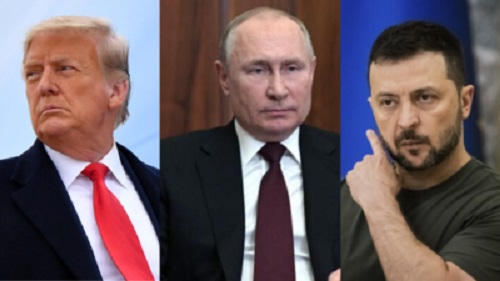
In a significant departure from its traditional allies in Europe, the United States has sparked controversy by siding with Russia in a United Nations vote on Ukraine. The move, orchestrated under the administration of newly elected President Donald Trump, has not only strained transatlantic relations but also cast doubts on Washington's evolving stance towards the Russia-Ukraine conflict.
The pivotal UN General Assembly vote witnessed the United States and Russia jointly opposing a resolution championed by European nations, particularly Ukraine, that explicitly condemned Moscow's invasion and demanded an immediate withdrawal of Russian troops. Despite widespread support with 93 votes in favor, the resolution faced opposition from 18 countries, with 65 others abstaining.
Initially proposing a more neutral resolution emphasizing peace without mentioning Russian aggression, the Trump administration encountered resistance when European amendments were successfully integrated into their draft. These amendments explicitly blamed Russia for the conflict, prompting the US to abstain from the final vote while Russia opposed it. Nevertheless, the revised resolution passed with 93 in favor, 8 against, and 73 abstentions.
The tensions escalated further when the US pushed its original draft for a vote in the UN Security Council, where it garnered approval from 10 members, but faced abstentions from five European nations. This sequence of events has underscored deepening divisions between the US, its European allies, and Ukraine, highlighting a shift in diplomatic strategy under the new administration.
President Trump's direct negotiations with Moscow, sidelining Ukraine and key European partners, have upended longstanding alliances and raised concerns about the US commitment to international solidarity. Recent inflammatory remarks by Trump, including labeling Ukrainian President Volodymyr Zelenskyy as a "dictator" and falsely accusing Ukraine of initiating hostilities, have further strained relations.
In response, President Zelenskyy criticized Trump for perpetuating Russian disinformation and emphasized Ukraine's inherent right to self-defense. Meanwhile, European leaders, once united with the US on Ukraine, now find themselves at odds with Washington's evolving policy.
US Deputy Ambassador Dorothy Shea defended the administration's approach, arguing that previous UN resolutions condemning Russia had failed to halt the conflict. She emphasized the need for a resolution that would secure commitments from all UN member states to achieve a lasting peace.
Ukrainian Deputy Foreign Minister Mariana Betsa reiterated Ukraine's plea for international support, urging nations to stand on the side of justice, humanity, and uphold the UN Charter. The General Assembly, given the Security Council's impasse due to Russia's veto power, has assumed a critical role in addressing the crisis.
Despite Russia's persistent opposition and attempts to shift the focus away from its actions, the international community, through resolutions like the one adopted, continues to demand the immediate cessation of hostilities and the withdrawal of Russian forces. The resolution also reaffirms that territorial gains through aggression will not be recognized as legal.
Russia's Ambassador to the UN, Vassily Nebenzia, initially praised the US-initiated resolution before expressing dissatisfaction with the European amendments. Moscow had also proposed its own amendment focusing on addressing the root causes of the conflict, but it was ultimately omitted from the final text.
As the world watches developments unfold at the UN, the divergence in US policy under President Trump marks a pivotal moment in international diplomacy, with implications far beyond the immediate Ukraine crisis. The fallout from these diplomatic maneuvers will likely shape global alliances and strategies in the uncertain times ahead.





















Leave Your Comment