


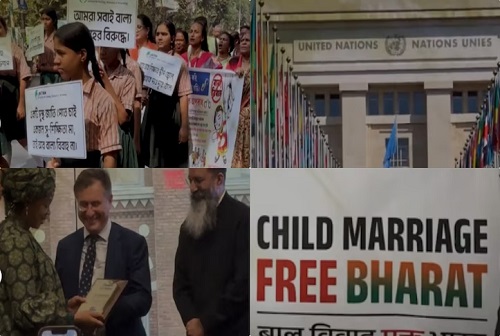
In a significant boost to the global campaign against child marriage, the United Nations has designated November 27 as the International Day for the Elimination of Child, Early and Forced Marriage. The decision marks an important step in strengthening international efforts to protect children from early and forced marriages and promote their right to education, health, safety and a dignified future.
The UN resolution is also being viewed as a major global recognition of India's growing efforts to eradicate child marriage. The development comes as a particular milestone for the Just Right for Children campaign and NDTV's campaign against child marriage, which have been working together on the Child Marriage Free India campaign since 2023.
The initiative has sought to build wider public awareness around the social and economic consequences of child marriage while encouraging communities, institutions and governments to take concrete action to prevent the practice.
The push for a dedicated international day gained momentum through the efforts of Bhuwan Ribhu, founder of Just Rights for Children, who proposed that the United Nations establish a specific day dedicated to the elimination of child marriage. The proposal subsequently found support at the international level.
The resolution was tabled at the United Nations on September 4 by Sierra Leone and was subsequently adopted, giving the fight against child, early and forced marriage a dedicated place on the international calendar.
The choice of November 27 has an especially strong connection with India's campaign. The date marks the launch of the Government of India's 'Bal Vivah Mukt Bharat' campaign in 2024, aimed at eliminating child marriage through greater awareness, community participation and stronger enforcement of existing laws.
Welcoming the UN's decision, Bhuwan Ribhu described the development as a matter of immense pride for India. Ribhu was the only civil society representative invited to the United Nations during the adoption of the resolution, underlining the role played by civil society organisations in bringing the issue to the centre of global attention.
The designation of an international day is expected to provide fresh momentum to efforts against child marriage by creating an annual platform for governments, civil society organisations, educational institutions and communities to highlight the issue and intensify preventive measures.
Child marriage remains a complex social challenge, often linked to poverty, lack of education, gender inequality and entrenched social practices. Beyond violating children's rights, early marriage can disrupt education, increase vulnerability to health risks and restrict economic opportunities.
The UN's decision therefore represents more than a symbolic recognition. It provides an opportunity to sustain international attention on the issue and encourage countries to translate commitments into action.
For India, November 27 will now carry a dual significance—marking both the country's Bal Vivah Mukt Bharat campaign and the world's collective commitment to eliminating child, early and forced marriage. The development could further strengthen India's efforts to build a future in which every child has the opportunity to grow, learn and choose their own path without being forced into marriage at an early age.



















Leave Your Comment