


Bhubaneswar has hosted many conferences, policy meetings, and public events, but the atmosphere inside Swosti Premium on Sunday, January 18, felt different in texture and intention. There was the familiar formality of a major conclave, security checks, name badges, bustling volunteers, photographers mapping angles, but there was also something more intimate: the sense that a room full of people had arrived not only to listen, but to belong to a shared undertaking.
That undertone became clearer as the day unfolded. The Uday India National Conclave 2026 was not positioned as a conventional seminar that ends with applause and disperses into polite memories. It was framed, and repeatedly reaffirmed, as a civic bridge; a platform where public representatives, policy minds, professionals, and citizens could meet the State’s Vision 2036 and Vision 2047 with seriousness, optimism, and a sense of responsibility aligned with Prime Minister Narendra Modi Ji's Vision of Viksit Bharat 2047. The gathering brought together Ministers, Members of Parliament, MLAs, senior bureaucrats, doctors, educators, industry leaders, entrepreneurs, journalists, lawyers and advocates, retired judges, defence forces veterans, civil society leaders, youth, student, religious and spiritual voices, not as a token audience, but as stakeholders invited to contribute ideas, energy, and ownership.
Odisha today speaks in two time registers at once. One register is immediate: livelihoods, service delivery, resilience against disasters, and the everyday aspirations of families across cities, towns, and villages. The other register is long-term: the State’s centenary in 2036 and the national milestone of 2047, with a vision to become more prosperous, more capable, and more globally present. The conclave attempted to hold both registers together, and to do so without cynicism. Again and again, speakers returned to a simple civic truth: a vision becomes real only when institutions and citizens feel responsible for it together.
By the time the valedictory session concluded, one theme had settled into the room like a shared refrain: 2036 is not merely a date on a timeline. It is a milestone that invites participation, across institutions, professions, communities, and generations.
In one day, the conclave stitched together four pillars, Health, Education, Infrastructure & Development, and Tourism & Culture, while also recognising public leadership and citizen excellence through awards for Outstanding Parliamentarians, Legislators, and the Uday India Pratibha Samman. The enduring takeaway was a pledge: Uday India will carry the Vision 2036 and Vision 2047 conversation beyond Bhubaneswar, to blocks, villages, and regions across Odisha, compiling recommendations for submission to the Government.

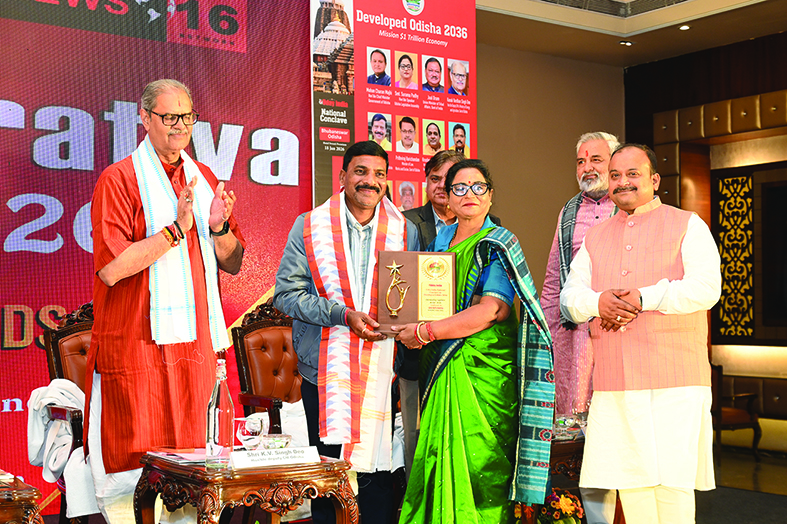
Rupu Bhatra. MLA , Kotpad, receiving Outstanding
Legislator Award from speakar Surama Padhy
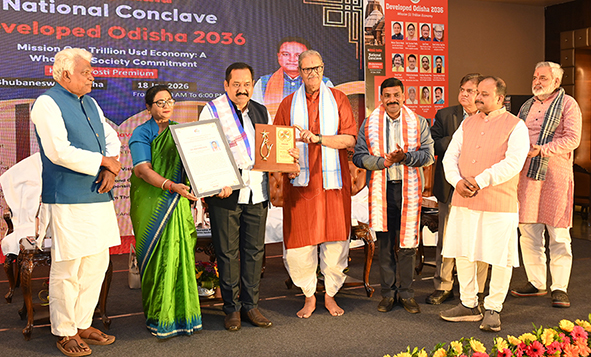
Amar Nayak, MLA, Barchana, receiving Outstanding Legislator
Award from Deputy CM K.V. Singh Deo
In one day, the conclave stitched together four pillars, Health, Education, Infrastructure & Development, and Tourism & Culture, while also recognising public leadership and citizen excellence through awards for Outstanding Parliamentarians, Legislators, and the Uday India Pratibha Samman. The enduring takeaway was a pledge: Uday India will carry the Vision 2036 and Vision 2047 conversation beyond Bhubaneswar, to blocks, villages, and regions across Odisha, compiling recommendations for submission to the Government.

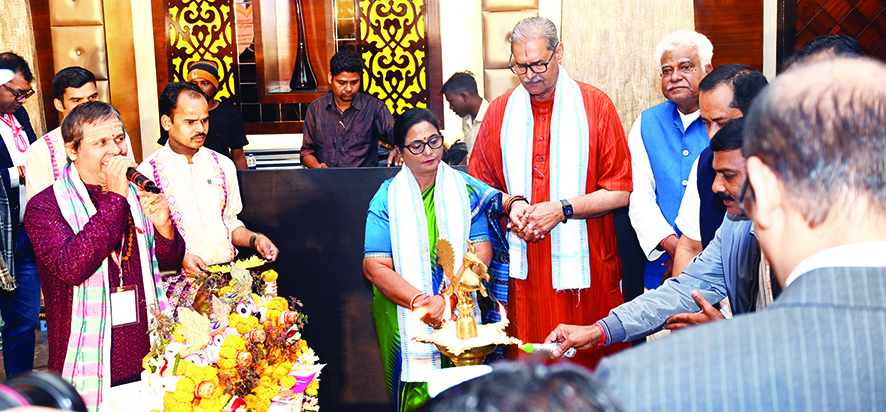
The first moments of a public gathering often tell the story of what the organisers truly value. At Swosti Premium, the day opened not with a hurried rush into speeches, but with a deliberately crafted sense of sacredness and symbolism. Vedic chants filled the air as dignitaries assembled on stage for the ceremonial Lighting of the lamp before Lord Jagannath, invoking clarity, learning, and collective purpose. It was not simply protocol; it worked like an emotional anchor, reminding the hall that Odisha’s development conversation, at its best, is not only about targets and timelines, but also about values, duty, integrity, compassion, and service.
The gesture that stayed with many participants was the welcome with Tulsi plants. In Odisha, Tulsi is not merely botanical; it is cultural memory, purity, healing, and a quiet daily discipline of care. Presented to guests as a mark of respect, it also signalled an ethic: development must remain aligned with ecology and wellbeing.
As the hall settled, the audience composition itself became a statement. Rows included senior doctors in crisp formal attire; academics taking notes with the ease of experienced listeners; industry leaders conferring quietly before panels began; journalists tracking quotable lines; advocates and lawyers observing governance vocabulary closely; civil society leaders greeting one another like old collaborators; defence veterans sitting with calm attention; and spiritual voices whose presence reminded everyone that society’s moral imagination matters in development.
When Vision Meets the Public Square
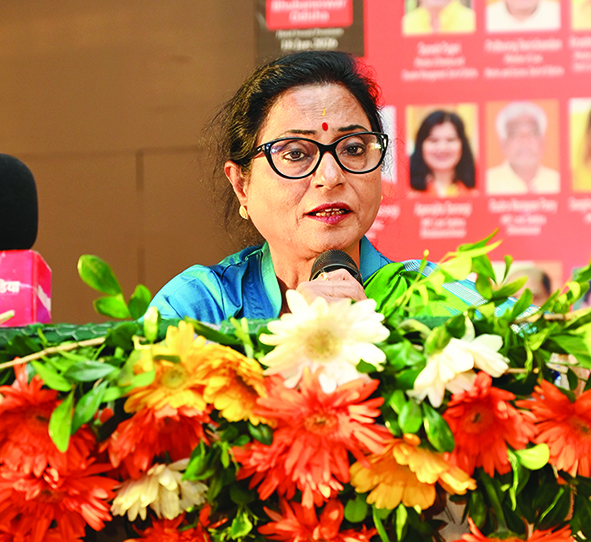
The inaugural session set the day’s intellectual and civic tone. As the Hon’ble Speaker of the Odisha Legislative Assembly, Smt. Surama Padhy, took the stage, the hall’s energy shifted from anticipation to attentive stillness. Her address was notable not merely for the authority of her office, but for its insistence that governance in the next decade must become more participatory, more collaborative, and more rooted in shared ownership.
“Odisha’s journey to 2036 must be rooted in collaboration. When citizens, institutions and policymakers come together, development becomes a shared destiny and not a distant aspiration.”
-Smt. Surama Padhy, Hon’ble Speaker, Odisha Legislative Assembly
Her words landed with a calm force. The line “shared destiny” travelled quickly, first as an applause line, then as a phrase repeated in hallway conversations. The Speaker’s emphasis was not on abstract optimism but on a governance principle: institutions perform best when citizens feel that the story belongs to them. Participatory governance, in her framing, was not an optional add-on; it was the bedrock of reforms that must endure across administrations and across the unpredictable pressures of time.
She acknowledged the special significance of 2036, the centenary year of Odisha’s statehood, while reminding the hall that the value of a centenary is not in celebration alone but in achievement. In that sense, the Speaker’s inaugural message served as both invitation and challenge: if Odisha wants a “Developed Odisha 2036,” it must build the habit of cooperation now, while the window of opportunity remains open.
Odisha is Ready for Its Finest Decade : K.V. Singh Deo
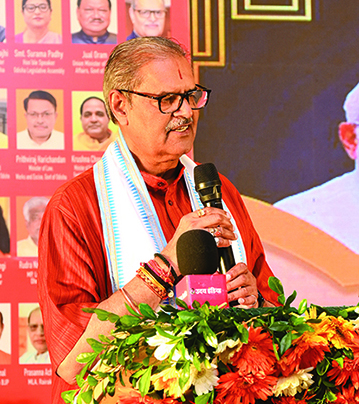
If the Speaker’s address provided the moral grammar of participation, the keynote by Shri Kanak Vardhan Singh Deo, Hon’ble Deputy Chief Minister of Odisha, brought the conversation into the realm of momentum, what can be done, and how quickly Odisha can do it when governance and people’s participation align. From the first lines, his speech carried an unmistakable confidence. He described the present moment as one in which Odisha can move from incremental progress to visible transformation.
The hall responded warmly. There was applause at key points, not as automatic politeness but as affirmation that the State is ready to think big. The Deputy CM highlighted reforms in infrastructure, industrial growth, social development, and governance efficiency, framing these not as isolated departmental tasks but as a connected mission. His address also drew attention to Odisha’s civilisational identity, its temples, traditions, and arts, and argued that Odisha’s development must not dilute its cultural core.
A striking element of his keynote was a call for responsible public discourse: what needs to be reported and shared, he suggested, should be done in the correct perspective, so that public understanding grows rather than fractures. It was received as a reminder that development requires not only plans and budgets but social trust, and that trust is strengthened when public communication stays constructive, accurate, and aligned with the broader vision.

Helping the conclave maintain its emotional balance between policy seriousness and civic celebration was the awards segment in the inaugural session. This segment honoured Outstanding Parliamentarians and Legislators, and also recognised prominent individuals through the Uday India Pratibha Samman. The stage, momentarily, became a place of gratitude, where the public could see leadership acknowledged in full view, and where honourees could accept recognition not as personal triumph alone but as a call to sustain public service and public excellence.
In the MP and MLA categories, the awards underscored the role of public representatives as carriers of people’s hopes. In addition, the Uday India Pratibha Samman recognitions expanded the definition of “public contribution” beyond politics. The recipients included individuals from social work, entrepreneurship, culture, and community leadership, each representing a dimension of Odisha’s living strengths.
The applause in this segment felt especially warm because it came from a mixed audience, professionals applauding public leadership, citizens applauding achievers, and leaders applauding community role models. It became a reminder that development is sustained by examples: visible lives that demonstrate what commitment looks like.

Smt Swati Kumar receives Outstanding Parliamentarian Award on behalf
of Shri Sujeet Kumar, MP ( Rajya Sabha) from the Deputy CM K.V. Singh Deo
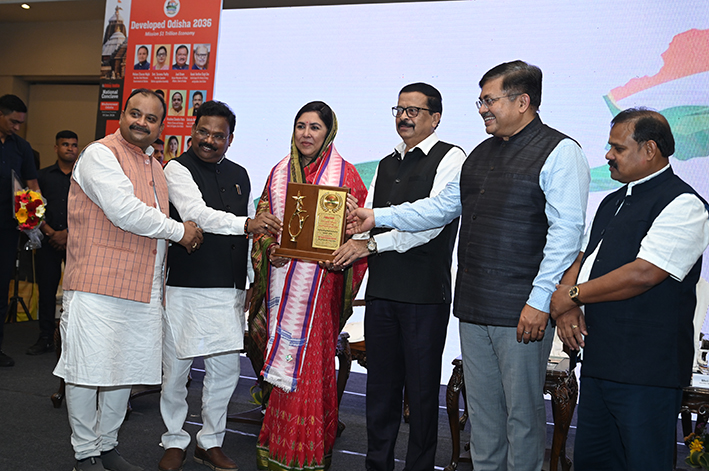
Smt Sangita Singh Deo, MP (Lok Sabha), receives Outstanding
Parliamentarian Award from Revenue Minister Suresh Pujari
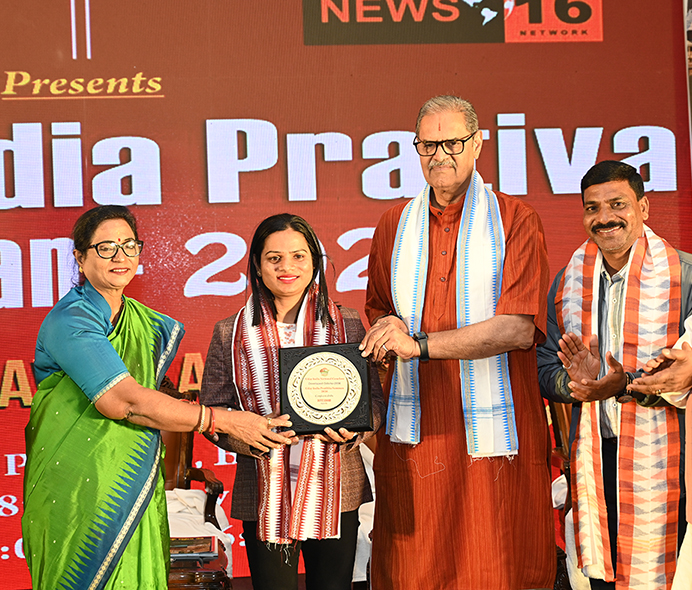
International athlete & Olympian, Dutee Chand, receiving Uday India Pratibha Samman
from Speaker Surama Padhy & Deputy CM K.V. Singh Deo
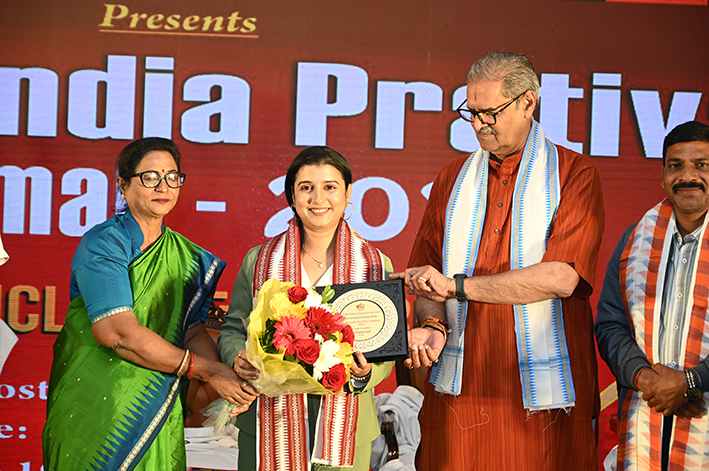
Renowned playback singer, Smt. Dipti Rekha Padhi, receiving
Uday India Pratibha Samman from Deputy CM and Speaker
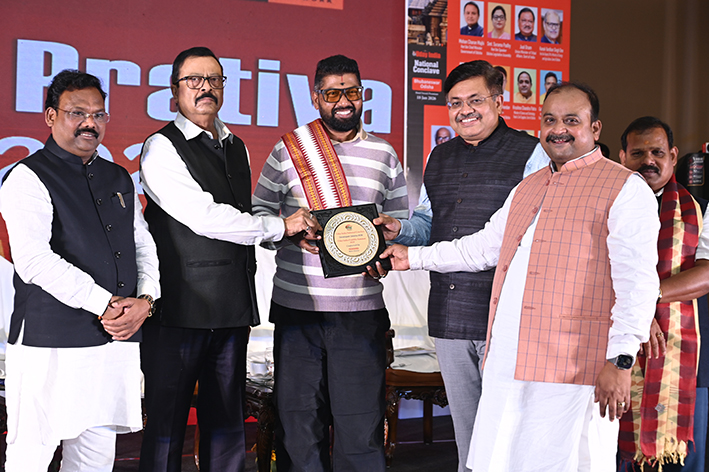
Renowned music director & composer, Prem Anand, receiving
Uday India Pratibha Samman from Revenue Minister Suresh Pujari and Law Minister Privthiraj Harichandan
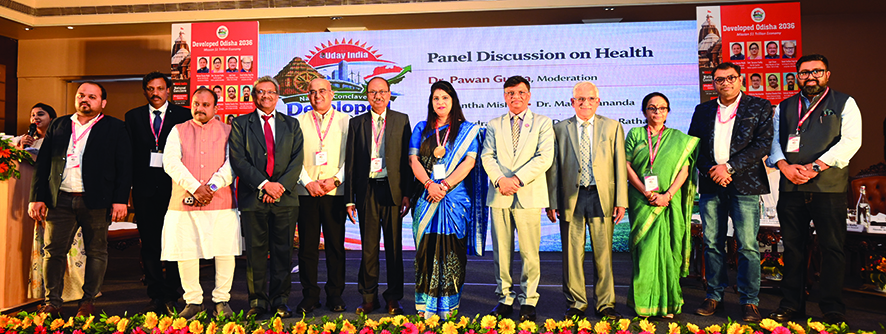
Dr. Pawan Gupta along with Dr. Neelkanth Mishra, Dr. Surendra Senapati,
Dr. BN Mohanty, Dr. Madhav Nanda, Dr. Mami Parija, Dr. Arvind Rath along with
Inner Wheel District Chairman Madhusmita Tripathi were present during the
discussion in the health session.

The Health session opened with a certain urgency in the room, the kind that appears when people know the topic is not theoretical. Health, after all, touches every household. Moderated by Dr. Pawan Gupta, the panel brought together healthcare professionals and voices who approached Odisha’s health future as both a policy and a moral concern: how does a State create systems that prevent suffering, protect families from catastrophic expenditure, and ensure that care is not a privilege but a guarantee?
The tone of this session was a blend of scientific seriousness and social empathy. Speakers spoke of cancer care, public health systems, research linkages, palliative innovation, and community health initiatives, especially the role of women-led models in strengthening last-mile wellbeing. The audience listened closely, and at moments of strong clarity, nods spread across rows like waves.
One intervention stood out for its bluntness and public-health clarity: the warning about tobacco as a driver of multiple diseases, including cancer. The speaker framed tobacco not as a personal habit alone but as a societal risk, noting that it affects nearly every part of the body and is linked to a vast range of diseases. The phrasing was direct, the delivery almost like a public service announcement, and the hall responded with a hush that signalled recognition.
Rather than remaining at the level of diagnosis, the session consistently returned to solutions: awareness, prevention, early detection, strengthened primary care, and improved research linkages. The panel’s underlying message was that Odisha’s ambition to be a healthcare leader in eastern India will require systematic investment, physical infrastructure, human resources, and community-based approaches that reduce disease burden before it reaches hospitals.
As the session concluded, the applause was thoughtful rather than loud, an applause that carried the weight of agreement. The Health session did what such sessions should do: it made the room feel that health is not one pillar among many, but the ground on which all other pillars stand.
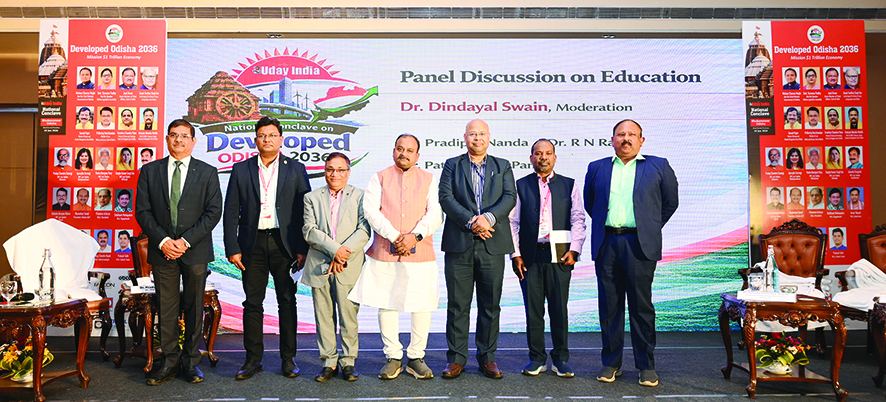
Dr. Deendayal Swain along with Dr. Pradipta Nanda, Dr. R.N. Rath,
Dr. Patitpavan Panda, Dr. Ishwar Chandra Nayak, and senior journalist
Jatin Das were present in this special session.
If Health spoke to survival and dignity, the Education session spoke to possibility. Moderated by Dr. Dindayal Swain, the panel explored what it would take for Odisha to become a Knowledge State by 2036, one in which universities and schools are not only institutions of credentialing but engines of capability, research, and employability.
The session’s tone was aspirational, sometimes even impatient in the best sense: impatient with mediocrity, impatient with slow reform, impatient with the disconnect between degrees and jobs. Speakers emphasised future-ready universities, research ecosystems, NEP 2020 alignment, and employability-driven programmes. There was a repeated call for deeper synergy among academia, industry, and government, not as a slogan but as a practical necessity.
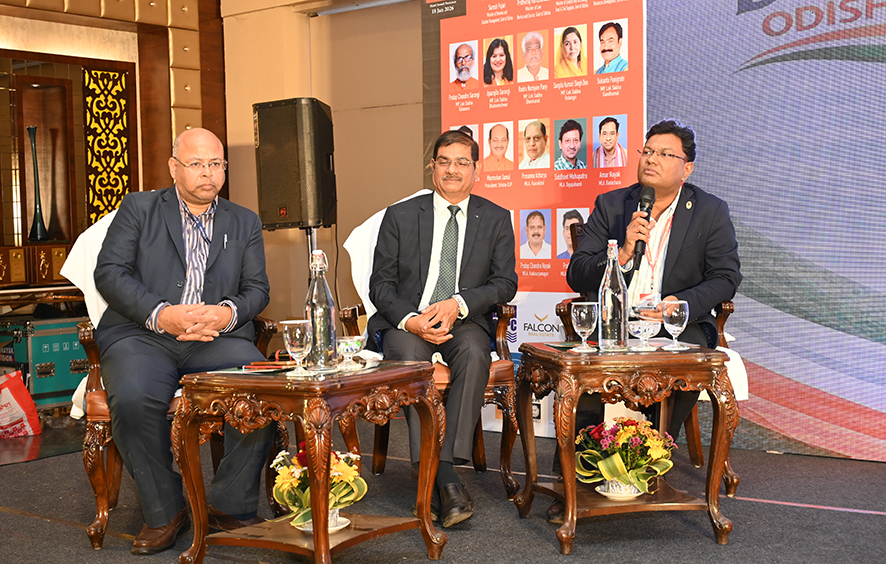
The audience included many educators, and their engagement was visible. Some leaned forward as statistics and system-level observations were mentioned; others scribbled notes when the discussion turned to implementation bottlenecks. The most resonant interventions were those that acknowledged complexity without surrendering to it, recognising that India has a vast higher education landscape and that reforms take time, but insisting that urgency must shape execution.
There was also a broader philosophical current in this session: that education is the most durable form of infrastructure. Roads can be built; ports can be expanded; industries can be invited. But without a population that can learn, adapt, innovate, and collaborate, development becomes fragile. The panel suggested that Odisha’s long-term competitiveness will depend on how well it cultivates talent and how confidently it can position its institutions as part of a national and global knowledge network.
When the session closed, the applause came with a visible sense of agreement, particularly from younger participants who seemed to recognise their own futures being discussed on stage.
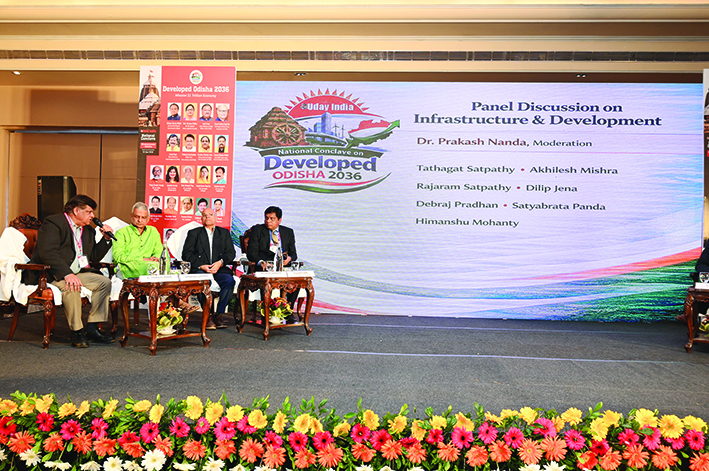
Dr. Prakash Nanda along with Editor of Dharitri, Tathagata Satpathy,
Senior Editor Rajaram Satpathy, academic Prof. Sarat C Das,
Devraj Pradhan, political leader Sajjan Sharama and Senior Journalist Sriram Dash
contributed to this special session.
The third session, moderated by veteran journalist Dr. Prakash Nanda, carried the energy of a strategy room. Infrastructure and development can be technical topics, but this discussion found a way to remain both concrete and visionary. It ranged across digital infrastructure, agriculture innovation, rural-urban connectivity, tech-driven governance, logistics, media ecosystems, and entrepreneurship, each treated as part of a single growth engine rather than isolated subsectors.
The room’s texture shifted here: industry leaders listened with the alertness of people who work with timelines and bottlenecks; policy watchers listened for signals of direction; younger entrepreneurs listened for pathways; and journalists listened for metaphors that can travel to readers.
One of the session’s most discussed moments came when a speaker challenged a common comparison made in popular conversations, “Odisha should be like Singapore”, and suggested that the better aspiration may be to learn from a model that leveraged coastal assets and ports to integrate with the global economy. The example offered was South Korea, presented not as a perfect template but as a more structurally meaningful reference.
The argument drew attention to Odisha’s strategic advantages: a long coastline, significant resources, and the possibility of building world-class logistics and port-linked industries. The broader point was that infrastructure is not only about building projects; it is about creating systems that connect Odisha to the world, economically, digitally, and culturally.
Climate resilience appeared repeatedly as a non-negotiable. Odisha’s lived experience of disasters has made resilience a practical imperative, not an abstract sustainability line. Speakers stressed the need for climate-conscious infrastructure that protects communities while enabling growth. This included not just physical infrastructure but governance systems, transparent processes, timely delivery, and a culture of accountability.
As the session ended, the applause was stronger and louder than earlier sessions, perhaps because infrastructure gives people a sense of tangible progress. Yet the mood remained grounded: the hall seemed to agree that ambitious infrastructure must be matched with institutional capability.
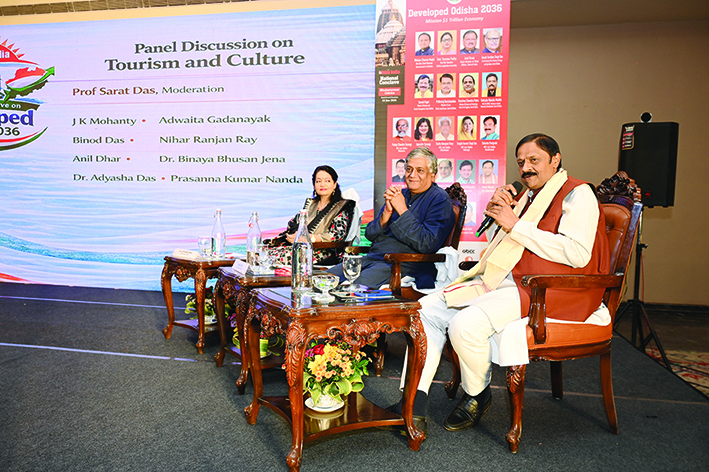
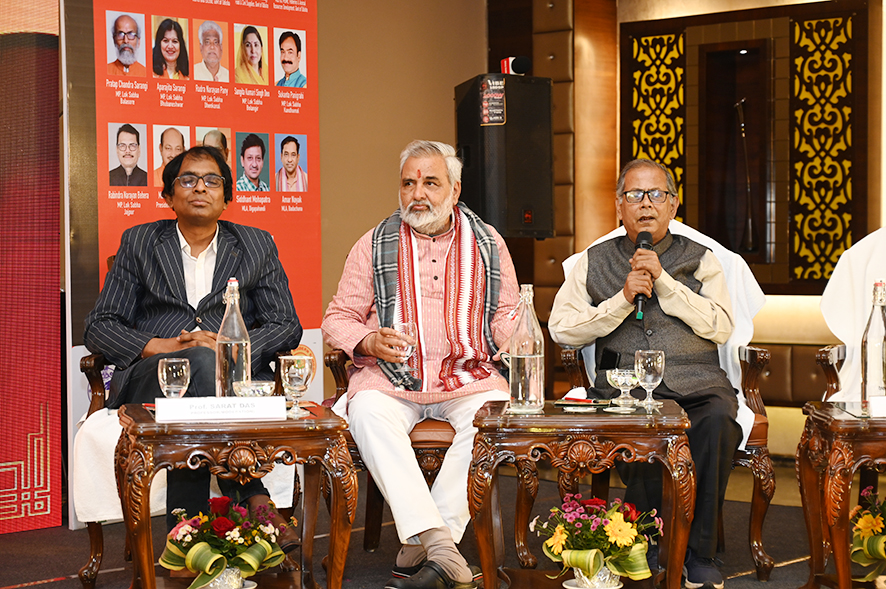
During this session, Indian sculptor Advaita Ganayak,
Fashion expert Dr. Binaya Bhusan Jena, WHO Regional Coordinator Nihar Ranjan Roy,
Tourism expert Dr. Adyasha Das, historian Anil Dhar, Murali Manohar Sharma and
Senior Advocate Prashanna Kumar Nanda were present.
The Tourism & Culture session, led by Prof. Sarat Das, felt like the conclave’s heart. Where earlier panels spoke in the language of systems and strategies, this session spoke in the language of identity, of what Odisha is, what it carries, and what it can offer the world.
The discussion celebrated Odisha’s classical arts, temple architecture, eco-tourism circuits, sculpture traditions, and emerging cultural diplomacy. Speakers described Odisha not as a state with “tourism potential” but as a civilisation with layered stories: coastal landscapes, forests and hills, lakes and valleys, living crafts, sacred geographies, and communities whose oral traditions carry histories older than many written archives.

At one point, the session’s tone shifted from celebration to candid realism. A speaker noted that despite Odisha’s abundance of natural and built heritage, the tourism potential may have been “unlocked” only partially so far. The remark did not land as criticism; it landed as invitation.
Another important thread was the need to recognise tribal heritage as central to Odisha’s cultural wealth. A compelling observation reminded the hall that the absence of written texts does not mean the absence of history, culture, or depth. Tribal traditions, preserved through oral continuity, deserve visibility, respect, and inclusion in Odisha’s cultural narrative.
The audience response in this session was warm and visibly proud. There were smiles at shared references, nods at familiar cultural truths, and applause that carried affection. The session suggested a development pathway that is both economic and civilisational: Odisha can build a sustainable tourism economy without flattening its heritage, by designing experiences that are community-led, ecology-respecting, and globally attractive.

Valedictory Session: (L-R) Smt. Sangita Singh Deo,
Hon'ble MP, Lok Sabha; Shri Deepak Kumar Rath, Group Editor, Uday India;
Shri Gokula Nanda Maallik, Hon'ble Minister; Shri Suresh Pujari, Hon'ble Minister,
Shri Prithviraj Harichandan, Hon'ble Minister; and Shri Pratap Chandra Nayak, Hon'ble MLA
A conclave is made not only by speeches but by the spaces between them: the lobby conversations, the tea-break reflections, the quick phone calls to colleagues in districts, the friendly debates near the photo backdrop. Throughout the day, those “between moments” carried the same energy as the stage: curiosity and seriousness, mixed with the quiet pride of being Odia in a State that is beginning to speak more confidently about its place in India and the world.
In one corner, a doctor discussed public health prevention with an educator, connecting lifestyle awareness to school curricula. Nearby, an entrepreneur spoke to a civil society leader about local value chains and livelihood creation. A journalist compared notes with a lawyer about language used to describe governance accountability. A defence veteran listened to a cultural expert discuss tourism circuits and remarked on how pride in heritage strengthens social cohesion. These were not formal panel interactions, yet they represented the conclave’s deepest ambition: to let cross-sector conversations happen naturally, without forcing artificial consensus.
Even the lunch interval carried the feeling of purposeful conversation. Around round tables and along the buffet line, introductions happened quickly, “Which district are you from?” “Which sector do you work in?” followed by the more serious question: “What do you think Odisha must prioritise first?” Some answered with a single word, “health,” recalling the day’s earlier warnings about preventable disease. Others said “Education and Skills,” pointing to a youth population that needs pathways. Industry voices spoke of connectivity, approvals, and logistics; cultural voices spoke of storytelling, circuits, and hospitality; and civil society leaders spoke of inclusion and last-mile participation.
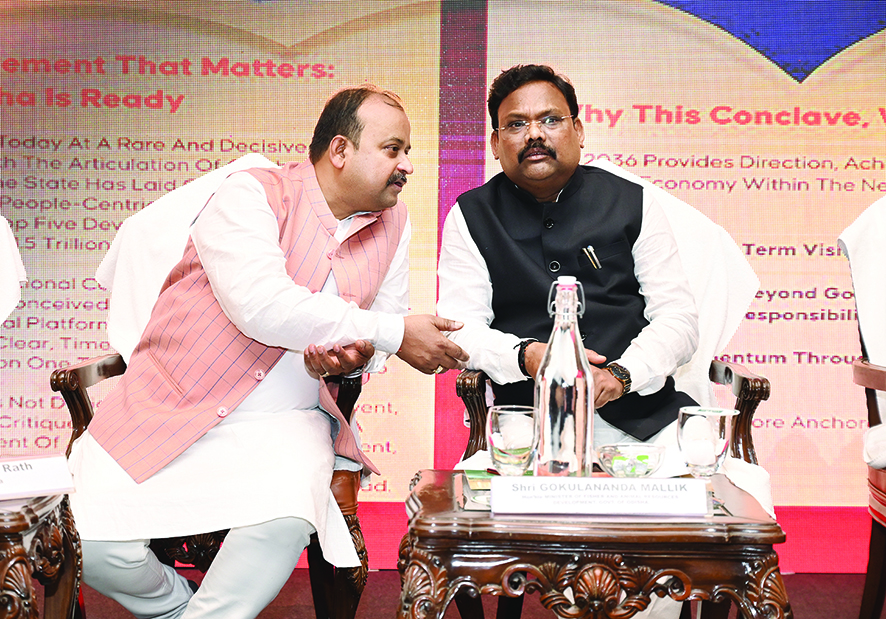
Shri Deepak Kumar Rath with Shri Gokula Nanda Mallik,
Hon'ble Minister of State for Fisheries, Animal Resources & MSME
What was striking was the absence of partisan heat. The tone was pragmatic: people wanted solutions, partnerships, and continuity. Several participants remarked that such platforms are valuable when they repeat over time and travel beyond the capital, because Odisha’s aspirations do not live only in Bhubaneswar, they live in district towns, in tribal belts, in coastal livelihoods, in industrial clusters, and in the everyday dreams of families.
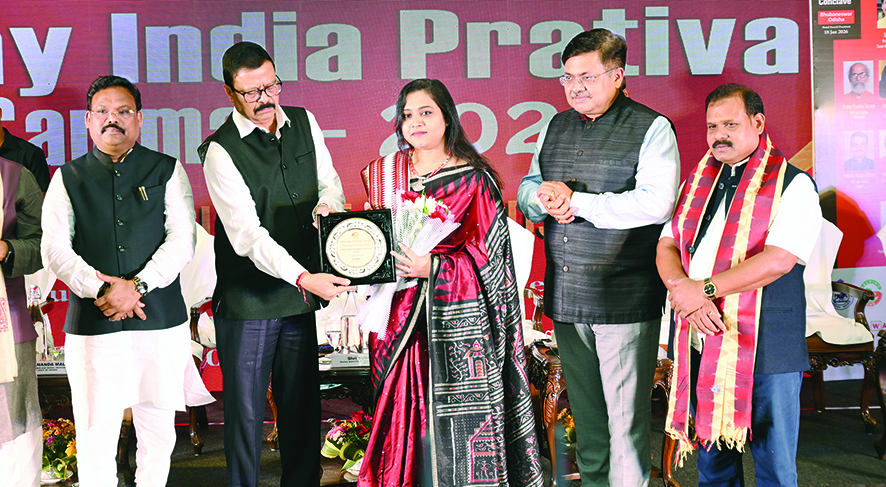
Alee Padhy, renowned social activist, receiving Uday India Pratibha Samman
from Revenue Minister Suresh Pujari and Law Minister Prithviraj Harichandan
As evening settled, the conclave moved into its valedictory session, a segment designed not only to conclude but to consolidate. The hall, though now deep into a long day, remained attentive. There was a sense that something had been built: a shared vocabulary, a set of priorities, and an emerging pledge that the conversation would not end at the hotel doors.
The valedictory opened with warm welcomes and the ceremonial presentation of Tulsi plants to dignitaries, once again signalling the ethical thread connecting tradition, ecology, and modern development. Then came a moment of synthesis: the Rapporteur’s Report.

Sriram Dash, senior journalist, receiving Uday India Pratibha Samman from
Revenue Minister Suresh Pujari and Law Minister Prithviraj Harichandan
Rapporteur’s Report: Capturing the Day’s Collective Intelligence
Prof. KK Dash presented the Rapporteur’s Report, summarising insights and recommendations emerging from the day’s discussions. The report worked like a mirror held up to the conclave: it reflected the convergence points, the recurring priorities, and the deeper call for civic participation.
The report emphasised that deliberations should translate into action pathways, through sustained dialogue, sectoral collaboration, and citizen engagement that reaches beyond urban centres. The tone was both appreciative and urgent: appreciative of what had been achieved in the room, and urgent about taking the conversation to every region and community.

The valedictory session featured prominent leaders who echoed their support for the 2036 mission and appreciated Uday India’s role in convening cross-sector dialogue. Among those present were Smt. Sangita Kumari Singh Deo, Member of Parliament; Shri Pratap Chandra Nayak, MLA (Kabisuryanagar); Shri Gokula Nanda Mallik, Minister of Fisheries, Animal Resources Development & MSME; Shri Prithiviraj Harichandan, Minister of Law, Works & Excise; and Shri Suresh Pujari, Minister of Revenue & Disaster Management.
Each address carried a shared theme: Odisha’s development cannot be delivered by government alone. It must become a collective enterprise in which citizens participate actively and institutions partner sincerely.
Shri Prithiviraj Harichandan emphasised inclusive governance and called the conclave one of Uday India’s meaningful contributions, urging the organisation to take similar discussions to southern, northern, and western Odisha so that people everywhere can voice their dreams for the future.
Shri Gokula Nanda Mallik praised the conclave for bringing diverse experts together and underscored the role of fisheries, MSMEs, and rural enterprises in equitable growth. His emphasis on dignity for communities, farmers, fishermen, and rural entrepreneurs, resonated strongly with the hall.
Smt. Sangita Kumari Singh Deo described the initiative as timely, necessary, and aligned with the aspirations of a rising Odisha, while Shri Pratap Chandra Nayak urged Uday India to expand such dialogues into remote regions to capture local perspectives. Shri Suresh Pujari reiterated the long-term development strategy and encouraged more platforms that deepen dialogue and collective understanding; he also encouraged preparation of a detailed report for State and Central governments.
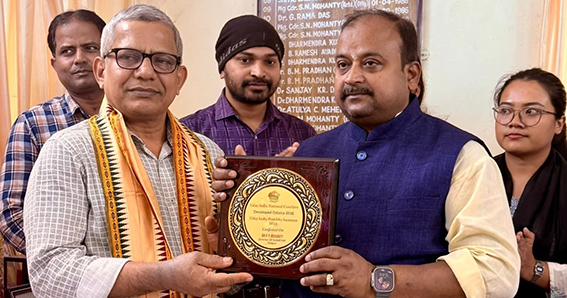
Dr. P. P. Mohanty, Director, SVNIRTAR, Olatpur, Odisha, receiving Uday India Pratibha Samman
The valedictory session also recognised outstanding individuals for their contributions to society and community development under the Uday India Pratibha Samman. Among those felicitated were social activist Alee Padhi, Dr. PP Mohanty of SVNIRTAR (Olatpur), renowned music director Prem Anand, entrepreneurs Manoj Pradhan and Prashant Kar, along with MP Smt. Sangita Kumari Singh Deo and MLA Shri Pratap Chandra Nayak. The recognitions celebrated excellence across public service, entrepreneurship, culture, and leadership, bringing the conclave’s theme back to its human centre: development is built not only through plans but through people.

If one sentence defined the conclave’s continuity beyond the day, it was the pledge articulated by Shri Deepak Rath, Founder and Group Editor of Uday India. He described the conclave as a bridge connecting citizens to policymakers and ideas to action, and he reaffirmed Uday India’s commitment to take this initiative beyond Bhubaneswar, to blocks, villages, and every corner of Odisha, so that citizens become active participants in shaping the State’s developmental agenda. He confirmed that Uday India would compile recommendations emerging from the conclave and present them formally to the Government.
The pledge carried special weight because it responded to what multiple leaders requested during the valedictory: expand such dialogues into diverse regions, include local perspectives, and convert the vision into a public conversation that reaches families, not only institutions. The conclave thus ended not as a completed project, but as the beginning of a movement-shaped agenda.




















Leave Your Comment