


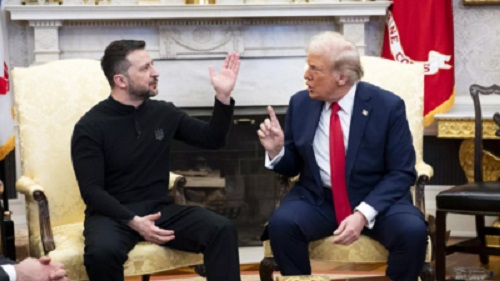
In a bold move that has sent shockwaves through diplomatic circles, President Donald Trump has decided to suspend American military assistance to Ukraine, citing the country's perceived reluctance to commit to peace negotiations with Russia. This decision comes mere hours after a contentious exchange between Trump and Ukrainian President Volodymyr Zelenskyy, where the latter suggested that an end to the conflict with Russia was still a distant prospect.
The suspension of military aid is accompanied by reports that the Trump administration is contemplating easing sanctions on Russia, a move that underscores a potential shift in U.S. foreign policy towards Moscow. Just a day earlier, the Pentagon had announced the cessation of offensive cyber operations against Russia, further signaling a thaw in tensions between the two nations.
Zelenskyy, who recently sought support from NATO allies in London following a contentious visit to the United States, finds himself at the center of a geopolitical realignment. The Trump administration's decisions appear to align Washington more closely with Moscow on issues pertaining to Ukraine, effectively sidelining NATO's stance on the conflict.
U.S. officials have carefully chosen their words, describing the aid suspension as a "pause" that could be reversed if Ukraine demonstrates a more conciliatory approach towards peace talks. However, this move is widely interpreted as a demand for capitulation on Trump's terms, prompting sharp reactions from both Ukrainian leadership and American lawmakers.
Senator Lindsey Graham, a prominent voice in U.S. foreign policy discussions, suggested that Zelenskyy's resignation could help mend ties with Trump—a proposal swiftly dismissed by the Ukrainian president, who rebuked Graham's remarks as interference in Ukraine's internal affairs.
The developments surrounding U.S. military aid and diplomatic maneuvers reflect a significant recalibration of global power dynamics, with implications for NATO's unity and Ukraine's strategic position in Eastern Europe. As Trump continues to navigate foreign policy challenges in his final months in office, the repercussions of these decisions are likely to reverberate across international relations.
The situation remains fluid, with observers closely watching for further developments and potential shifts in U.S. policy towards Ukraine and Russia.




















Leave Your Comment