


The dispute over Vande Mataram has opened another fault line within the Opposition INDIA bloc, with the Congress and its Jammu and Kashmir ally, the National Conference (NC), taking visibly different positions on the rendition of the national song.
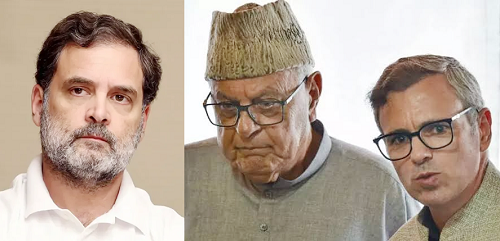
The immediate trigger was Jammu and Kashmir Chief Minister Omar Abdullah and NC president Farooq Abdullah standing through the full six-stanza version of Vande Mataram at the inaugural International Film Festival in Srinagar. Their decision has put the Congress in the unusual position of publicly reminding an ally of the political consensus that surrounded the version of the song adopted by the freedom movement.
Congress general secretary KC Venugopal made clear that his party remains committed to the version of Vande Mataram that was adopted by the Congress in 1937. He argued that the decision was rooted in the effort to preserve India's pluralistic character and avoid turning the song into a source of communal division.
Venugopal invoked the collective judgment of several of the country's most prominent freedom fighters, including Mahatma Gandhi, Jawaharlal Nehru, Sardar Vallabhbhai Patel, Subhas Chandra Bose, Rajendra Prasad, Maulana Abul Kalam Azad, Sarojini Naidu and J B Kripalani. He also referred to Rabindranath Tagore's counsel in shaping the historical approach to the song.
For the Congress, therefore, the issue is not simply about how many stanzas should be sung. It is presenting the question as one connected with the political and constitutional philosophy of the freedom struggle.
Venugopal urged allies to respect what he described as the wisdom of the freedom fighters and join the Congress in singing the version they had adopted. He maintained that this approach was intended to prevent Vande Mataram from being "communalised" and to protect the secular and inclusive character of the Republic.
The NC's position creates an obvious political contrast. Omar Abdullah and Farooq Abdullah's decision to stand through the complete rendition in Srinagar signals that the party does not share the Congress's reluctance towards the full version.
That difference is significant because the National Conference and Congress are not merely ideological partners at the national level. They are political allies in Jammu and Kashmir, where questions of identity, regional aspirations, nationalism and secularism have particularly deep political resonance.
Omar Abdullah's gesture can consequently be read in more than one way. It may reflect the NC's desire to demonstrate respect for a historic national song without accepting the political framing that the Congress has attached to its complete rendition. It also allows the Abdullahs to project a form of nationalism that is distinct from the Congress's interpretation of the issue.
The episode highlights an important reality within the INDIA bloc: opposition to the BJP does not automatically translate into agreement among its constituent parties on questions of national identity and cultural symbolism.
The Congress increasingly appears isolated in its insistence on restricting official singing to the two-stanza version.
The Trinamool Congress has opposed making the full version mandatory, although it has not adopted the same position as the Congress. The Samajwadi Party has not mounted a national-level opposition to the complete song, while the Shiv Sena (UBT) has also not backed the Congress line. The positions of the RJD and Sharad Pawar-led NCP (SP) have similarly not translated into an unequivocal endorsement of the Congress's stand.
This creates a delicate political equation for the Opposition. The Congress wants to frame the debate around the secular and pluralist legacy of the freedom movement, while several of its allies appear unwilling to make the song a point of confrontation with the broader nationalist sentiment surrounding it.




















Leave Your Comment