


On April 22, 2025, at least four to five Islamic terrorists (numbers still unknown), brutally massacred 28 tourists at Baisaran Valley near Pahalgam, Anantnag district in Jammu and Kashmir. Out of the 28 tourists killed, 26 were Indian nationals whereas two were foreign citizens from Nepal and UAE. 20 others were injured in the attack. A local pony guide who was a Muslim, was also killed by the jihadi terrorists when he tried to snatch an assault rifle from a terrorist, for protecting the tourists from being murdered. The dead included those from the Indian states of Arunachal Pradesh, Karnataka, Kerala, Maharashtra, Odisha, Gujarat, Haryana, West Bengal and Uttar Pradesh, as well as the injured from Gujarat, Tamil Nadu and Maharashtra. The casualties also included an Indian Navy officer and an Intelligence Bureau (IB) official. The brainwashed Islamic terrorists had a free run, forced the tourists to reveal their religious identities by asking them to recite ‘Kalimas’ and removed their pants to check circumcision, after which the beasts shot as many non-Muslims as they could with their AK-47 automatic assault rifles and M-4 carbines. The Resistance Front (TRF), an offshoot of the Pakistan-based Islamic terrorist group Lashkar-e-Taiba (LeT), claimed responsibility for the attack. Intelligence agencies later identified Saifullah Kasuri (alias Khalid), a top LeT commander, as the mastermind of the massacre. Accounts from survivors indicated that an attacker spared a woman saying that she was being spared so she could narrate the horrors of the brutality to the Indian Prime Minister Narendra Modi. The diplomatic ramifications of this attack were such that Prime Minister Narendra Modi had to cut short his official visit to Saudi Arabia and had to return to New Delhi in the wee hours of April 23, 2025.
The aftermath of the attack
Union home minister Amit Shah travelled to Srinagar to assess the situation and coordinate the security response, and later travelled to the site of the attack on April 23, 2025. On the night of April 23, 2025, the Indian foreign secretary Vikram Misri held a special press briefing after a meeting with the Cabinet Committee on Security (CCS). He announced India's decision to temporarily suspend the Indus Waters Treaty with Pakistan with immediate effect until Pakistan ceases its support for cross-border terrorism. He further announced the closure of the integrated check post at Attari–Wagah Border, a comprehensive travel ban for all Pakistani nationals to India under the SAARC Visa Exemption Scheme, and cancellation of all previously issued visas. Additionally, Pakistani military advisers at the Pakistan High Commission in New Delhi were expelled, while their Indian counterparts in Islamabad were withdrawn, and the staff strength of the Indian High Commission in Islamabad was reduced from 55 to a minimum of 30. The posts of such military advisors were deemed abolished.
Following the attack, an increase in the number of visitors leaving Jammu and Kashmir was recorded, prompting Air India to operate additional flights to the region. Protests were held in many parts of India condemning the attack. The much-awaited and planned weekend inauguration of the Katra-Srinagar Vande Bharat Express train was called off.
The attack drew immediate widespread condemnation from political leaders and the civil society. President Droupadi Murmu called it a "dastardly and inhuman act." Vice President Jagdeep Dhankhar called the act as "reprehensible" and condemned it. Prime Minister Modi termed the attack as "shocking and painful" and those responsible would be brought to justice. Chief Minister of Jammu and Kashmir Omar Abdullah described the incident as "much larger than anything we've seen directed at civilians in recent years." Defence Minister Rajnath Singh labelled it an "act of cowardice." The leader of the opposition in Lok Sabha, Rahul Gandhi, described the attack as "horrific" and emphasised support for the victims, while also criticising the ruling BJP.
The National Investigation Agency initiated an investigation into the attack after visiting the site on April 23. Based on eyewitness testimonies, the Jammu and Kashmir Police released the sketches of three of the militants believed to have been involved in the attack. The police further stated that all of them were linked to Lashkar-e-Taiba and at least two were Pakistanis. The suspects were identified as Asif Fauji, Suleman Shah, and Abu Talha, known by their code names Moosa, Yunus, and Asif respectively. All of them have been linked to previous militancy-related incidents in the Poonch region of Kashmir.
The attack drew widespread condemnations and statements of condolences to the victims from several other countries including Iran, Israel, Italy, Saudi Arabia, the United Arab Emirates, the United Kingdom, the United States, and India's neighbours including Bhutan, China and Sri Lanka. The United Nations and the European Union also issued similar statements.
‘Bleeding India with a thousand cuts’
As per SATP data, 3590 Indian security forces personnel have been martyred by terrorists between the year 2000 and 2024, whereas 13,321 terrorists have been slaughtered during the same period. Roughly more than 41,000 civilian deaths have also been caused by terrorism in Jammu and Kashmir between 1990 and 2017. And this death toll excludes the death toll of Kashmiri pandits massacred during the late 1980s and early 1990s. This clearly shows the intensity of the conflict caused by Pakistani military’s “Bleed India with a thousand cuts” doctrine. Islamic separatist terrorists also incite violence against the local Kashmiri populace.
After the Taliban victory in the Soviet-Afghan War, Mujahideen terrorists, under the Operation Tupac with the aid of Pakistan, slowly infiltrated Kashmir with the goal of spreading a radical Islamist ideology to wage Jihad against India in the region. USA’s Federal Bureau of Investigation (FBI), in their first ever open acknowledgement in 2011 in US Court, said that Pakistan’s Inter-Services Intelligence (ISI) sponsors and oversees separatist militant groups in Kashmir. Former Pakistan President General Pervez Musharraf in October 2014 openly stated during a TV interview: "We have source (in Kashmir) besides the (Pakistan) army...People in Kashmir are fighting against (India). We just need to incite them."
Large-scale terror attacks in Kashmir
• 2000 Chittisinghpura massacre: The Chittisinghpura massacre referred to the mass murder of 35 innocent Sikh villagers on March 20, 2000 in the village of Chittisinghpura in Anantnag district, Jammu and Kashmir on the eve of the US President Bill Clinton's state visit to India. The massacre was executed by the LeT. Wearing Indian Army fatigues, the terrorists arrived into the village in military vehicles in two groups at opposite ends of the village where the two gurdwaras were located. The militants marched from home to home, introducing themselves as Indian Army personnel and ordered every male member of the household come out for security checks. They ordered them to line up in front of the gurdwaras and opened fire, killing 35 Sikhs.
• 2019 Pulwama bombings: The 2019 Pulwama attack occurred on February 14, 2019, when a convoy of vehicles carrying Indian security personnel on the Jammu–Srinagar National Highway was attacked by a vehicle-borne suicide bomber at Lethapora in the Pulwama district of Kashmir. The attack killed 40 Central Reserve Police Force (CRPF) personnel as well as the perpetrator- Adil Ahmad Dar, who was a local Kashmiri youth from the Pulwama district. The responsibility for the attack was claimed by the Pakistan-based Islamist terrorist group, Jaish-e-Mohammed.
• 2023 Rajouri attacks: The 2023 Rajouri attacks was a terrorist attack that occurred on January 1 and 2, 2023 in the Dangri village of the Rajouri district in Kashmir. The first attack, a shooting, resulted in the death of four and injured nine others. In the second attack, an IED (Improvised Explosive Device) exploded near the same attack site, resulting in the death of a child at the scene and injuring five others. A second child injured in that blast, also died from injuries, raising the overall death toll to six.
• 2024 Reasi attack: The 2024 Reasi attack was a terrorist attack that occurred on June 9, 2024 in the Reasi district of Kashmir. Several unidentified Islamist terrorists opened fire on a passenger bus transporting Hindu pilgrims from the Shiv Khori cave to Katra, causing it to lose control and plummet into a deep gorge, followed by further firing at the crashed bus by the Islamist beasts. Nine people were killed in the attack, and an additional 41 were injured.
All these terror attacks, and now the current one by Islamist beasts had only one modus operandi- to initiate a massacre for instilling fear amongst non-Muslims, be it locals or mainlanders, with ISI footprints clearly visible in the plot.
Military options on the table
It is quite evident that a post-Uri or a post-Pulwama like limited response will not be adequate in the current scenario. A surgical strike (commando raid) inside Pakistan Occupied Kashmir (PoK) for destroying a few jihadi camps or a Balakot-like airstrike for taking out a few madrasas, seminaries and terrorist training camps located inside PoK or mainland Pakistan will not be credible as a long-term or even mid-term deterrence. Rather, it is time for the Indian government to extract a heavy price from Pakistan, not just by building dams over the Indus River or changing the course of other rivers, but also by permanently closing the Indian airspace for all civilian flights taking-off, landing, or halting midway in Pakistan.
Moreover, India should launch repeated and massive barrages of cruise missile strikes, aerial strikes from standoff ranges (from inside Indian airspace), kamikaze drone strikes and guided-artillery strikes against terrorist training camps, seminaries, and madrasas inside Pakistan and PoK. The Indian Navy also must play a role in this operation by launching cruise missile strikes from warships and submarines. The initial targets should be the terror targets. But if the Pakistani military decides to walk along the escalation matrix by engaging with the Indian forces during the Indian offensive missions, India should strike back against Pakistan’s strategic targets with full-force and using a whole gamut of weapons and platforms. The intention should be to wipe out Pakistan’s war fighting capabilities and strategic infrastructure and literally send the Islamic terrorist nation back to the medieval. Not an eye for an eye, but India needs to gauge out Pakistan’s both the eyes to make it permanently blind and handicap.
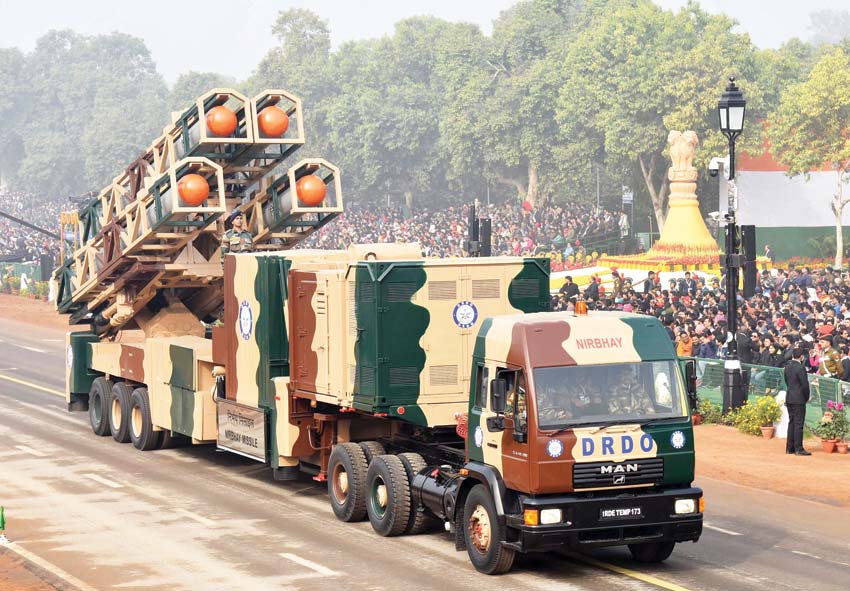
The continuous barrages of cruise missiles like Nirbhay and BrahMos, drones like IAI Harop loitering munition, precision-guided rocket artillery shells like Pinaka and Smerch, glide-bombs like SAAW (Smart Anti-Airfield Weapon) and Sudarshan laser-guided bomb, and air-to-surface missiles like BrahMos, Meteor, etc. should be such that Pakistan’s top leadership in Islamabad and the shadow leadership in Rawalpindi should remember the Indian retaliation for many generations to come. The target should be to kill as many terrorists as possible, numbering at least in thousands or even tens of thousands.
Due to the wrong and toothless policies of the erstwhile Congress-led governments, the situation has become so gloomy that unarmed tourists in an Indian state enjoying bhelpuri or ice-cream while taking an afternoon stroll, are being attacked and brutally murdered under open daylight. And the so-called peaceniks and doves are tight-lipped about this horrific incident and have the audacity to give irrelevant lectures about a possible war’s toll on India’s economic outlook. What they don’t talk about is how are such incidents based on racial profiling of non-Muslims and non-Kashmiris taking place in a sovereign, socialist, ‘secular’, ‘democratic’ republic and how has these two cancerous tumours called ‘Islamic terrorism’ and ‘Pakistan’ spread fangs in South Asia. It is only due to the inaction of the previous regimes that we are in such a scenario today, and these so-called doves and peaceniks are the real traitors and anti-nationals whose only agenda is to keep the ruling dispensation in inactive mode. They are possibly paid from across the border for keeping their agendas running. There should be a merciless police crackdown on all such motormouths who are literally the real terrorist sympathisers in disguise.
Some cost always needs to be paid for achieving everlasting peace. Today Israel has become a much safer place to live in, thanks to the Israeli military actions in Gaza and Lebanon against Hamas and Hezbollah terrorists. US is vying for the safe transits of vessels by bombing Houthi terror targets in Yemen. Russians cleansed Chechnya of Islamic terrorists by a long military campaign during the 1990s and 2000s. China wiped out the Uyghur terrorists. Iran wiped out Pakistan-based terrorist organisations like the Jundallah. Now is the right time for us as Indians to show the desired willpower to show the world what we can do when it comes to our national security and citizens’ safety. As the great Indian scholar Vishnugupta once aptly said: "The power of a king lies in his mighty arms. Security of citizens during peacetime is of paramount importance because the state is the only savior for men and women who suffer solely due to the negligence of the state." This age-old doctrine remains very much relevant and universally applicable even in the 21st century.
The proletariat of the nation has given a wholehearted (if not overwhelming) mandate to Prime Minister Narendra Modi during the 2024 Lok Sabha elections. Now it is up to the ruling dispensation to prove its mettle by not becoming like those toothless shenanigans who ruled the nation for almost 75 years with very little or almost no tangible output as far as tackling Pakistani-sponsored terrorism is concerned.

By AMARTYA SINHA
(The author is a Delhi-based defence journalist.)
(The content of this article reflects the views of writers and contributors, not necessarily those of the publisher and editor. All disputes are subject to the exclusive jurisdiction of competent courts and forums in Delhi/New Delhi only)














Leave Your Comment