


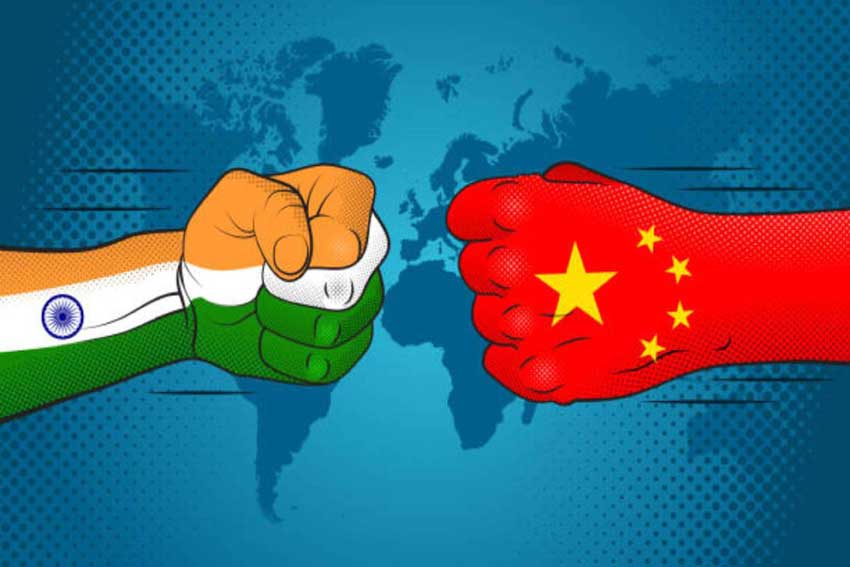
China is in our headlines again. First, it was Congress leader Rahul Gandhi’s attack on the Modi government for surrendering Indian lands to China in Ladakh. That it is perverse to say this is something I will explain later. Second, China has released, which it periodically does, its official map that shows the entire Arunachal Pradesh as its territory. Here too, China’s map , which also shows territories of other countries such as the Philippines, Indonesia, Malaysia and even Russia, has invited strong rejections from the concerned countries.
The reality on the ground may be different, but by successfully drawing attention to it, China is succeeding in what the experts call the political or the information warfare. And this warfare of China is not restricted to India alone; it is global in nature.
Revelation of the questionable activities of a charismatic American millionaire, Neville Roy Singham, who is of Sri Lankan-Cuban descent and known as a socialist benefactor of far-left causes, is the latest example of how China is successfully conducting its political warfare all over the world and pushing its agenda.
A New York Times investigation has found how Singham has been an instrument of China’s lavishly funded influence campaign that defends China and pushes its propaganda. “From a think tank in Massachusetts to an event space in Manhattan, from a political party in South Africa to news organizations in India and Brazil, The Times tracked hundreds of millions of dollars to groups linked to Mr. Singham that mix progressive advocacy with Chinese government talking points”, the reports says.
In India, the NYT report talks of the news portal of NewsClick, based in New Delhi. It is said to have been financed by Singham’s network. This news website’s articles are “sprinkled with talking points from the Chinese government.” The title of one of the videos on the website was “China’s history continues to inspire the working classes.”
Incidentally, NewsClick has also been under investigation by Indian agencies like the Enforcement Directorate(ED). Investigations have revealed that Singham has been the main source of Rs. 38 crore that the media portal has received in between 2018 and 2021.
The NYT report says that under the rule of Xi Jinping, “China has expanded state media operations, teamed up with overseas outlets and cultivated foreign influencers”.
Apparently, “Mr. Singham’s groups have produced YouTube videos that, together, racked up millions of views. They also seek to influence real-world politics by meeting with congressional aides, training politicians in Africa, running candidates in South African elections and organizing protests like the one in London that erupted into violence”.
Of course, in recent years, there have been many important studies on China’s political warfare. The latest in this regard happens to be one by the prestigious American think-tank Centre for Strategic International Studies, which was released on August 2.
In 2020, former British spy Christopher Steele of M16 had compiled a 86 page report that provided details of manipulations by China to penetrate the strategic and influential communities in important countries and manipulate them to serve China’s larger strategic objectives. He referred to them as Beijing’s “useful idiots.”
Similarly, the US National Counterintelligence and Security Centre, in its July 2022 report, revealed the extensive Chinese activities to manipulate the US state and local leaders to support the policies that are favorable to Beijing in accordance with what China calls the strategy of “using the local to surround the central.”
S D Pradhan, a former chairman of India's Joint Intelligence Committee and deputy national security adviser, has argued that such tactics of China have actually worked in India. He says how many Indian political leaders, many of them from the opposition Congress party, have tried to aversely weaken the decision-making capability of the present government led by Narendra Modi “to create doubts in the capabilities of the ruling regime, to foment anti-leadership sentiments, and to diminish the will to fight against China. In the case of the Congress Party, besides the normal channels of cognitive warfare, the linkage between the Rajiv Gandhi Foundation and the Chinese Communist Party could have been also used to manipulate the perceptions of targets”.
For instance, Pradhan cites three dimensions in the criticisms of the Modi government’s response to the Chinese incursions in Ladakh in 2020-21. First, it was intended to convey the message that “China continues to thrash our jawans at the border,” with the goal of demoralising the Indian Armed Forces.
The second was to project that China has better fighting capabilities.
“The third was to create the impression that the current government has surrendered 2,000 kilometres of land to China. China has been in illegal occupation of 38,000 square kilometres of Indian territory for more than six decades. Besides, it has also obtained 5,180 square kilometres of Indian territory since 1963 through an agreement with Pakistan. It is unclear how these 2,000 square kilometres of land were added. Lt. Gen. Kalita, the GOC-in-C, had stated that no land is under Chinese occupation, but this is also disregarded. Obviously, this figure has come from the narrative built by China”.
Broadly speaking, China’s “political warfare” includes what are termed “the three warfares” (Three Ws): public opinion warfare, psychological warfare and legal warfare.
Public opinion warfare is aimed at shaping and influencing domestic and international views of China. Psychological warfare is considered strategic in nature, influencing various economic, political and other societal leaders to not oppose Chinese actions and even to support them. These complement legal warfare that involves foreign nationals arguing that “China is obeying the laws and is right , but our country and its policies are wrong”.
Against this background, the latest CSIS study, titled “Competing without Fighting: China's Strategy of Political Warfare" is an important addition. It warns that the U.S. and its partners, including India, have been too slow to identify and counter Chinese political warfare.
And this warfare involves sophisticated Chinese espionage activities, offensive cyber operations, disinformation on social media platforms, economic coercion, and influence operations targeting companies, universities, academic institutions, companies, government agencies, and nongovernmental organizations (NGOs) and other organizations.
The CSIS report says that while all countries engage in some level of political warfare, the size and scope of Beijing's activity is unprecedented.
It gives the example of when Daryl Morey, the general manager of the Houston Rockets basketball team, expressed support for Hong Kong protesters in 2019, tweeting "Fight for Freedom," a "troll mob" was unleashed on the executive, with 170,000 tweets flooding out of China. Pro-Chinese government accounts mentioned Morey more than 16,000 times and approximately 4,700 of the replies included "NMSL," a Chinese acronym meaning "your mother is dead."
The report said that "This high volume of activity is all the more anomalous given that Twitter is banned in China".
Another example that the report has given is how entities linked to the Chinese government broke into the 2008 presidential campaigns of both Sen. John McCain and Sen. Barack Obama to gain insight into each potential administration's China policy. The report also points out how over the past year, the FBI and Department of Justice (DOJ) have arrested or indicted numerous individuals for espionage, cyber operations, and illegal influence campaigns.
How to deal with China’s political warfare? The CSIS report has recommended many measures. Four of them are particularly noteworthy:
One is to identify Chinese vulnerabilities and exploit them, proactively weakening Chinese power, influence, and relationships overseas.
Two, the report has suggested “ piercing a hole in China's Great Firewall -- which blocks or censors hundreds of thousands of websites and apps -- to enable the people of China to access the likes of Google, YouTube, Instagram, Reddit, Wikipedia, WhatsApp and LinkedIn”.
Three, it wants the US to strengthen Foreign Agent Registration Act (FARA) and related efforts such as the Lobbying Disclosure Act and the Department of Education’s Section 117 disclosures, to counter Chinese and other foreign influence.
Four, the report recommends the US allies and partners to do the same. In fact, it suggests the establishment of “a Multilateral Bloc to Counter Chinese Economic Coercion”, composed of the United States, Australia, South Korea, Japan, India, and other countries—including in Europe.
"Participant countries should be prepared to sanction China in response to Chinese threats or actions that do not conform to World Trade Organization rules and are aimed at meeting Chinese political goals unrelated to trade. In addition, participant countries could create a collective compensation fund for losses and offer alternative export or import markets to divert trade in response to Chinese sanctions”, the report says.
It emphasizes on the need of “Deepening relationships with partners” as “critical” in meeting the Chinese threat.
“ China also has significant weaknesses and vulnerabilities that can be exploited. Together with its partners, the United States now needs to develop a comprehensive approach to compete in this arena that is consistent with its democratic principles and values. The clock is ticking”.
Will the US allies and partners, including India, respond?

By Prakash Nanda
(prakash.nanda@hotmail.com)














Leave Your Comment