


It is heartening to see that the people of Bihar have validated views expressed in the article, ‘Between hope and cynicism…” published in last issue.
In choosing Nitish Kumar and ignoring the rising Jan Suraaj experiment led by Prashant Kishor, the people of Bihar have spoken with clarity. This mandate is not just a calculation of politics—it is a plea for stability, a conviction that amidst uncertainty, Nitish remains the last credible beacon of hope. This is not an ordinary mandate; it carries a moral weight. It is an act of faith, of patience, and of pragmatism merged into one.
But this faith is fragile. The people have not given Nitish another term merely to govern; they have entrusted him with the responsibility to finally deliver on the long-promised aspirations of development, dignity, and opportunity. Youth cannot wait endlessly for jobs and women want a safe and secure Bihar for their family. This MY factor has not defeated the other MY factor (Muslim Yadav) for patty freebies. Similarly, farmers cannot endure perpetual neglect, and its citizens cannot be asked to settle for half-measures. The expectations invested are larger than any electoral victory—they represent Bihar’s longing for real change, a transformation that has eluded it for generations. Neither the pain of being called Pravasi (Bhaiyya) in their own country nor all the 20 million Bihari enjoy working outside Bihar. The overloaded trains to Bihar during Chhath puja are the evidence that physically they may live anywhere but their soul remains in Bihar.
The challenge is gigantic
For two centuries, Bihar has endured exploitation and misrule—from the colonial drain of wealth under the British Raj to the populist stagnation of later decades.
1. Colonial Exploitation destroyed everything Magadh was known for (Late 18th – 1947)
2. Independence brought Hope but little improvement (1947 – 1970s)
3. The Era of caste becoming a source of conflict. (1980s – 1990s)
4. Lalu Prasad Yadav’s Misrule (1990 – 2005)
5. formation of Jharkhand as an independent state in 2010.
Definitely all this demoralised people, but could not defeat them. The time has come to break this cycle and reclaim Bihar’s rightful place as a cradle of culture, intellect, and progress.
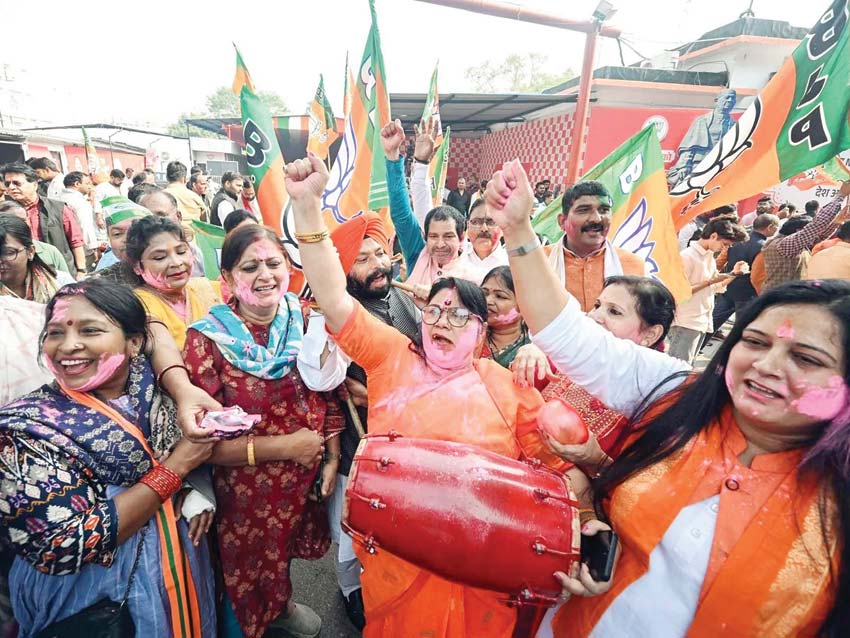
From Critique to Confrontation: The Opposition’s Distrust Politics.
Post election, the opposition seems inclined toward a confrontational, negative approach rather than constructive engagement. Instead of presenting a coherent alternative roadmap for Bihar, they are resorting to constant allegations—questioning Nitish Kumar’s mandate, casting doubts on the credibility of the Election Commission. Attempting to create an atmosphere of distrust around the electoral process. It may energize their political base, but they risk undermining public confidence in democratic institutions and distracting attention from Bihar’s pressing development challenges. By choosing accusation over accountability and disruption over dialogue, the opposition is hoping to create a situation similar to Bangladesh and Nepal. They have resources not only inside India but outside as well. Bihar being a border state makes the matter more challenging.
Silver lining in the dark clouds
Despite these challenges, the people of Bihar have consistently fought for dignity and representation. from the time of Chanakya uprooting the exploitative Nand Vansh, Bihar/Magadh has fought against injustice. from uprising of 1857, to Champaran’s satyagraha, to JP’s student movement —Bihar has consistently sought transformation. Each struggle reflected the people’s refusal to accept exploitation, injustice, or stagnation. If Nitish is able to carry forward that legacy, channelling Bihar’s historic spirit of resistance into a vision of inclusive development and social renewal the defeated forces have nothing more to do then licking their own wounds.
What Nitish Must Do Next?
From Kamraj midday meal in schools of Tamil Nadu, to recent turn arounds in Gujrat, MP and UP. it is clear that people of India respond to good governance, financial support, education, improved infrastructure and better health services. Patna has every resource which Hyderabad had, before Chandrababu Naidu took charge as CM. Today if Hyderabad competes with Bengaluru, Pune and Gurugram, it is just because of vision, commitment and the persistence. As soon as law and order improves, Bahubali’s are tamed and corruption is dealt with deterrent, educated Bihari will draw attention of the global investors. The government has to;
Invest in Education & Skills of public at large.
o Revive Bihar as a land of learning (Nalanda, Vikram Shila).
o Modernize educational infrastructure to deliver digital literacy, vocational training, and research.
Agricultural Transformation to reap the benefit of vast river network.
Industrial & Infrastructure Growth in harmony with local skills and resources.
Healthcare & Social Welfare
The Call Bihar Awaits: A Slogan to Spark a Statewide Mindset Shift.
Bihar today needs a transformative mass campaign—something as emotionally resonant and mindset-shifting as “Jai Jawan, Jai Kisan” given by Lal Bahadur Shastri. It motivated the nation crushed by 1962 defeat. The state’s challenges are not just administrative but deeply psychological, rooted in years of migration, limited opportunities, and a collective loss of confidence. A powerful, unifying slogan and movement could ignite pride, responsibility, and participation among citizens, especially the youth. Bihar needs a call that speaks to its strengths, rebuilds self-belief, and inspires people to see themselves as active partners in progress, not passive recipients of governance. Only such a campaign can create the cultural shift required for lasting transformation.
It is very much viable as NDA has successfully launched many such campaigns starting from Abki Baar Modi Sarkar, Beti Bachao Beti Badhao, Double engine ki sarkar, Swachh Bharat and Make in India etc.
Creating inspiring Youth leaders.
Biggest challenge is not just building roads or expanding welfare schemes—it is rebuilding trust and reconnecting governance with its young citizens. Bihar’s youth have lived between aspiration and exodus, watching opportunity slip through despite their potential remained unquestionable. Young voices must be placed at the forefront of its outreach, communication, and policy engagement.
Cultural youth icons like Maithili Thakur and a rising generation of young legislators can become transformative partners. Maithili, with her immense popularity, cultural influence, and deep connection to Bihar’s heritage, embodies the confidence and creativity of the state’s youth. Her voice carries credibility that no government advertisement or press conference can replicate. By involving figures like her in awareness campaigns, digital outreach, skilling drives, and cultural programmes, the state can turn governance into an inspiring experience.
Bihar’s young legislators, understand the language, struggles, and aspirations of a generation that communicates more through smartphones than political rallies. These MLAs can bridge the long-standing gap between government schemes and beneficiaries. Whether it is promoting entrepreneurship, education, health initiatives, or rural employment, these young leaders can give policies the one thing they often lack: resonance.
Bihar has the talent, the ideas, and a rising sense of self-belief. A collaborative model is needed so that the government partners with young cultural icons and emerging political leaders to build a narrative of possibility. If the state can harness these voices, it will not just implement schemes—it will ignite a mission. And missions, unlike schemes, transform societies. It will train them for future leadership roles.
Bihar’s Talent Abroad: Learning from UP’s Employment Strategy.
Bihar’s youth unemployment is one of its most pressing challenges, and managing it effectively requires both domestic job creation and strategic exploitation of overseas employment opportunities. Uttar Pradesh, for instance, has actively encouraged skill development programs aligned with international labour demand, particularly in the Middle East, Southeast Asia, and Europe, helping young workers find higher-paying opportunities abroad while also ensuring they return with skills and remittances that benefit the state economy.
Bihar can adopt a similar approach, but it has to overcome a unique hurdle. The state has a large proportion of semi-urban and rural youth with limited formal education and vocational skills. Without targeted skill mapping, certification programs, and placement support, simply sending youth abroad risks exploitation or irregular employment. However, if Bihar invests in industry-aligned skill centres, partnerships with foreign employers, and legal safeguards for migrant workers, it can turn this challenge into a significant opportunity. Gujarat did it by engaging with private training institutes, universities, and IT training centres to upskill youth in coding, software support, and business English.
Combining overseas employment strategies with local entrepreneurship, MSME support, and public-private skill programs could reduce the pressure on migration. Done correctly, Bihar can replicate UP’s success.
Bihar’s Next Big Bet: Building Industrial Powerhouses.
Transforming its economic landscape by building industrial hubs akin to Noida or Gurugram needs translating recent momentum into concrete infrastructure. The state has assembled a land bank of 3,000 acres and is offering “plug and play” industrial sheds. With its Gross State Domestic Product (GSDP) projected to reach ₹10.97 lakh crore in 2025–26, and average annual growth over 11% in recent years, Bihar is increasingly becoming investor friendly. Still the state’s industrial output remains underdeveloped: manufacturing contributes only around 5.7% of total workers according to recent labour-force data. By creating well-planned industrial corridors — tapping into agro-processing, textiles, IT, and renewable energy — Bihar can retain its youth by attracting long-term investments. The ongoing Gaya Integrated Manufacturing Cluster, a 1,670-acre greenfield smart city project linked to the Eastern Dedicated Freight Corridor, already shows that the vision is coming to life. If these pockets are backed by strong governance, skilled labour, and solid infrastructure — housing, transport, power — they can rewrite Bihar's growth story.
Flowing Forward: Reviving Bihar’s Historic Ganga Transport Network.
The National Waterways project (NW-1: Haldia to Allahabad) already includes the Ganga stretch in Bihar, offering a platform for revival. If Bihar invests in dredging, terminals, and logistics hubs, the state could cut freight costs by up to 30%, reduce pressure on roads, and revive river-based commerce that once powered its economy. Moreover, this can generate thousands of direct and indirect jobs, from vessel operation to logistics management, while positioning Bihar as a key trade corridor in Eastern India.
This is not just another chance—it is the last chance to prove that Bihar’s faith was not misplaced.
This is the moment for Nitish Kumar to rise above political arithmetic which led to changing loyalties. It is time to embrace visionary leadership. He must act with urgency, rebuild trust in institutions, and lay down a roadmap that outlasts his tenure. Roads, schools, hospitals, industries—these are not just projects, they are promises of dignity. If he falters, the disappointment will be historic; if he succeeds, Bihar can finally reclaim its destiny as a land of progress and pride. It will be a big boost to India 2047.

By Rakesh Kumar
(The content of this article reflects the views of writer and contributor, not necessarily those of the publisher and editor. All disputes are subject to the exclusive jurisdiction of competent courts and forums in Delhi/New Delhi only)















Leave Your Comment