


‘Odia Asmita’ may have been the theme song for the BJP in the simultaneous elections in Odisha in May this year. But it was the Subhadra Yojana that proved to be the real game changer for the party as it wrested power from the Biju Janata Dal (BJD), which had ruled the state for five consecutive terms. The promise of cash assistance worth Rs 50, 000 to ‘all’ women in the state helped break the stranglehold of the BJD on the women’s vote, which had been the single biggest factor that ensured its victory in successive elections, to an extent that tilted the scales in the BJP’s favour.
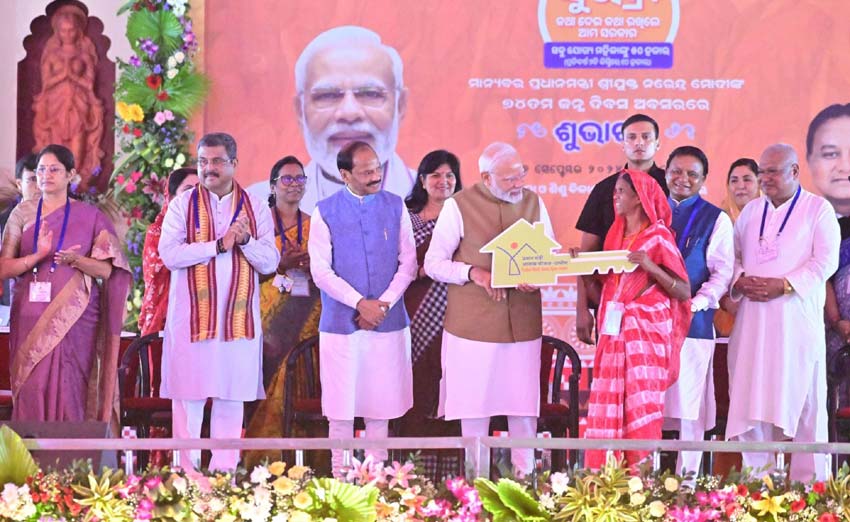
The importance of Subhadra Yojana, described by Chief Minister Mohan Majhi as an ‘epoch making step in women’s empowerment’ in the Assembly, in the saffron party’s scheme of things was evident during the campaign itself as every BJP leader, from Prime Minister Narendra Modi down to state leaders, harped on it in virtually every election rally or meeting. Even the party’s ad campaign focused on it more than any of the other promises made by the party. The centrality of this scheme in the new dispensation was further underlined when the BJP government headed by Mohan Charan Majhi put its seal of approval in the very first cabinet meeting held barely hours after the swearing in ceremony on June 12. In keeping with its importance for the BJP, Prime Minister Modi himself came down to Bhubaneswar to formally launch the scheme on September 17, his birthday.
The ambitious scheme launched by the BJP government is estimated to benefit over one crore women, 25 lakh of whom received the first instalment of the scheme on the day it was launched. All other eligible beneficiaries would have the money transferred to their bank accounts by March 8, 2025 when the second instalment is due, Deputy Chief Minister Pravati Parida, who is also the Women and Child Welfare minister, said on September 25, eight days after the scheme was launched. “The response to the scheme has been overwhelming. Over 92 lakh women have already registered under it and the number is all set to cross one crore soon,” she gloated.
Shoddy Implementation
While there is no denying that there has been a mad rush to register for the scheme across the state, the way the government has gone about implementing it has left a sour taste in the mouth. First, the guidelines for the scheme were clearly announced in a hurry without weighing all the pros and cons. This led to misgivings on many scores, requiring repeated revisions of the original guidelines and ‘a clarification a day’ for nearly a month. To take one example, the guidelines said women who already receive Rs 1, 500 a month (Rs 18, 000 a year) under any other government scheme would not be eligible for the assistance under Subhadra. The government had to come out with a clarification saying women who get student scholarships would be included in the scheme. As the scheme was rolled out in August, long and serpentine queues, reminiscent of the queues seen during demonetization in 2016, were seen at many places due to a rumour that August 25 was the deadline to get registered under the scheme. Women were seen lining up before anganwadi centres and panchayat offices since wee hours to make sure they didn’t miss out. A concerned government had to come out with a clarification that there was no deadline for getting registered under the scheme before the crowds started thinning.

Second, the unseemly rush to get registered under the schemes proved to be a nightmare for women as the POS machines used for e-KYC verification did not function properly at many places, especially in the remote tribal areas, due to internet connectivity issues. Besides, touts emerged at many places seeking to dupe gullible, illiterate women by demanding money for registration or by sending fraudulent links to the beneficiaries. The government did address these issues as they cropped up. But it was clear that in its rush to roll out the scheme at the earliest, the government had not done its homework and anticipated the problems that might arise during its implementation. Even without the touts, the process of registration proved too cumbersome for women in remote tribal areas where bank penetration is low and connectivity is a constant issue. As per the guidelines issued by the government, a woman without a bank account has to first open one, then ensure the account is Aadhar linked, make the account DBT enabled and finally complete the e-KYC verification process. Needless to say, all this is a nightmare for the illiterate and semi-literate women in far-flung areas, leaving the field wide open for touts to step in.
Let Down
While these were minor irritants that were addressed by the government as and when they emerged, the government has been under fire from the Opposition mainly for what it called the ‘breach of its election promise’. During the campaign, the BJP had promised that all women in the state will get the cash assistance of Rs 50, 000 under the Sunhadra scheme. But when the guidelines for the scheme were announced by Chief Minister Mohan Majhi in the Assembly, it emerged that a sizeable section of women will be left out of its purview due to the eligibility criteria fixed. ‘All women’ quietly became ‘all eligible women’ as multiple exclusion/ineligibility criteria were announced by the government. “Why limit the scheme to the age group of 21-60? Are women below 21 or above 600 not entitled to cash assistance for income generating activities?” many people, including Opposition leaders asked. But the biggest complaint was reserved for spreading the benefits of the scheme over five years instead of the two promised. It may be noted that the BJP election manifesto had promised Rs 50, 000 to all women in the state. However, while launching the scheme, the goverment announced that the amount will be paid in 10 instalments of Rs 5, 000 each to be spread over five years, to be paid on Raksha Bandhan day and International Women’s day on March 8 every year. Analysts point out that stretching the scheme over five years – instead of the two promised – defeats its very purpose; namely empowerment of women. “What kind of empowerment will take place with Rs 5, 000 paid every six months? There is no way it can be invested in a gainful way to generate income. All that will happen is the money will be spent in meeting household expenses,” they point out. Cynics go a step further and say it is an allowance given by the government to women to ‘buy sarees’!
Comparison with schemes in other states
The Subhadra scheme launched by the Odisha government doesn’t compare favourably with women-centric schemes launched in other states. The assistance under Subhadra - at Rs 5, 000 every six months (which amounts to Rs 833 a month) is the least among all such schemes in the country. While the Gruha Lakshmi scheme launched by the Karnataka government last year provides Rs 2, 000 a month to the woman head of BPL families, the Laadli Behna Yojana launched by the Shivaraj Singh Chouhan government in the run up to the Assembly elections in Madhya Pradesh last year gives Rs 1, 250 a month to all eligible women. The Maharashtra government’s scheme for women – Majhi Ladki Bahin Yojana - provides Rs 1, 500 a month, besides additional benefits like three free LPG cylinders, while the West Bengal and Jharkhand governments provide an assistance of Rs 1, 000 a month under their respective schemes: Lakshmi Bhandar scheme in WB and Mukhyamantri Maiya Samman scheme in Jharkhand.
The eligible age fixed for availing the benefits of Subhadra - 21 to 60 – has also faced criticism on the ground that it leaves a lot of women out of the purview of the scheme. In contrast, all women above the age of 21 are eligible for the Magalir Urimai scheme launched by the MK Stalin government in Tamil Nadu while the upper age limit of the Maharashtra scheme is 65 years. The Indira Gandhi Pyari Behna Yojana launched by the Sukhibir Singh Sukhi government in Himachal Pradesh in July this year – worth Rs 1, 500 a month - goes a step further by expanding the age bracket to 18-69!
Comparison with Mission Shakti
Mission Shakti, the ambitious scheme launched by the erstwhile Naveen Patnaik government way back in 2001, was one of the pioneering and most successful initiatives for women’s empowerment in the country. Nearly seventy lakh women had been included in the scheme, which sought to promote self-employment for women with the formation of self-help groups (SHGs) at the grassroots level and by providing them interest-free loans to take up income generating activities. The state government provided interest subvention of 4% while the rest was taken care of by the Centre.
The Subhadra scheme too has women’s empowerment at its core. But with the assistance of Rs 50, 000 to be paid over five years, there is legitimate apprehension that it may not be able to fulfill its core objective as the instalment of Rs 5, 000 is too little – and too spread out – for women too make productive investment to generate income. Of course, the lakhs of women SHGs formed under Mission Shakti are still intact. And unless the Mohan Majhi government decides to do away with it – a highly unlikely scenario - it will continue to provide interest-free loans to rural women to take up income generating activities. Thus, the assistance under Subhadra will be a bonus for the women beneficiaries of the scheme. It will be a win-win situation for the women in the state.
The politics of women’s vote
While Mission Shakti was a model followed by several states, where things went wrong was its complete politicization. With party workers and government officials at the grassroots level, the BJD government put in place a system whereby the women of the state were built and used as a vote bank. The vast network of all-women SHGs, for all practical purposes, became an extension of the BJD’s women’s wing. This large vote bank stood behind Naveen like a rock, giving him thumping electoral victories one after another. Ironically, it was the politicization of the scheme which caused a crack in the rock in the last election as fissures developed among Mission Shakti members over sharing of the spoils. Many women felt the office bearers cornered the lion’s share of the benefits of the scheme and chose to vote for BJP for a change this time.
The BJP is aiming to further widen the cracks in the wall with the Subhadra scheme so that the citadel comes down under its own weight. With the BJD thrown out of power, the women now have no reason to stick to the party. If the BJP plays its cards well, they would have switched their loyalty to the party by the time of the next election. It is widely believed that the Laadli Behna scheme, launched by the Shivraj Singh Chouhan government on the eve of the elections in 2023, helped the BJP retain power in Madhya Pradesh with a thumping majority, while the Mahatari Vandan Yojana promised by the BJP enabled the saffron party wrest power from the Congress in neighbouring Chhattisgarh. The Mohan Majhi government is hoping that Subhadra will do for it what Laadli Behna did for Chouhan in MP and Mahatari Vandan did for Bishnu Deo Sai in Chhattisgarh.
Conclusion:
Encouraged by the prospective political dividends of women-centric schemes, both the major national parties – BJP and Congress – are now targeting women voters with alluring promises. A case in point is Haryana where both the parties are promising freebies to women on the eve of the elections scheduled for October 5. While the Congress has promised Rs 2, 000 a month to all women in the age group of 18-60, besides LPG cylinders at Rs 500, the BJP has set the bar even higher by promising them a monthly assistance of Rs 2, 100.
While freebies can win elections, the hard, unpalatable truth is they are unlikely to lead to sustainable and long-term women’s empowerment. Such schemes make women mere pawns in the political game of chess. And as we have seen in all elections in the recent past, no political party – whether national or regional - is averse to playing the cynical game, empowerment be damned!
(The content of this article reflects the views of writers and contributors, not necessarily those of the publisher and editor. All disputes are subject to the exclusive jurisdiction of competent courts and forums in Delhi/New Delhi only)

By Sandeep Sahu














Leave Your Comment