


The term "refugee" has historically been associated with war, political persecution, or ethnic conflict. However, as the 21st century progresses, a new and more silent driver of human displacement has emerged: the changing climate. India, with its vast coastline, diverse topography, and heavy reliance on monsoon cycles, stands at the epicenter of this brewing crisis. Climate refugees—individuals forced to leave their homes due to sudden or gradual alterations in their local environment—are no longer a theoretical projection for India; they are a present reality. The country faces a dual challenge: managing internal displacement caused by domestic environmental shifts and preparing for a potential influx of migrants from neighboring nations, particularly Bangladesh, which are even more vulnerable to the rising tides of the climate emergency.
The geographical vulnerability of India is profound. According to the Internal Displacement Monitoring Centre, millions of people in India are displaced annually due to natural disasters. Unlike the permanent relocation seen in some parts of the world, much of India’s climate-induced movement begins as circular migration, where farmers or laborers move to cities after a failed harvest or a flood, hoping to return. Yet, as the frequency of extreme weather events increases, these temporary shifts are becoming permanent. In the Sundarbans, the world’s largest mangrove forest spanning the border of India and Bangladesh, sea-level rise is occurring at a rate significantly higher than the global average.
Islands like Ghoramara and Lohachara have already partially or fully vanished beneath the waves, forcing thousands of "saltwater refugees" to flee to the slums of Kolkata. These individuals lose not just their homes, but their entire way of life, transitioning from self-sufficient fishermen and farmers to marginalized urban laborers.
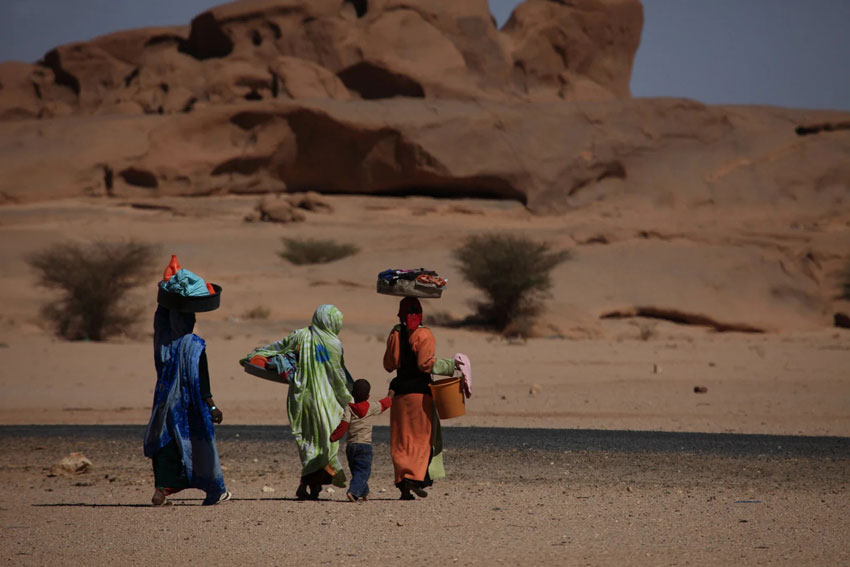
Beyond the coastlines, the Himalayan region presents a different but equally dire narrative. The melting of glaciers, often referred to as the "Third Pole," threatens the water security of hundreds of millions. Sudden events like Glacial Lake Outburst Floods (GLOFs) and chronic issues like drying mountain springs are hollowing out villages in Uttarakhand and Himachal Pradesh. When the water disappears, the economy collapses, leaving the youth with no choice but to migrate to the plains. This internal migration puts immense pressure on India’s already overstretched urban infrastructure.
Cities like Delhi, Mumbai, and Bengaluru are becoming the destination for these "environmental migrants," leading to the rapid growth of informal settlements where living conditions are precarious and the cycle of vulnerability continues.
The international dimension of this crisis adds a layer of geopolitical complexity. India shares a long, porous border with Bangladesh, a country where a significant portion of the landmass sits less than five meters above sea level. Projections suggest that by 2050, one in every seven people in Bangladesh could be displaced by climate change. Given the shared geography and history, a large-scale movement across the border is inevitable. This poses a significant challenge for Indian policymakers, as the current international legal framework, including the 1951 Refugee Convention, does not recognize "climate" as a valid ground for refugee status. Without a legal definition or a dedicated policy, these migrants often find themselves in a state of legal limbo, viewed through the lens of national security or "illegal immigration" rather than human rights and climate justice.
Addressing the issue of climate refugees requires a shift in how India views development and disaster management. While the government has made strides through the National Action Plan on Climate Change (NAPCC), there is an urgent need for a specific policy framework that addresses "managed retreat"—the planned relocation of communities from high-risk areas before disaster strikes. Furthermore, India must lead the global conversation in demanding "climate reparations" from industrialized nations, whose historical carbon emissions are the primary cause of the current crisis. The burden of hosting and rehabilitating climate refugees cannot fall solely on developing nations that are geographically predisposed to these disasters.
Ultimately, the story of climate refugees in India is a story of resilience meeting its breaking point. It is a reminder that the environment is the foundation of all social and economic stability. As the Himalayan ice melts and the Indian Ocean rises, the boundaries between environmental science and social justice blur. India’s response to this crisis will not only define its own domestic stability in the coming decades but will also serve as a blueprint for how the Global South navigates the most significant mass migration in human history. The time for viewing climate change as a distant threat has passed; for the millions already on the move within and toward India’s borders, the climate crisis is a lived, daily struggle for survival.

By Viral Desai
(The author is a known Environmentalist and the pioneer of Satyagraha Against Pollution movement, viraludayindia@gmail.com )
(The content of this article reflects the views of writer and contributor, not necessarily those of the publisher and editor. All disputes are subject to the exclusive jurisdiction of competent courts and forums in Delhi/New Delhi only)

















Leave Your Comment