


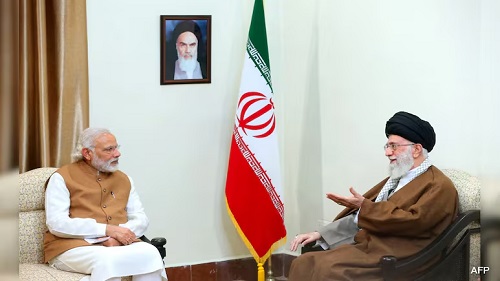
As Iran’s clerical leadership grapples with the most significant domestic protests in years—fuelled by economic distress, political fatigue, and a thirst for social change—the ripples are being felt far beyond its borders. In New Delhi, policymakers are watching the unfolding crisis with quiet but profound unease. For India, Iran is not merely another regional player; it is a pivotal strategic partner, a historical counterweight, and a crucial geographical corridor. The potential weakening or transformation of the Iranian state threatens to upend decades of careful Indian diplomacy and recalibrate the fragile balance of power in West Asia.
The India-Iran partnership is forged from necessity and shared interests. Geographically, with Pakistan steadfastly blocking India’s overland routes to Afghanistan and Central Asia, Iran has long been New Delhi’s only viable western gateway. Politically, the Shia leadership in Tehran has served as a natural counterbalance to Sunni-majority Pakistan’s influence, acting as a stabilising pillar in India’s intricate West Asia policy. This relationship provided New Delhi with strategic manoeuvring space in a region where its challenges are multiplying: from regime change in Bangladesh and persistent terror threats from Pakistan, to China’s relentless expansion and the unpredictable shifts in US policy. An unstable Iran risks collapsing this already shrinking space.
1. Chabahar: The Corridor at Risk
At the heart of India’s strategic investment lies Iran’s Chabahar Port. More than just a port, it is envisioned as India’s dedicated land bridge to Afghanistan and the mineral-rich markets of Central Asia, deliberately bypassing Pakistan. However, corridors of connectivity require political stability, security guarantees, and long-term commitment—all of which are now in question.
As Professor Rajan Kumar of Jawaharlal Nehru University told The Times of India, “In a post-Khamenei power struggle, Chabahar risks becoming a hostage to instability rather than a strategic asset.” India has already invested significant diplomatic capital and resources into the project, and its viability hinges on a coherent and cooperative partner in Tehran.
2. The Pakistan Counterbalance
Despite being a Muslim-majority nation, Iran’s Shia identity has historically placed it at odds with Pakistan’s Sunni-dominated establishment and its patronage of certain extremist groups. This divergence worked decisively in India’s favour during the 1990s Afghan civil war, when India and Iran jointly backed the Northern Alliance against the Pakistan-backed Taliban. This alliance prevented Pakistan from achieving unchallenged “strategic depth” in Afghanistan. Even on the global stage, Tehran has aided Delhi, notably by resisting Islamabad’s push for international sanctions over Kashmir in the mid-1990s. A regime collapse or a radical reorientation in Tehran could dismantle this tacit anti-Pakistan alignment.
3. The Shadow of the Dragon: China’s Deepening Foothold
While Iran balances Pakistan for India, its own “Look East” strategy has increasingly tilted towards Beijing. The landmark 25-year strategic cooperation pact signed in 2021 has cemented China’s role as Iran’s economic lifeline amidst crippling Western sanctions. In 2025, over $14.5 billion worth of Iranian goods flowed to China, its largest trade partner.
India’s presence, particularly at Chabahar, has been a modest but symbolic counter to China’s Belt and Road Initiative inroads. Persistent chaos in Iran, however, makes Beijing an even more attractive partner for any future regime desperate for investment and security support. Reports indicate that Iranian officials are already discussing Chinese-funded power plants and port projects in Khuzestan, suggesting a future where Beijing’s influence could become overwhelming, sidelining Indian interests.
Navigating this crisis requires a blend of strategic patience and proactive safeguarding. As former Foreign Secretary and Ambassador Nirupama Menon Rao articulated in a social media post, India’s approach must remain “measured and carefully calibrated.”
“It should keep a certain distance,” she advised, “because the situation in Iran has reached a point where outside actors cannot control the ramifications, nor reliably shape the outcome. The first duty is protection: the interests of Indian citizens in Iran, and in the wider region, must be safeguarded through strong consular readiness and contingency planning.”
This counsel underscores India’s immediate priorities: ensuring the safety of its nationals and protecting existing investments. In the longer term, New Delhi must prepare for multiple scenarios. It must engage with all significant stakeholders within Iran while avoiding any perception of interference. Diplomatically, it will need to reinforce ties with other regional powers like Israel, Saudi Arabia, and the UAE—relationships that have deepened in recent years but now must be balanced with the need to preserve whatever remains of the Iran partnership.
Furthermore, India must realistically assess the vulnerability of its connectivity projects and explore parallel routes, even as it hopes for Chabahar’s survival. The challenge is to prevent Iran from becoming a vacuum that draws in adversarial forces, thereby altering the regional security and trade architecture India has long relied upon.
The fires in Iran are burning on a foundation of deep-seated public discontent. For India, the stakes are extraordinarily high. The nation must now craft a policy that is both resilient and flexible—one that protects its citizens and its interests today, while positioning it to engage with whatever Iran emerges tomorrow. In the grand chessboard of West Asia, a key square is trembling, and India must play its next moves with utmost skill and foresight.
















Leave Your Comment