


On a pleasant bright winter afternoon in New Delhi on January 27, 2026, the lawns outside Hyderabad House looked unusually vibrant. National flags from across Europe fluttered beside the Indian tricolour, and there was a quiet excitement in the air, something that comes only when a moment of real consequence is about to unfold. Inside, Prime Minister Narendra Modi, European Commission President Ursula von der Leyen, and President of the European Council António Costa sat across a long table. The smiles, the nods, the murmurs among officials, they all hinted at what the world would soon witness: the signing of what leaders were already calling the “mother of all deals.”
In that carefully choreographed setting, India and the European Union sealed a Free Trade Agreement that had been almost twenty years in the making. For years the negotiations stopped, restarted, stalled, turned political, became technical, changed formats, and changed speed. Yet, somewhere between New Delhi and Brussels, persistence won over fatigue. And suddenly, on that January afternoon, you could feel that something big had finally clicked into place.
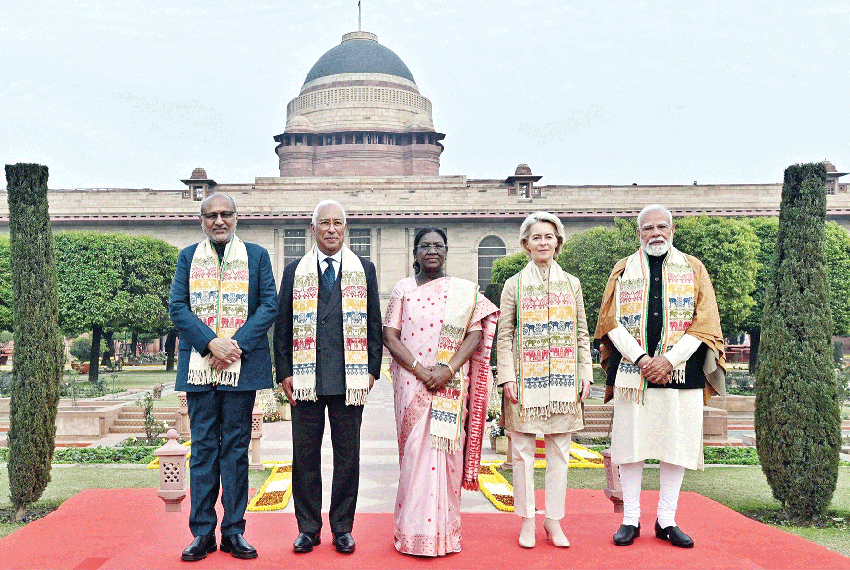
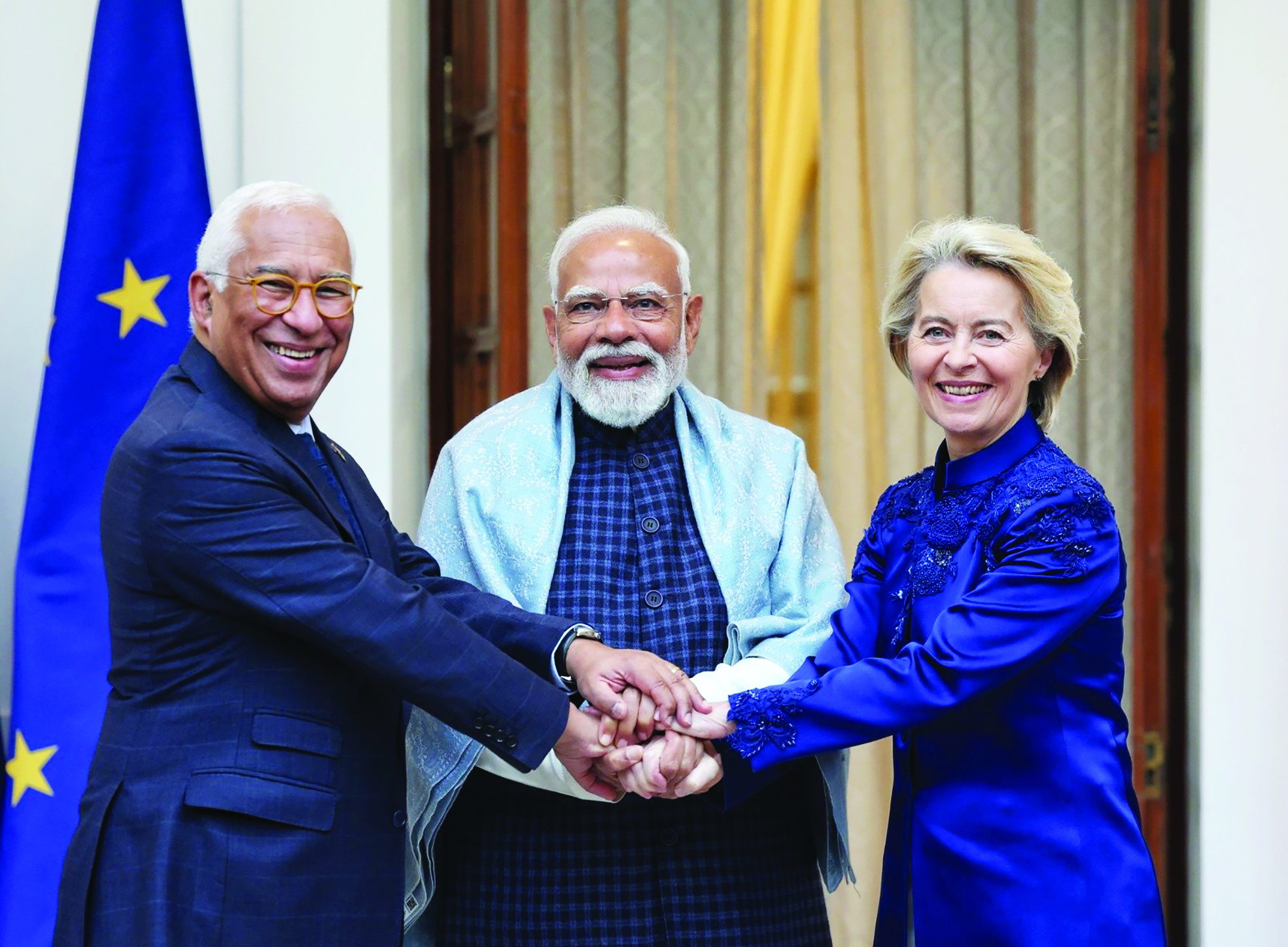
For a country of 1.4 billion people and European Union’s 450 million, this wasn’t just paperwork. This was a handshake between two of the world’s largest democratic spaces, stitching together a market valued atleast $27 trillion. If you paused and looked long enough at that handshake, you could see the outlines of future trade lanes, factories humming with new orders, and millions of workers whose everyday lives could change as the world’s largest economies brought down barriers that once stood firmly between them.
The significance of the moment was captured best by Ursula von der Leyen herself, who declared with unmistakable enthusiasm that Europe and India had just concluded “the mother of all deals.” Her words weren’t a diplomatic flourish. They were a reflection of the sheer scale of what had been agreed upon, a trade pact covering 25% of the world’s GDP and nearly one-third of global commerce.
What makes this FTA feel even more dramatic is the global backdrop against which it has been signed. With the United States turning increasingly inward under President Donald Trump and trade tensions rising across continents, both India and the EU found themselves needing reliable partners. In an age where trade has started to become weaponised, this agreement felt like a reaffirmation of trust in openness.
Diplomats in Brussels whispered that the deal symbolised “strategic confidence.” Officials in New Delhi described it as “a bridge for the next decade.” But for many who watched the signing live, it simply felt like the sort of moment that marks a new and historic chapter.
To understand why this moment holds such promise, it helps to step back and see how the relationship has evolved. For years, India’s access to the EU market was hindered by high duties, complicated certifications, and regulatory hurdles that often-discouraged small exporters. On the European side, a mix of tariffs and India’s protective policies made it difficult for EU companies to enter one of the world’s most dynamic markets. The new FTA wipes away many of these barriers. The agreement reduces or eliminates tariffs on over 96% of traded goods by value. And that simple shift, cutting down duties, can change the geography of trade more than any speech or summit ever could.
Imagine European cars that no longer cost as much as a small apartment. Think of Indian textiles, which were often penalised by duties of 8 to 12 per cent, now entering the European market at competitive prices. Picture Indian seafood, coffee, spices, engineering goods, and pharmaceuticals reaching store shelves from Lisbon to Helsinki with far fewer layers of paperwork standing in their way. These are not just statistics; they are everyday realities that millions of people across both continents will soon experience.
But the story of this FTA is not merely about cheap cars or easier exports. It is about the tone of the new global order. When Donald Trump’s administration ramped up tariffs on Indian goods, especially textiles and jewellery, it sent a jolt through exporters from Tiruppur to Surat. Suddenly, India needed new openings. And the EU, still recovering from supply-chain shocks and looking for reliable partners beyond China, needed diversification. The two sides found themselves facing the same question from opposite ends: Where do we go now?
As one Indian diplomat put it, “When America frowned, Europe smiled.” It was a simple line, spoken with quiet humour, but it captured a deeper truth. With Washington adopting a more combative economic stance, Brussels emerged as a stable, dependable partner. The result was an acceleration in negotiations, driven partly by necessity and partly by political chemistry between leaders who believed that democracies must support each other in uncertain times.
Even as the champagne glasses clinked in the reception that followed the signing, there were murmurs about what the deal really meant. Experts around the world offered a mix of celebration and caution. Trade economist Biswajit Dhar noted that while textiles, shrimp, engineering goods, and gems might see a boom, Europe’s tougher intellectual property regime could raise concerns for India’s pharmaceutical sector, which supplies 20% of the world’s generic medicines. The Atlantic Council suggested the deal wouldn’t dramatically reshape global supply chains overnight, but called it a “diplomatic win with long-term economic dividends.”
Still, the optimism outweighed the caution. Indian Commerce Minister Piyush Goyal called the agreement “India’s largest and most ambitious FTA ever”, one that could open the door to exports worth ₹6.4 lakh crore. Analysts in Europe predicted that EU companies could save as much as €4 billion a year in duties. And if these numbers hold true, they could trigger a wave of investment, trade, and mobility across sectors ranging from automobiles to green technologies.
What truly sets this FTA apart, however, is how deeply it is rooted in political strategy. In today’s multipolar world, India has emerged as a balancing force between major blocs. By strengthening its ties with Europe, India reduces its vulnerability to unpredictable shifts from the United States. By gaining access to India’s vast consumer market, the EU lessens its dependence on China. This is not merely trade; it is geopolitics dressed in the language of economics.
Trump’s reaction, understandably, was somewhere between irritation and acknowledgment. Sources in Washington hinted that the President wasn’t visibly pleased that India had found a strong alternative to the US market. Yet even within his administration, some voices admired how Modi navigated the landscape. Robert Greer, Trump’s trade chief, went on record saying, “India comes out on top. Modi negotiated hard and smart.” It was as close to praise as one could expect in a tight political season.
Meanwhile, on social media, the reactions were as colourful as India’s democracy. Some hailed it as a “historic reset,” praising the government’s ability to strike a major trade deal at a time when global tensions were increasing. Others worried about the potential flooding of Indian markets with European goods, raising concerns for small and medium enterprises. Farmers groups celebrated the exclusion of sensitive agricultural items, while industrial leaders discussed how Indian manufacturing could leverage European technology to move up the value chain.
And yet, beyond the noise and opinions, there is a simple truth: India has rarely had such an opportunity. The deal creates space for millions of small exporters to dream bigger. It gives Indian engineers, designers, and service professionals a clearer route to European markets. It pushes Indian industries to raise their standards and embrace sustainability norms that will dominate global trade in the coming decades. It allows European firms to invest in Indian capacity, manufacturing, clean energy, and digital technologies with confidence.
One negotiator from the European side summed it up beautifully: “This is not the end of a negotiation; it is the beginning of a relationship.” That sentence, soft but powerful, describes the real spirit of the India–EU FTA. Trade deals come and go. But relationships of trust, especially between democracies that share values of openness and stability, are what shape the future.
As the sun set over Delhi that evening, the crowds outside dispersed, journalists filed their stories, and leaders boarded their planes, one thing was clear: something important had shifted. India had not just signed a trade pact. It had declared its place in a changing world.
And perhaps years from now, when Indian textiles dominate European high streets, when European green technologies power Indian factories, when students, chefs, coders, and entrepreneurs move more freely between Bengaluru and Berlin, people will look back and remember the day the “mother of all deals” was signed and the day when India-Europe story had irreversibly changed.
(The content of this article reflects the views of writer and contributor, not necessarily those of the publisher and editor. All disputes are subject to the exclusive jurisdiction of competent courts and forums in Delhi/New Delhi only)














Leave Your Comment