



Rakesh Kumar
I was deeply amused recently to read Saurabh Dwivedi’s highly publicised declaration about dropping his traditional family surname from his children’s names. The prominent Indian journalist has long faced accusations of opportunism from critics and social media commentators. This latest pronouncement does little to dispel that reputation; instead, it epitomises a broader, modern malaise: the substitution of genuine, systemic social reform with performative public relations. While framed as a bold stance against casteism, the gesture feels hollow when he himself retains his own upper-caste surname, continuing to leverage the very social capital he claims to reject for his descendants. My father along with thousands of other ordinary people dropped surname from my name 60 years ago. This change along with teachings from Bhagwat Geeta and Yog Darshan helped me in developing a mindset where every living creature from an ant to an elephant, earned respect for having the same soul. There are ample evidences in Indian culture to support this thinking and Dayanand did the same using Indian scriptures only. His ‘Pakhnad Khandini Pataka’ mission defeated propagators of birth-based superiority.
To understand why this selective virtue signalling rings so hollow, one only needs to look to the pages of history. India’s true social reformers understood that dismantling deep-rooted hierarchies required profound personal sacrifice and structural upheaval, not superficial changes to a birth certificate.
How British Administration Strengthened Caste Categories with No Intention of Uplifting the Downtrodden
1. Census Classification
Beginning with the late 19th-century censuses from 1871 onward, British administrators attempted to place India's highly diverse communities into fixed categories.
Before this:
The census required every person to be assigned a specific caste category, creating official records that often froze identities that had previously been more flexible.
2. Administrative Convenience
The British increasingly used caste categories for:
3. "Martial" and "Non-Martial" Castes
`Indian saints and reformers were working relentlessly during this period.
Consider Swami Dayanand Saraswati (12 February 1824 – 30 October 1883), the visionary founder of the Arya Samaj in the 19th century. He did not merely indulge in symbolic gestures; he aggressively challenged the legitimacy of the birth-based caste system (Janmanat Varna) using the same literature . The Arya Samaj actively promoted Guna-Karma-Swabhava—the radical idea that a person's status should be determined solely by their character, education, and actions, rather than the accident of their birth.
The Arya Samaj sought to challenge caste hierarchies through:
We can see that this movement started many decades earlier to first consensus of 1871.
Swami Vivekananda.
Swami Vivekananda approached the eradication of caste not by seeking to destroy the social fabric, but by advocating for the spiritual and educational elevation of the masses. He vehemently condemned the rigid, birth-based caste system of his time, labelling its discriminatory practices as a perversion of true Vedantic philosophy, which views all human souls as inherently divine. Vivekananda argued that the original caste concept was meant to be a flexible division of labour based on individual aptitude (guna and karma), rat her than an oppressive tool of social exclusion. To dismantle these artificial barriers, he championed universal education and spiritual awakening, believing that true equality would naturally emerge once the underprivileged were given the tools of knowledge, self-respect, and economic independence.
Mahatma Gandhi
Mahatma Gandhi approached the annihilation of untouchability as a monumental spiritual and social penance for the Hindu community. Gandhi’s methods were arduous and deeply immersive. He lived in sanitation workers' colonies, launched national campaigns against untouchability, and established the Harijan Sevak Sangh. Whether one agrees with all aspects of his methodology or prefers the constitutional, rights-based radicalism of Dr B.R. Ambedkar, there is no denying that these figures chose the hard, dusty road of grassroots social engineering. They changed minds, challenged laws, and altered the structural realities of millions.
Rise of Dr. Bhim Rao Ambedkar
While thousands of books and articles have been written highlighting the exceptional work of Babasaheb Ambedkar, an important historical reality is often overlooked:
Dr. B. R. Ambedkar's struggle against caste discrimination was not fought in isolation.
While he faced severe social barriers and personal humiliation, he also received support from individuals and institutions belonging to communities labelled as upper castes—people who recognized his extraordinary abilities and shared a commitment to social reform.
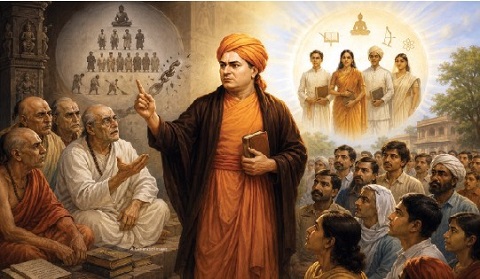
Some notable examples include:
These examples suggest that by the late nineteenth and early twentieth centuries, significant currents of social reform were already present within Indian society. Many individuals from traditionally privileged communities actively opposed untouchability and supported the educational and social advancement of marginalized groups. At the same time, sections of society, including those associated with places such as the Kala Ram Mandir in Nashik and parts of Kashi, continued to resist such reforms and worked to preserve existing social barriers.
At the same time, Ambedkar's achievements remain remarkable because the existence of reformist allies could not eliminate the structural barriers completely. Access to education, public facilities, employment, and social equality remained severely restricted for many members of the Depressed Classes.
The Rashtriya Swayamsevak Sangh (RSS)
The Rashtriya Swayamsevak Sangh (RSS) approaches untouchability and caste discrimination primarily through the lens of Hindu unity (Sangathan) and social harmony (Samajik Samrasta). Its foundational goal is to consolidate a unified Hindu society, which it believes has historically been weakened and fractured by internal caste-based divisions. The RSS has actively campaigned against upper-caste Hindus preventing Dalits from entering temples. The organization advocates for training Dalits and Other Backward Classes (OBCs) as Hindu temple priests—a role historically reserved for Brahmins.
Critics, including Marxist historians, Dalit activists view the organization’s anti-caste initiatives differently. They argue that the approach focuses more on symbolic assimilation to counter conversion.
Vote politics and glee to get reservation has created chaos and distrust.
While visionaries who devoted their lives to addressing the complexities of the caste system through sustained social reform, much of the current political class has chosen the path of least resistance.
Modern politicians often find it more profitable to exploit them. A complex socio-historical challenge has been reduced to an electoral calculation. It is easier to mobilize identities, engineer caste coalitions, and distribute patronage for short-term political gain.
Even media figures—who command vast digital platforms built around analysing and monetizing these very caste equations during election cycles.
True progressivism cannot be achieved by erasing a few letters from a name or by continually expanding the list of reservation beneficiaries. Admission to a medical college or selection to the civil services, without adequate support and competence-building, can deepen perceptions of unfairness and widen distrust. by resisting meaningful realignment Courts have questioned provisions that they considered inconsistent with principles of natural justice, yet politicians keep enacting new laws that remain legally contentious. The result is a growing trust deficit.
Until public, intellectuals and political leaders move beyond these convenient, low-risk gestures and recommit themselves to the difficult social work championed by earlier reformers, the complex architecture of caste will remain intact—preserved, in part, by its continuing political utility.
The Way Forward
Caste-based reservation was never a major point of contention. The larger challenge today lies in political opportunism and the continuous demand to include more communities in reserved categories for electoral advantage.
It is a paradox of modern India that, even as the nation progresses, an increasing number of communities seek recognition as disadvantaged. Equally concerning is the perception that some laws permit arrest before adequate investigation, creating anxiety and resentment among sections of society.
In a digital age where evidence is increasingly traceable, the focus should be on more efficient policing, better investigation, and faster delivery of justice. The principle that an innocent person should not be punished must remain central to the legal system. Passing increasingly stringent laws cannot compensate for weak investigations, poor policing, or delays in the judicial process.
The nation must also reflect on why courts have struck down or questioned certain statutory provisions enacted by Parliament. Ignoring these concerns risks repeating past mistakes, where judicial decisions were effectively overturned through legislation, as happened following the Supreme Court's Shah Bano judgment. Lasting social harmony will come not from multiplying legal provisions or electoral promises, but from strengthening justice, expanding opportunity, and rebuilding trust across communities.
Education for All and Employment for Every Employable Person: The Real Path to Ending Caste-Based Discrimination.
Education expands opportunities, challenges inherited prejudices, and empowers individuals to rise above limitations imposed by birth. Employment, in turn, provides economic independence, dignity, and social mobility, enabling people to be valued for their skills, character, and contributions rather than their caste identity.
Social barriers weaken when people study together, work together, compete on merit, and pursue shared aspirations. Economic empowerment reduces dependence on traditional social hierarchies, while education fosters confidence, awareness, and mutual respect. Together, they create an environment in which caste becomes increasingly irrelevant to an individual's opportunities and social standing. The growing acceptance of inter-caste marriages in many parts of society is one visible sign of this transformation.
Lasting change is achieved when every child has access to quality education and every capable individual has the opportunity to earn a dignified livelihood. A society that guarantees both learning and employment opportunities for all lays the foundation for greater equality, inclusion, and social harmony.
Education opens minds. Employment opens doors. Together, they can help close the chapter on caste-based discrimination.
Government must understand the ground realities!
Mushrooming private schools and coaching industry is a proof that Indian public wants quality education and ready to pay for it, even if it requires curtailing essential requirements. The government educational institutions to improve both in number and quality. It is an irony that that despite independence, we have failed to provide one education minister of repute who could transform the educational system. Same is true for budget being allotted for education.
The author has worked in public sector for 38 years and invested time and energy in training the employees who get employed using reservation. The competence improved immediately and not a single incidence of caste-based discrimination took place. Neither the customer nor the peers are worried about caste until unless inefficiency or discrimination is visible.
‘Sabka Sath Sabka Vikas’ has to be realised by fair rules and transparent policies. Caste based manipulative arithmetical formula may make winning election easy but unity in diversity will suffer.
(The content of this article reflects the views of writer and contributor, not necessarily those of the publisher and editor. All disputes are subject to the exclusive jurisdiction of competent courts and forums in Delhi/New Delhi only)




















Comments (2)
M
This eye opener deep research should be read by so called journalists to take dialogue in right direction
D
Thoughtful and analytical. वर्ण व्यवस्था was division of labor based on individual 's intellect, competence ,attitude and preferences. Over the time It was natural that job related competencies would transfer from ancestors to their descendants and so came into existence cast based occupational system. To think that from the very beginning cast system was rigid and discriminatory , is not correct . Till society was affluent different castes lived in harmony. With the foreign invasion and our economic depletion started exploitation of working class and many evils crept into our social system.