


How a quiet Tantric training centre reshaped priesthood, challenged intellectual orthodoxy, and restored authenticity to Kerala’s Hindu ritual traditions.
Kerala’s temples have always been more than places of worship—they are cultural organisms, guardians of ritual memory, and anchors of social identity. For centuries, the right to perform their sacred rites, especially the complex tantric rituals central to Kerala’s temple culture, remained in the hands of a few hereditary families. This lineage-based authority shaped not only ritual life but the social landscape surrounding temples.
Yet in recent decades, these inherited foundations have begun to shift. Public debate now surrounds questions that were once confined to the sanctum:
Who is spiritually qualified to perform rituals? Can heredity supersede constitutional equality?
Amid these debates stands an institution few outside Kerala know about, yet one that has quietly transformed the very nature of priesthood in the state: Thanthra Vidya Peetham (TVP), Veliyathunad, near Ernakulam.
This is the story of an institution that did not argue for reform but built it—patiently, methodically—through conviction rather than confrontation, and by deepening access rather than diluting tradition.
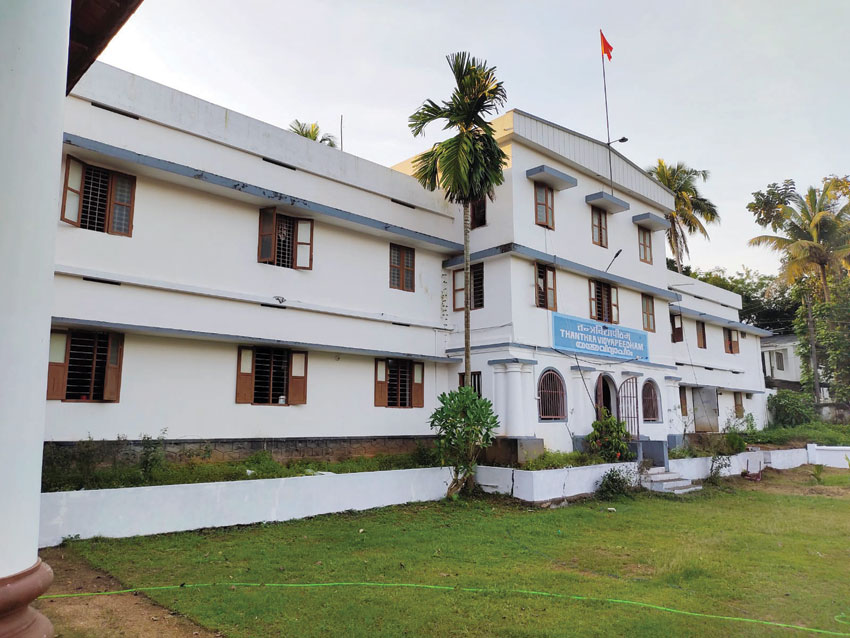
Tucked away in the quiet, green expanses of Veliyathunad in Ernakulam, on the sacred banks of the holy River Poorna (Periyar), the institute does not announce itself with imposing gateways or architectural grandeur. The campus remains understated, unadorned, and deeply serene—perfectly mirroring its ethos: discipline without display, scholarship without spectacle, and spirituality without noise.
The Thanthra Vidyaa Peettham was formally launched on June 23, 1972, with the blessings and financial support of Kanchi Kamakoti Peetham’s Sankaracharya Jayendra Saraswathi. Established at a time when Kerala’s tantric heritage was facing a slow decline, the Peettham began humbly with simple huts, open classrooms, and the unwavering resolve of its founders.
Over the decades, this modest campus evolved into one of the state's most respected centres of Tantric learning. Yet its spirit remains the same—quiet, disciplined, inward-looking, and grounded in the gurukula ethos.
Inspired by the guiding ideal of the TVP—that the right to perform temple worship must rest on competence (karma) rather than birth (caste)—Kerala witnessed a quiet but profound revolution in the 1980s. In October 1985, the Kerala Kshetra Samrakshana Samiti (KKSS), drawing strength from Sangh principles, issued the landmark Paliyam Declaration. It boldly affirmed that every Hindu, irrespective of caste, has the right to become a temple priest, provided they are properly trained and qualified. This unprecedented proclamation challenged entrenched orthodoxy, reshaped Kerala’s temple traditions, and opened the doors of priesthood to all who were willing to learn and serve.
The Genius Behind TVP
The story of TVP begins with the remarkable vision of the late Madhavji (P. Madhavan: 1926-1988) a senior RSS pracharak, spiritual thinker, noted social worker, and reformer whose influence extended across Kerala’s cultural landscape. Madhavji saw clearly that Kerala’s tantric traditions were being weakened by modern pressures, social transitions, and the gradual thinning of traditional Tantric lineages. He believed that if the system was to survive, the solution lay not in lamenting its decline but in rebuilding its knowledge foundations.
Bringing together his colleagues from traditional Tantric families and respected figures from Kerala’s social and cultural spheres, he established TVP with a clear mission:
to preserve, systematise, and transmit the tantric knowledge that lies at the heart of Kerala’s temple culture.
Madhavji’s strategic brilliance lay in grounding reform within tradition. Unlike movements that sought to challenge the hereditary system through agitation, TVP sought to renew it by expanding access to authentic training. Reform was not imposed from outside but grown from within.
His leadership style was characterised by humility, discipline, deep scriptural learning, and an unwavering commitment to societal upliftment. He built TVP not as a personal legacy but as a cultural trust, ultimately placing it under the guidance of a committee of respected Acharyas and eminent personalities, ensuring continuity beyond individual lives.
The Gurukula That Built a New Social Architecture
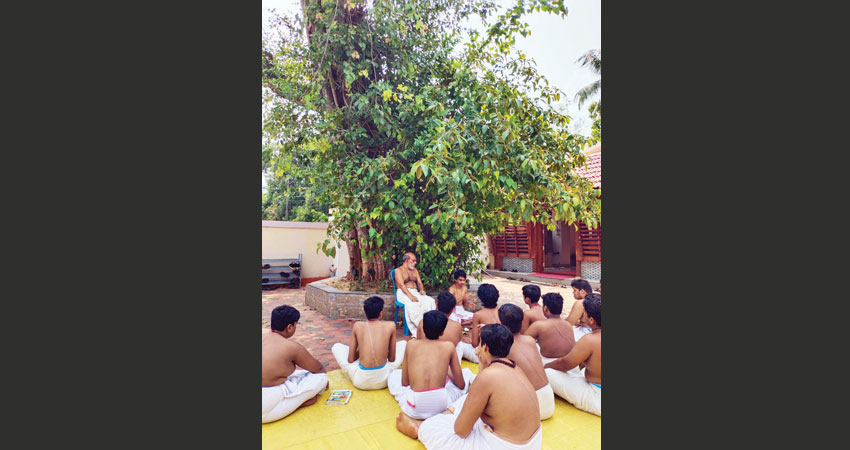
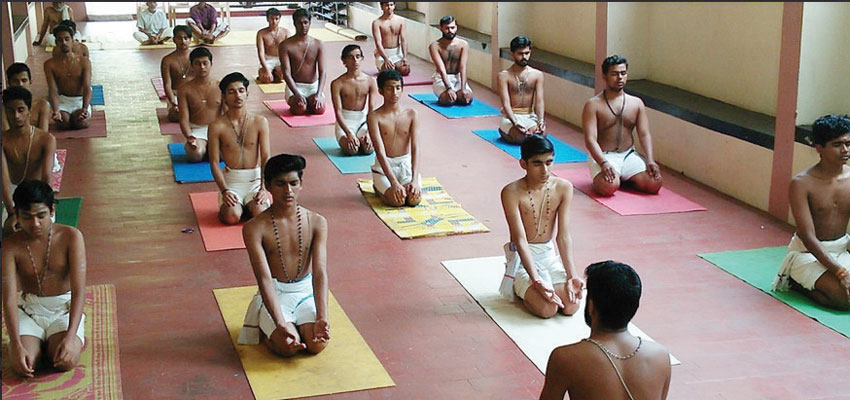
TVP was envisioned as a modern gurukula—a living learning space grounded in discipline, purification, and the intimate teacher–student bond. For Madhavji and his colleagues, mastering rituals was not enough; a Tantric practitioner had to develop scriptural understanding, ethical conduct, philosophical depth, inner purity, and devotional focus. The curriculum they shaped was therefore both rich and demanding, drawing from Agama and Tantra texts, the Thantra Samuchayam, temple architecture, mantra and yantra traditions, mudras, homa and consecration procedures, and the philosophical frameworks that support these practices. Students lived on campus under the direct guidance of Acharyas, learning through observation, participation, and steady practice. Character formation—particularly humility, self-discipline, and devotion—was considered as vital as intellectual study. Over the years, this gurukula model quietly reshaped Kerala’s priesthood, shifting the basis of ritual authority from inherited privilege to genuine competence and authentic training.
Rooted in Tradition, Open to Contemporary Realities
Although firmly rooted in ancient tantric systems, the Peetham has always remained sensitive to contemporary needs. Rather than rejecting modernity, TVP selectively adopts what aligns with its mission while preserving the inner spirit of Tantric knowledge. This balanced approach enables it to document and systematise oral traditions, encourage comparative scriptural study, train students to meet modern temple administrative challenges, collaborate with cultural organisations, and conduct public sessions on ritual awareness. Such grounded openness has allowed TVP to remain relevant across generations without ever compromising its core values.
A Pillar of Kerala’s Temple Ecosystem
Today, TVP-trained alumni serve across Kerala—quietly, competently, and with deep reverence for tradition. They have become tantras of major temples, shantikkar (priests) who perform daily and special rituals, consultants for temple renovation and consecration, scholars who teach ritual studies, and cultural resource persons who guide festival committees.
Through their work, TVP has indirectly shaped Kerala’s temple rituals, festivals, consecrations, and everyday worship patterns for over five decades. The institution’s impact is not loud but deeply structural—rooted in competence, continuity, and spiritual discipline.
Madhavji’s Larger Vision: Dharma Rooted in Social Service
To understand TVP is to understand Madhavji’s philosophy. His work as a pracharak, social worker, organiser, and spiritual guide shared a single thread: the upliftment of society through dharmic values.
His colleagues recall that he saw Tantric learning as a public responsibility—not a secretive privilege. He believed that:
These convictions shaped every aspect of TVP’s functioning, from its transparent governance to its emphasis on humility, service, and spiritual ethics.
A Quiet Influence, A Lasting Legacy
For all its significance, TVP has never sought publicity. It does not issue loud declarations, hold aggressive campaigns, or position itself as a reformist force. Its influence is slow, steady, and organic—built through decades of training rather than months of activism.
Whenever a temple performs a consecration with precision, or a festival unfolds with ritual depth, or a young priest performs his duties with clarity and humility, the unseen presence of institutions like TVP becomes visible.
It has changed Kerala’s temple culture without changing its outward symbols—by strengthening the hands that uphold them.
Continuity Through Community
One of TVP’s greatest achievements is the vibrant community it has nurtured—a network of teachers, alumni, trustees, devotees, scholars, and cultural organisations. This living collective provides the institution with stability, ethical leadership, steady growth, and the careful preservation of its rich, intangible ritual knowledge. It is a community bound not by organisational loyalty but by a shared commitment to dharma and tradition.
A Living Repository of Tantric Knowledge
Kerala’s Tantric tradition is not merely textual; it is experiential, practical, and transmitted through lived practice. TVP serves as a guardian of this heritage by preserving rare manuscripts, oral teachings, temple-specific customs, local ritual variations, consecration and purification methods, and the ancestral knowledge handed down through Tantric families. In doing so, it safeguards a tradition that is at once philosophical, ritualistic, cultural, and deeply spiritual.
A Legacy That Continues to Evolve
From its humble beginnings in 1972 to its role today as a quiet powerhouse of Tantric study, TVPstands as a testament to what perseverance, vision, and conviction can build.
It is an institution born not from agitation but from responsibility, not from public demand but from inner understanding. Founded by Late Madhavji, nurtured by traditional Tantric scholars, and sustained by a committee of Acharyas and eminent cultural personalities, Tantra Vidya Peetham remains central to Kerala’s spiritual and ritual landscape.
It did not challenge hereditary structures through slogans; it challenged them by producing scholars. It did not argue for equality; it enabled it. It did not dismantle tradition; it deepened it.
In doing so, it has quietly shaped the rituals, the priests, and the spiritual atmosphere of Kerala for more than half a century—and continues to illuminate the path for generations to come.
The Mystery of Temple Energy
Late Madhavji’s book, Kshetra Chaitanya Rahasyam is one of the most insightful works on Kerala’s Tantric temple tradition. It explains with clarity and authority why a temple becomes spiritually powerful, how its energy is created, and what keeps it alive. Drawing from scripture, experience, and a lifetime of service, Madhavji reveals the hidden architecture of sacred spaces and the inner science behind their rituals.
The Living Energy of Temples
At the heart of the book is the idea that a temple is not just a place of worship, but a field of awakened consciousness. This “chaitanyam” is generated through consecration, mantra, geometry, and disciplined worship. Madhavji insists this is not symbolic but a functional spiritual reality shaped by strict Tantric and Agamic principles.
Architecture as an Energy System
A temple, he explains, is an engineered structure designed to hold and radiate divine energy. The proportions of the sreekovil, the placement of the balikkal, the sequence of spaces, and the directional layout all act together like a spiritual circuit. Even small design changes can weaken the temple’s vibrational core. Thus, architecture becomes inseparable from spiritual function.
The Tantri as Custodian of Power
The book highlights the tantri as the key guardian of a temple’s energy. More than a ritual expert, he is a spiritual scientist whose inner purity, ethical discipline, mantra mastery, and philosophical understanding sustain the chaitanyam of the temple. Technical skill alone, Madhavji says, cannot uphold sacred power; the tantri’s inner state is crucial.
How Temples Lose Their Power
Madhavji speaks frankly about the decline of temple energy. A temple loses its chaitanyam when rituals are diluted, when commercialisation takes over, when unqualified priests are appointed, when architecture is altered carelessly, or when daily worship is neglected. A temple can remain physically intact yet spiritually extinguished if discipline collapses.
The Science of Consecration
One of the book’s strongest sections is its explanation of prana pratishta. Madhavji describes consecration as a precise, layered process involving mantra, meditation, visualization, and a prepared state of mind. Through this, the deity becomes a living presence—not a symbol—within the sanctum.
Temples as Social Anchors
Beyond spirituality, Madhavji shows how temple energy shapes society. Historically, temples were centres of culture, learning, ethics, and communal harmony. When a temple’s chaitanyam is strong, the society around it becomes naturally cohesive.
A Modern Classic
Kshetra Chaitanya Rahasyam has become a reference work for scholars, priests, administrators, and devotees. Its greatest strength is its ability to bridge ancient Tantra with contemporary understanding without losing depth or authenticity.
This book is a masterkey to understanding the invisible spiritual mechanics of temples. Madhavji succeeds in revealing how temples are built, sustained, and protected—not through superstition, but through a sophisticated spiritual science rooted in Kerala’s Tantric heritage.
 4
4
By Pradeep Krishnan
(The content of this article reflects the views of writer and contributor, not necessarily those of the publisher and editor. All disputes are subject to the exclusive jurisdiction of competent courts and forums in Delhi/New Delhi only)














Comments (6)
Though heard of Madhavji, the information of TVP is new to me. A very good article.
S
Nice presentation. A detailed article on the subject.
L
Very informative.
S
Great study on the subject. Very informative.
As usual very clear and informative article filled with facts
K
The artcile is precise,clear and simultaneously detailed but concise infomation.