


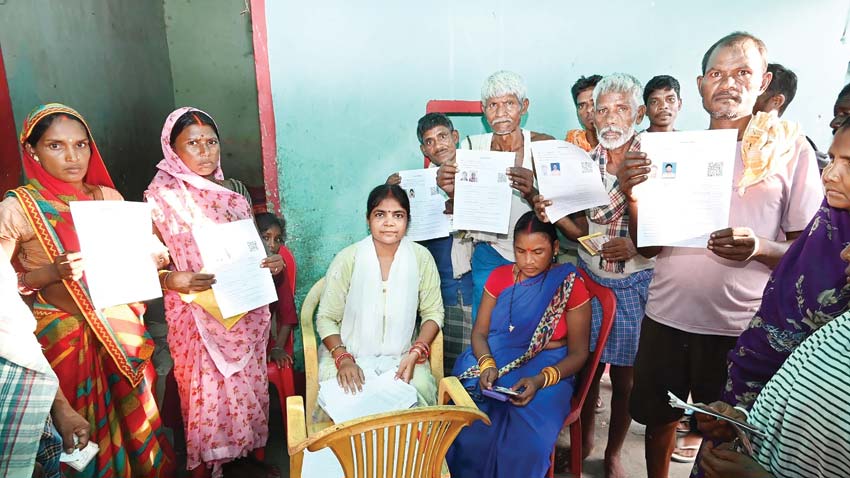
In Bihar, the heartland of India's political churn, a rather routine administrative exercise has turned into a full-blown political storm. The Election Commission of India (ECI), in its constitutional role, has initiated a voter list revision drive aimed at updating the electoral rolls ahead of the 2025 Assembly elections. However, what is otherwise a standard exercise undertaken across Indian states has triggered protests from Opposition parties in Bihar, who allege that the EC is operating with a hidden agenda — one that benefits the ruling party at the Centre. The Rashtriya Janata Dal (RJD), the Congress, and Left parties have all accused the EC of orchestrating a “voter cleansing” campaign, selectively removing names of Muslim, Dalit, and backward caste voters — communities that traditionally support the Opposition.
At the core of this protest is a deep mistrust in institutions, amplified by political insecurities. The Opposition’s main contention revolves around the claim that the EC is deleting names en masse without proper verification, and that the process is being used to engineer electoral demographics in favour of the BJP. They argue that voters belonging to marginalized and minority groups are being disproportionately targeted for deletion under the guise of duplication, migration, or death. While this sounds alarming on the surface, the actual details of the revision drive reveal a different picture. The EC has followed its standard protocol: door-to-door verification by booth-level officers (BLOs), provision of forms for inclusion and deletion (Form 6, 7, and 8), and a public grievance redressal mechanism to handle complaints and objections.
The timing of the protest also raises questions. The voter list update is not a sudden initiative but a part of the Election Commission’s annual calendar. In fact, such drives are conducted routinely across the country to ensure electoral integrity. In states like Maharashtra, West Bengal, and Karnataka, similar exercises have been completed or are underway without inviting such political backlash. That Bihar’s drive is being singled out for controversy suggests that the motivations behind the protest might be political rather than procedural. While the Opposition frames its outcry as a defense of democracy and the rights of the marginalized, the lack of concrete evidence to support the allegations of targeted deletion weakens its case.

Moreover, the Election Commission has repeatedly stated that Aadhaar linkage, which is part of the process, is voluntary and used only for de-duplication, not for disenfranchisement. The Supreme Court has already placed limits on the mandatory use of Aadhaar for voter verification, and the EC has confirmed compliance with this ruling. Despite this, the Opposition continues to raise the Aadhaar issue as a key point of concern, further highlighting a gap between political rhetoric and ground reality. It is also important to note that the EC has publicly urged political parties to participate in the process by appointing agents at the booth level to monitor verification and lodge objections where necessary. That several Opposition parties chose not to engage meaningfully with this invitation undermines their claim of being deliberately excluded from the process.
What then explains the vehemence of the protest? A deeper political analysis suggests that the Opposition, particularly the RJD-Congress-Left alliance, is staring at an uncertain future in Bihar’s fast-evolving electoral landscape. Traditional caste coalitions that once assured them dominance are shifting, especially with younger and aspirational voters entering the fold. In such a climate, the fear of losing their loyal vote banks — even if those fears are unfounded — prompts a reactionary strategy. By projecting the EC’s drive as an assault on democracy and portraying themselves as victims of state-sponsored voter suppression, these parties hope to consolidate their support base through emotional appeal rather than factual reasoning.
There is also a broader strategy at play — one that aims to pre-emptively discredit any future electoral outcome that does not favour the Opposition. By casting doubts on the EC’s integrity now, they are laying the groundwork for questioning the 2025 Bihar Assembly election results should they prove unfavourable. This tactic of institutional delegitimization has been witnessed before, notably in the debates surrounding Electronic Voting Machines (EVMs) and the role of the EC in national elections. While healthy skepticism of institutions is a cornerstone of democracy, persistent and baseless attacks can erode public trust and damage the very foundations of the democratic process.
Equally troubling is the impact such protests could have on the common voter. If repeated often enough, the message that the voter list is being tampered with could discourage genuine voters — especially from vulnerable communities — from even checking their enrollment status, let alone participating in the election. This form of voter demobilization, caused by fear and confusion, poses a greater threat to democracy than any administrative flaw in the EC’s procedures. In other words, while the Opposition claims to be defending the rights of voters, its methods risk disempowering them.
Another layer to this controversy is the internal dynamics of the Opposition itself. Bihar’s Mahagathbandhan is a fragile alliance, with no clear face for the chief ministerial position and growing tension between alliance partners. By rallying around an external “enemy” like the Election Commission, these parties can momentarily suppress internal divisions and manufacture a sense of unity. It is a tactic designed more for internal consolidation than external confrontation.
However, the true casualty in this political drama is institutional credibility. The Election Commission, despite being a constitutionally autonomous body, finds itself under relentless attack with every election cycle. If political parties, instead of cooperating with the EC, choose to delegitimize its actions without proof, the long-term consequence is a weakened democratic system. The EC’s job is already difficult in a country as vast and complex as India. It cannot perform effectively if every step is viewed through a lens of suspicion and accused of bias without evidence.
What could the Opposition have done differently? For starters, they could have engaged more actively with the voter list update process — appointing agents, training volunteers to assist voters in verifying their status, and filing formal objections where necessary.
They could have run awareness campaigns in their constituencies to ensure that voters were not disenfranchised due to technical errors. Instead, they chose street protests, press conferences, and a media blitz filled with dramatic accusations but scant documentation.
In essence, the protest against the Election Commission’s voter list update in Bihar is less a battle for electoral justice and more a manifestation of political insecurity. It reflects a crisis of confidence, not in the EC, but within the ranks of the Opposition. The drive itself, by all current accounts, adheres to established norms and protocols, and the mechanisms for correction and appeal are robust and accessible. The challenge for Bihar’s electorate, therefore, is to see through the political smokescreen and recognize the difference between genuine democratic engagement and opportunistic outrage.
At a time when democracies across the world are grappling with misinformation and institutional distrust, India cannot afford to follow the same path. Opposition parties have a crucial role to play — not just in critiquing the government, but in upholding the institutions that keep the electoral process credible. Turning routine electoral updates into political controversies may yield short-term headlines, but it erodes long-term trust.
If democracy is to thrive in Bihar — and in India — it must rest on the twin pillars of accountability and responsibility. The Election Commission must remain accountable to the people and the law. But political parties too must act responsibly — participating in the system, not just protesting it. Because in the end, elections are not won by undermining voter rolls. They are won by winning voters' trust.

By NILABH KRISHNA
(The content of this article reflects the views of writers and contributors, not necessarily those of the publisher and editor. All disputes are subject to the exclusive jurisdiction of competent courts and forums in Delhi/New Delhi only)















Leave Your Comment