



Dr. Vikas Bhardwaj
The Arithmetic of Divergence: A Debt-Dynamics Audit of Punjab Against Haryana, Gujarat and Maharashtra, 2014–2026
Punjab's finance minister, Harpal Singh Cheema, closed his March 2026 budget speech with a promise India has heard from Punjab before: fiscal consolidation, starting now. The arithmetic underneath told a different story. Punjab's fiscal deficit for 2026-27 is budgeted at 4.1% of GSDP — more than double the 3% ceiling the Sixteenth Finance Commission has set for every state through 2031, and the widest gap of any large Indian state (PRS Legislative Research 2026a). The state had promised 3.8% for 2025-26; the revised estimate came in at 4.2%. The year before that, it had promised 3.8% and delivered 4.7%.
Missed targets are not new for Punjab, and they are not the property of one party. What has changed is the company Punjab now keeps in the comparative data. Set its 2026-27 budget beside Haryana's, Gujarat's and Maharashtra's, and a state that once out-earned all three now looks like it is being run on a different balance sheet altogether.
A LEDGER, NOT AN OPINION
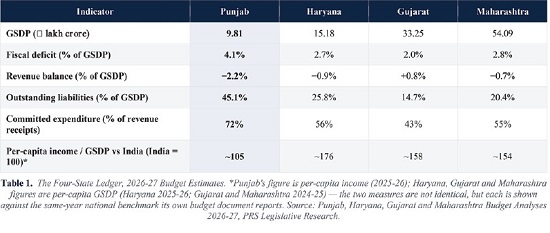
Punjab is not poor by Indian standards — its per-capita income is still a shade above the national average. It is overextended. Table 1 lays out where each state stood in its 2026-27 budget.
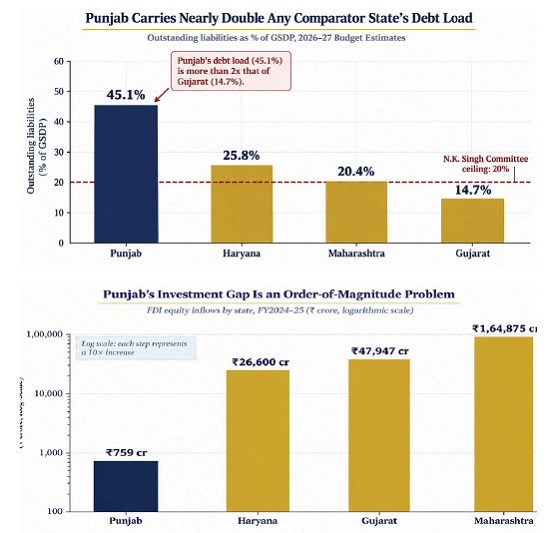
Outstanding liabilities of 45.1% of GSDP are the highest of any large Indian state, and more than double the 20% ceiling the NK Singh Committee recommended for state borrowing. The Comptroller and Auditor General's own decadal audit put Punjab's narrower public-debt ratio at 40.35% as far back as the close of FY2022-23 — already the highest in the country, in a year that ended almost exactly as Bhagwant Mann's government completed its first year in office (CAG 2025). Of every rupee Punjab expects to collect in 2026-27, 72 paise is already committed to salaries, pensions and interest before a single road or health centre gets built; on 2024-25 actuals the figure was 85 paise. Haryana's equivalent is 56 paise, Maharashtra's 55, Gujarat's 43 (PRS Legislative Research 2026a–d).
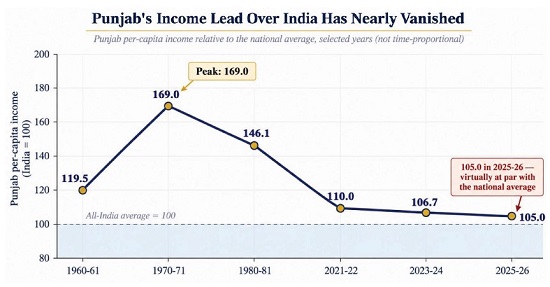
Punjab was independent India's wealthiest large state through the 1960s and 1970s; its per-capita income peaked at 169% of the national average in 1970-71, on the strength of the Green Revolution (EAC-PM 2024). It held near 146% through 1980-81 and stayed roughly there for two decades. Then, in the flat language of the Prime Minister's own Economic Advisory Council, “Punjab's economy has deteriorated after 1991” (EAC-PM 2024). By 2021-22 NITI Aayog put Punjab's per-capita income at 10% above the national average; by 2023-24 the EAC-PM put it at 106.7% — lower than in 1960-61, before the Green Revolution had even begun; by 2025-26, on this year's budget documents, it had eased further, to roughly 105% (NITI Aayog 2025; EAC-PM 2024; PRS Legislative Research 2026a). Three decades of relative decline, spanning Congress, Akali-BJP and AAP governments alike, is not a story that starts in March 2022.
Punjab's best-known fiscal habit is older still, and just as bipartisan. Free power for farmers began in January 1997 under Congress Chief Minister Rajinder Kaur Bhattal, for holdings under seven acres; the incoming Akali-BJP coalition under Parkash Singh Badal extended it to every farmer within a month (The Tribune 2025). Twenty-five years before AAP took office, both of Punjab's traditional major parties had already signed on. A 2020 report commissioned by the succeeding Congress government itself, led by former Planning Commission deputy chairman Montek Singh Ahluwalia, called the policy “highly regressive” and found it consumed 1.9% of GSDP; a separate academic study found four in five beneficiaries were medium and large farmers who did not need the help (Hindustan Times 2020; The Tribune n.d.). Neither the Akali-BJP government nor the Congress government that followed it withdrew the subsidy in the face of organised opposition. Nor has AAP.
WHAT THE MANN GOVERNMENT OWNS
Two things belong specifically to the last three-and-a-half years, and neither is small.
The first is the missed target itself. A state government sets its own fiscal-deficit ceiling in its own budget; Punjab has overshot its own ceiling in each of the two most recent years for which figures exist — by 0.9 percentage points of GSDP in 2024-25 actuals and by roughly 0.4 points in the 2025-26 revised estimate. Interest payments, a direct consequence of that borrowing, are budgeted at ₹28,755 crore for 2026-27 — 23% of revenue receipts, up 16.8% from ₹24,621 crore just two budget cycles earlier (PRS Legislative Research 2026a).
The second is the domestic power subsidy. The 300-unit-free scheme for every household, delivered on AAP's 2022 campaign promise, sits on top of the older farm subsidy and has pushed total power subsidies to a budgeted ₹15,550 crore for 2026-27 — 12.3% of revenue receipts (PRS Legislative Research 2026a). A study conducted for the Sixteenth Finance Commission found that 75% of Punjab households in the highest consumption bracket — the state's wealthiest electricity users — still receive power free of charge, the second-worst targeting failure of any state the Commission examined (16th Finance Commission 2026). It is the domestic-consumer version of the same design flaw Ahluwalia's report identified in the farm subsidy fifteen years earlier — this time introduced, not inherited.
Table 2 separates what is inherited from what is new. The Finance Commission's own formula changes add a further complication: having discontinued the Revenue Deficit Grant that had softened Punjab's shortfall for a decade, the new award will cost the state a further ₹4,800 crore a year through 2031 — an outcome of the national award formula, not of anything Chandigarh has done (Rozana Spokesman 2026).
THE DEBT-DYNAMICS ARITHMETIC
Debt sustainability turns on one comparison: does the economy grow faster than the effective cost of servicing what it owes? On the 2026-27 budget's own figures, Punjab's effective interest rate — ₹28,755 crore in interest against outstanding liabilities of roughly ₹4.42 lakh crore — works out to about 6.5%. Budgeted nominal GSDP growth is 10% (PRS Legislative Research 2026a). Because growth still clears the interest rate, the standard sovereign debt-dynamics identity implies the ratio should be gently self-stabilising even without further correction — roughly consistent with the actual movement from 45.2% of GSDP in the 2025-26 revised estimate to 45.1% in the 2026-27 budget. That is the one mechanically reassuring fact in this audit, and it should not be mistaken for good news. Punjab's primary deficit — the shortfall left once interest is excluded, ₹11,216 crore, or 1.1% of GSDP — means fresh borrowing keeps arriving before the interest bill is even counted, and interest alone already consumes 23% of Punjab's revenue receipts against 20% for Haryana, 12% for Gujarat and 11% for Maharashtra (PRS Legislative Research 2026a–d). The comfortable growth-over-interest gap narrows quickly the moment growth slips, borrowing costs rise, or a new subsidy is added to the ledger. Punjab is not yet caught in the compounding spiral that overwhelmed Greece's public finances after 2010; it has instead chosen, budget after budget, to hold an already-dangerous ratio flat rather than bring it down.
HOW BORROWING BECAME THE OPERATING MODEL
The CAG's decadal report supplies the sharpest diagnostic tool for any of this: the “golden rule” of state borrowing holds that governments should borrow to build assets, not to cover running bills. Punjab breached it more visibly than almost any state audited. Capital expenditure amounted to just 26% of the state's net borrowing in the CAG's FY2022-23 audited figures — roughly three rupees of every four borrowed went somewhere other than a road, school or hospital (CAG 2025). Between 2014-15 and 2023-24, Punjab drew on RBI's short-term Ways and Means Advances or an overdraft facility for between 221 and 344 days a year — “near-continuous,” in the CAG's own phrase — a facility twelve states, Gujarat among them, did not need to touch at all in 2023-24 (CAG 2025; PRS Legislative Research 2026a). Eighteen of Punjab's thirty-three working state enterprises are loss-making, concentrated in the power, grain-procurement and food-processing corporations that sit at the centre of the state's agricultural economy (PRS Legislative Research 2026a).
The investment consequence shows up in a single, stark line of DPIIT's own state-wise data. Punjab drew ₹759 crore in FDI equity in 2024-25 — 0.18% of India's total. Haryana, a state of comparable population, drew ₹26,600 crore; Gujarat drew ₹47,947 crore; Maharashtra drew ₹1.65 lakh crore (DPIIT 2025). Haryana alone attracted 35 times Punjab's foreign investment. Maharashtra attracted 217 times as much.
THE COMPARATORS ARE NOT SPOTLESS
A fair audit does not let Haryana, Gujarat or Maharashtra off the hook either. Haryana has run a revenue deficit every year since 2020-21, and the CAG separately found that 41% of a sample of its 2023-24 spending landed in March alone — more than double the 30% ceiling budgetary guidelines recommend, which the CAG read as evidence of weak expenditure planning (PRS Legislative Research 2026b). Gujarat has collected nothing against a combined ₹35,000 crore disinvestment target over the last two years, and the CAG found a 23% shortage of doctors and paramedics across its public hospitals as of March 2022 (PRS Legislative Research 2026c). Maharashtra has posted a revenue deficit every year since 2022-23, its own liabilities ratio rose from 19.1% to 20.4% of GSDP in a single budget cycle, and it recovers barely 0.2% of the guarantee fees it is owed from public enterprises (PRS Legislative Research 2026d). Each has its own list of failings. None of those lists resembles Punjab's in scale.
WHERE THIS LEAVES THE ARGUMENT
The honest version of this story is less satisfying than a partisan one, and more durable. Punjab's fiscal crisis was not manufactured in March 2022: the CAG's own baseline shows the state already carrying India's highest debt ratio before Bhagwant Mann's government had passed its first full budget, and the income divergence from Haryana traces to choices and shocks from the 1990s, not the 2020s. But three-and-a-half years of AAP government have not reversed the trend on the metrics a government actually controls year to year — the deficit ceiling has been missed twice running, and a new subsidy was layered onto an old one in a form that, on the Finance Commission's own evidence, mostly reaches households that do not need it. Punjab does not need a new party to blame. It needs a government — of whichever party eventually forms one — willing to treat the ledger as binding and the next campaign promise as negotiable, which is the opposite of what every one of its governments has chosen since 1997.
(The content of this article reflects the views of writer and contributor, not necessarily those of the publisher and editor. All disputes are subject to the exclusive jurisdiction of competent courts and forums in Delhi/New Delhi only)




















Leave Your Comment