



NILABH KRISHNA
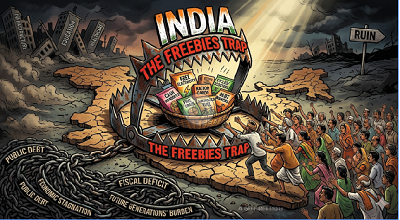
For decades, Indian politics has operated on a dangerous but electorally rewarding formula: promise more, distribute more, borrow more, and let the future deal with the consequences. What began as welfare-oriented governance in the early decades after independence has, over time, transformed into a culture of competitive populism where political parties seek votes not through long-term nation-building but through short-term material inducements. Free electricity, free water, free bus rides, loan waivers, cash handouts, free gadgets, subsidised commodities, and now direct income promises have become central to electoral politics across states. In the prevailing global economic and geopolitical environment, however, this model has become increasingly unsustainable and potentially catastrophic for Bharat’s long-term economic ambitions.
India today stands at a historic crossroads. On one side lies the possibility of becoming a global manufacturing hub, a trusted supply-chain partner, a technological powerhouse, and eventually a developed nation. On the other side lies the temptation of fiscal populism that weakens state capacity, distorts economic priorities, and traps governments in cycles of debt and dependency. The debate around freebies is therefore not merely an economic issue; it is a civilisational question about what kind of republic India wants to become in the twenty-first century.
The roots of the freebies culture in India can be traced back to the socialist economic framework adopted after independence. The early Indian state saw itself as the primary provider of welfare, employment, and economic direction. Subsidies on food, fertilisers, fuel, and public services were introduced with the intention of protecting vulnerable sections of society. Many of these measures were necessary in a poor and newly independent country struggling with food shortages and deep inequality. However, over time, a distinction between welfare and political freebies began to disappear.
The turning point came during the late twentieth century when regional parties started using targeted giveaways as electoral instruments. Tamil Nadu became one of the earliest laboratories of this politics. Free televisions, mixers, grinders, laptops, and consumer goods became common campaign promises. What initially appeared as isolated state-level populism gradually spread across the country. Political competition transformed governance into an auction where parties outbid each other using taxpayer money. The success of such models electorally encouraged replication in other states, irrespective of fiscal realities.
The consequences of this approach are now visible across India. Several states are burdened with alarming debt levels. Revenues that should ideally be invested in infrastructure, industrial development, healthcare capacity, technological innovation, irrigation systems, or quality education are increasingly diverted toward consumption-based subsidies. Governments that spend excessively on populist schemes often have little left for capital expenditure. This creates a vicious cycle: weak economic growth reduces revenue generation, which increases dependence on borrowing, which in turn expands fiscal deficits and debt burdens.
Punjab serves as one of the starkest examples of how reckless populism can hollow out a state’s economic structure. Once among India’s most prosperous states, Punjab today struggles with debt, unemployment, industrial stagnation, and fiscal stress. Years of unsustainable subsidies, especially free electricity and politically motivated loan waivers, have severely weakened the state’s finances. Productive sectors that could generate employment and investment have suffered from chronic neglect. A culture of entitlement has gradually replaced a culture of productivity.
Similarly, states that continuously expand non-merit subsidies often face severe pressure on public finances. Governments borrow heavily not to create assets but to sustain political commitments. This distinction is crucial. Borrowing for infrastructure, logistics, manufacturing clusters, ports, railways, or digital connectivity creates future economic returns. Borrowing to fund unlimited giveaways without productive output merely postpones a financial crisis.
The timing of this debate becomes even more critical given the prevailing global situation. The world economy is entering a phase of uncertainty marked by wars, energy disruptions, inflationary pressures, supply chain fragmentation, protectionism, and geopolitical realignment. The Russia-Ukraine conflict destabilised energy markets globally. Tensions in West Asia continue to threaten shipping routes and fuel security. Rising protectionism in Western economies is changing trade patterns. China’s economic slowdown is reshaping global manufacturing networks. At the same time, technological disruption through artificial intelligence and automation is altering labour markets across the world.
In such an environment, India requires enormous fiscal strength and strategic economic discipline. Bharat cannot afford to weaken itself through uncontrolled populism when global conditions demand resilience, investment, and competitiveness. The coming decades will require massive investments in defence modernisation, semiconductor manufacturing, renewable energy, urban infrastructure, water security, AI capabilities, cyber security, and industrial supply chains. Every rupee wasted on politically motivated giveaways is effectively a rupee diverted from nation-building.
The geopolitical dimension of the freebies debate is often ignored but deserves serious attention. Nations rise not merely through electoral promises but through productive capacity. China became an economic superpower not because it distributed unlimited subsidies for electoral purposes, but because it invested aggressively in manufacturing, logistics, exports, ports, industrial parks, and infrastructure. Similarly, South Korea and Singapore focused on industrial competitiveness, skill creation, and export-led growth. These countries understood that long-term prosperity emerges from productivity, not perpetual distribution.
India’s demographic advantage can either become a dividend or a disaster depending on policy choices. If governments continue encouraging dependency politics, large sections of the population may become politically conditioned to expect state support without corresponding productivity. This weakens entrepreneurial culture and reduces incentives for economic participation. A nation aspiring to become a five-trillion-dollar or eventually ten-trillion-dollar economy cannot sustain a governance model centred around perpetual giveaways.
There is also a dangerous moral dimension to the freebies culture. Democratic politics increasingly shifts from rights and responsibilities to transactional voting behaviour. Citizens begin evaluating governments not on governance quality, institutional reforms, law and order, or economic vision, but on immediate material benefits. Elections become contests of distribution rather than debates about development. In the long run, this erodes democratic maturity.
At the same time, it is important to distinguish between legitimate welfare and irresponsible freebies. A developing country like India cannot abandon social protection. Subsidised food for the poor, healthcare access, rural housing, sanitation, education support, and targeted assistance for vulnerable groups remain essential components of governance. Welfare aimed at empowering citizens is fundamentally different from populism aimed at electoral manipulation.
For example, investments in toilets under the Swachh Bharat Mission, rural electrification, tap water access, housing schemes, and health insurance create long-term social and economic value. These measures improve productivity, public health, and human capital. In contrast, indiscriminate cash transfers or universal free utilities without financial sustainability often generate little structural improvement. The distinction lies in whether expenditure creates future capacity or merely temporary political satisfaction.
The Supreme Court of India has also expressed concern over the issue of freebies in electoral politics. Economists, former Reserve Bank officials, and policy experts have repeatedly warned that unchecked populism could create severe fiscal instability. International rating agencies and investors closely monitor state finances. Excessive debt and uncontrolled subsidies reduce investor confidence, increase borrowing costs, and weaken economic credibility.
Another major concern is intergenerational injustice. Governments that borrow excessively to finance freebies are effectively transferring today’s political costs to future generations. Young Indians entering the workforce tomorrow may inherit weaker public finances, higher taxes, reduced state capacity, and lower developmental investment because current governments chose electoral populism over economic prudence.
The problem becomes particularly alarming when one examines the fiscal health of several Indian states. Rising debt-to-GDP ratios, mounting interest payments, pension liabilities, and subsidy burdens are squeezing developmental expenditure. In some cases, states spend enormous portions of their revenue merely on salaries, pensions, and subsidies, leaving little room for infrastructure creation. This is economically unsustainable in the long term.
The politics of freebies also creates distortions in essential sectors. Free electricity, for instance, has contributed to groundwater depletion in several agricultural regions because there is little incentive for efficient consumption. Similarly, repeated farm loan waivers weaken credit discipline and affect banking systems. While such measures may provide temporary relief, they rarely solve structural agricultural problems such as fragmented landholdings, irrigation gaps, poor storage infrastructure, or market inefficiencies.
India today needs a transition from entitlement politics to empowerment politics. The focus must shift from distributing consumption benefits to creating productive opportunities. Instead of promising endless subsidies, governments should invest in skill development, manufacturing ecosystems, entrepreneurship support, digital infrastructure, research and development, and employment generation. Citizens ultimately need dignity through opportunity, not dependency through perpetual political patronage.
Prime Minister Narendra Modi has repeatedly argued for aspirational politics over appeasement politics. The broader emphasis on infrastructure expansion, digital governance, manufacturing initiatives, and direct-benefit transparency reflects an attempt to reorient governance toward long-term capacity creation. However, even national politics has not remained entirely untouched by populist pressures. Electoral competition often pushes all parties toward subsidy-oriented strategies. This demonstrates how deeply embedded the freebies culture has become in India’s democratic ecosystem.
The media and civil society also carry responsibility in this debate. Often, public discourse treats every subsidy announcement as inherently pro-poor without examining fiscal consequences. Serious economic scrutiny is replaced by political spectacle. India needs a more mature national conversation where citizens understand that there is no such thing as “free” in economics. Every giveaway is ultimately financed either through taxpayer money, borrowing, inflation, or reduced future investment.
The challenge before Bharat is not merely economic management but national discipline. Great powers are built through strategic patience, productive investment, institutional strength, and fiscal prudence. India cannot simultaneously aspire to global leadership while normalising financially reckless governance. The world is entering an era of intense economic competition and geopolitical volatility. Countries that maintain fiscal resilience will emerge stronger. Countries trapped in populist debt cycles will struggle.
Bharat possesses immense strengths: a young population, expanding digital infrastructure, growing geopolitical influence, a large domestic market, and rising manufacturing potential. Yet these advantages can only translate into sustained national power if economic resources are deployed wisely. The state must act as an enabler of productivity rather than a distributor of endless political patronage.
The time has therefore come for a national consensus on responsible fiscal governance. Political parties across ideological lines must recognise that competitive populism threatens India’s long-term stability. Electoral reforms may also be necessary to ensure greater transparency regarding the fiscal implications of manifesto promises. Voters deserve to know how proposed giveaways will be financed and what trade-offs they entail.
India’s freedom struggle was built on sacrifice, discipline, and national purpose. The republic that emerged from it cannot afford to become hostage to short-term electoral consumerism. Welfare for the genuinely needy must continue, but reckless freebies that mortgage the future of the nation must be curbed immediately.
The global environment no longer permits economic complacency. In an age of geopolitical instability, technological disruption, and strategic competition, Bharat needs investment, innovation, industrial growth, and fiscal strength—not the illusion of prosperity funded by debt-driven populism. The choice before India is clear: build a productive civilisation-state prepared for the future, or drift into a politics of permanent dependency. The direction chosen today will define the destiny of Bharat for generations to come.
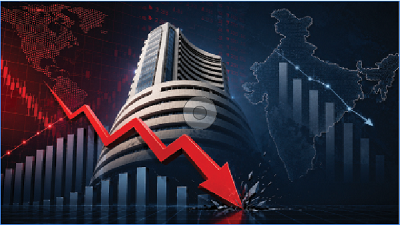
When Rahul Gandhi aggressively pushed the Congress party’s “khatakhat” style welfare politics — a phrase that became symbolic of rapid-fire cash promises and populist guarantees — it was projected as a model of compassionate governance. In states like Himachal Pradesh, however, the political excitement generated by these promises is increasingly colliding with harsh economic reality. Today, the hill state finds itself grappling with mounting debt, delayed payments, shrinking development capacity, and severe fiscal stress, raising uncomfortable questions about whether competitive populism has pushed Himachal Pradesh toward an economic trap.
Himachal Pradesh was never an economically large state with massive industrial depth or abundant revenue streams. Its economy has traditionally depended on tourism, horticulture, hydropower, and central assistance. Unlike manufacturing-heavy states, Himachal operates within limited fiscal space. Yet after the Congress government came to power, the pressure to fulfill expansive election guarantees rapidly intensified expenditure obligations. Subsidised schemes, welfare commitments, old pension liabilities, and politically attractive handouts created a financial burden that the state’s fragile revenue base struggled to absorb.
The “khatakhat” political model works effectively during elections because it creates instant emotional connection with voters. The messaging is simple: immediate relief, direct benefits, and rapid state support. But governance is far more complicated than campaign rhetoric. Himachal Pradesh soon discovered that promises made in political rallies must ultimately be financed through taxes, borrowing, or cuts elsewhere. As expenditure surged, the state’s debt burden expanded sharply, forcing the government into an increasingly dangerous cycle of borrowing simply to sustain routine commitments.
The fiscal stress became visible through delayed salaries, pending dues, pressure on government departments, and reduced developmental flexibility. Funds that could have been invested in roads, tourism infrastructure, disaster resilience, industrial incentives, or employment generation were increasingly consumed by recurring liabilities. This is the central flaw of populist economics: it prioritises immediate political optics over long-term economic capacity creation.
The revival of the Old Pension Scheme became one of the biggest fiscal burdens. While politically rewarding in the short term, pension obligations dramatically increase future liabilities for states already struggling with limited resources. Economists have repeatedly warned that states adopting fiscally unsustainable pension models risk crowding out developmental spending over time. Himachal Pradesh now faces precisely this challenge. Revenue expenditure is growing at a pace that threatens capital expenditure, the very spending necessary for economic growth.
The irony is that Himachal Pradesh requires investment-driven governance more than most states. Frequent natural disasters, landslides, fragile mountain infrastructure, and climate-related vulnerabilities demand large-scale capital investment. Instead, fiscal resources are increasingly being locked into politically motivated expenditure patterns. The result is a dangerous imbalance where consumption-based spending rises while productive investment weakens.
The broader national debate around freebies culture becomes highly relevant in Himachal’s context. Competitive populism has created a political environment where parties fear losing elections unless they continuously escalate promises. This transforms governance into a bidding war funded by public money. In the process, financial discipline becomes politically inconvenient.
Rahul Gandhi’s “khatakhat” politics may have succeeded as an electoral slogan, but Himachal Pradesh today reflects the deeper risks of such an approach. Welfare is essential in a developing society, but when welfare crosses into fiscally reckless populism, the consequences eventually surface in the form of debt, stalled development, and economic stagnation. Himachal’s current fiscal struggles are not merely administrative failures; they are warning signs of what happens when electoral economics overtakes economic realism.
In the end, states cannot run indefinitely on applause-driven governance. Political narratives may win elections “khatakhat,” but rebuilding damaged fiscal health is always painfully slow.
(The content of this article reflects the views of writer and contributor, not necessarily those of the publisher and editor. All disputes are subject to the exclusive jurisdiction of competent courts and forums in Delhi/New Delhi only)




















Leave Your Comment