



RAKESH KUMAR
In the river, something black, warm, and precious-looking—like a blanket—was floating from afar. A foolish man thought it would be useful to him and decided to grab it.
When he swam close to the “blanket,” he saw that it wasn’t a blanket at all—it was a bear. Now he wanted to let go of the bear, but the bear had caught him instead.
People standing on the shore shouted, “Let go of the blanket!”
The fool cried out, “I want to let go, but it’s not letting go of me!”
It is unfortunate that Indian politicians have not only fallen for these imaginary blankets! They are inventing bigger and deadly bears in the form of more freebies. The painful fact is that it is not the politicians who are paying the price? It is being funded by the hardworking citizens who earn and pay taxes. The world's most populous country is making its citizens lazy and irrational.
The beginning…
The practice of distributing saris, liquor (“daru”), cash, or gifts during elections did not originate as an official policy of the Indian National Congress leadership in the 1950s. However, over time, sev-eral social and political factors encouraged the growth of patronage-based politics at the local level. Widespread poverty, illiteracy, and dependence on local power brokers made voters vulnerable to small inducements such as food, clothing, money, or liquor. In many regions, politics evolved through networks of favors and personal loyalty rather than ideology alone, turning elections into exercises in patron-client relationship building. During the 1950s and 1960s, weak enforcement of election laws further enabled local candidates and party workers to use informal inducements even without explicit approval from central leadership. As political competition intensified in later decades and opposition parties gained strength, competitive populism and vote-buy
Freebies often harm both the economy and ethics because they strain public finances, reduce in-centives to work, and are frequently used as political tools rather than genuine welfare measures. They can create dependency, distort resource allocation, and undermine fairness in society.
Economic Impact of Freebies
● Fiscal burden: Free electricity, water, or consumer goods multiply expenditure, leading to budget deficits. States like Karnataka have diverted funds away from education and health to fi-nance such schemes.
● Opportunity cost: Money spent on freebies curtails investment in long-term development areas such as infrastructure, healthcare, and research.
● Dependency culture: Free provisions discourage labor participation. For example, agricul-tural sectors in Maharashtra have reported shortages of workers due to reliance on government handouts.
● Economic instability: Sri Lanka’s recent collapse was partly attributed to reckless freebie policies combined with tax cuts, showing how unsustainable populist measures can destabilize an economy.
Ethical Concerns
● Vote-bank politics: Freebies are often announced just before elections, raising questions about whether they are genuine welfare or electoral bribes. Surveys show that 78% of people see them as vote-seeking tactics.
● Erosion of work ethic: When citizens receive benefits without effort, it undermines per-sonal responsibility and self-sufficiency.
● Unfair distribution: Freebies often benefit select groups rather than addressing systemic inequality, creating resentment among those excluded.
● Distinction from welfare: Unlike structured welfare schemes (like MGNREGA or mid-day meals), freebies lack long-term developmental goals and are ethically questionable because they prioritize short-term popularity over sustainable justice.

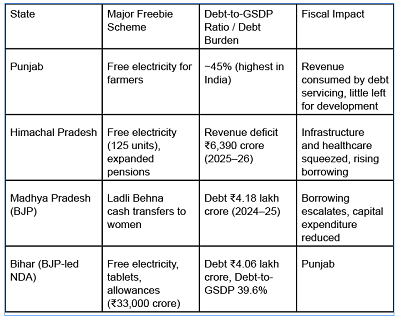
reckless freebie politics has severely damaged state finances across both opposition and BJP-ruled states. Punjab is one of the worst-hit, with free electricity for farmers and other subsidies pushing its debt-to-GSDP ratio above 45%, leaving most of its revenue consumed by debt servicing and lit-tle for development. Himachal Pradesh faces a similar crisis, where free power up to 125 units and expanded pension schemes have ballooned its revenue deficit to over ₹6,390 crore, forcing cuts in infrastructure and healthcare spending. Even BJP states are not immune: Madhya Pradesh and Bi-har are not far behind. In all these cases, freebies have crowded out productive investment, wors-ened deficits, and locked states into debt traps, showing how short-term populism undermines long-term fiscal sustainability:
The way out
First things first is ‘one nation one election’ it will reduce the frequency and competition. Second option is some ngo filing a PIL in Supreme Court that political parties can not use tax payers money to promote their personal agenda. This becomes important as no political party will bell the cat.
According to Indian scriptures, freebies supporting wants are like adding oil to fire.
The most unfortunate part is that India understood the uselessness of irrational freebies 2300 years ago Chankya wrote,
विनाशकारी-िनःशुल्कदानम् (Destructive Freebies);
“चाणक्यः अयोग्येषु िनःशुल्क-वस्तु-वितरणं तथा अनार्जित-धनदानं घोरदोषरूपेण पश्यति।
तस्य मते, सक्षमेषु जनासु कारणविहीन-दानप्रथा आलस्यं, परावलम्बित्वं, उत्तरदायित्वहीनतां च जनयति।
एवं समाजे “परजीवी-वर्गः” उत्पद्यते, यः अन्ततः राष्ट्रस्य अर्थव्यवस्थां दुर्बलां करोति।”
Chanakya regarded the distribution of free goods and unearned wealth to undeserving or able-bodied people as a serious flaw in governance.
According to him, the practice of giving benefits without justified reason encourages laziness, de-pendency, and a lack of accountability among capable citizens.
As a result, a “parasitic class” emerges within society, which ultimately weakens the nation’s econ-omy.
Vulnerability to Enemies: A state with an empty treasury is vulnerable to internal rebellions and external invasions.
Modern management theory: Maslow's hierarchy of needs
The long-term failure of excessive subsidy and freebie culture can also be understood through the ideas of Abraham Maslow. Maslow emphasized that material gratification alone cannot motivate human beings for long. Once basic needs are temporarily satisfied, people naturally aspire for higher goals such as dignity, achievement, self-respect, responsibility, and self-development.
Despite having this valuable wisdom from both east and west, our politicians have reduced democ-racy to a race of reckless giveaways, the very foundation of governance is weakened. Freebies — televisions, cash transfers, free electricity — are not welfare; they are fiscal bribes.
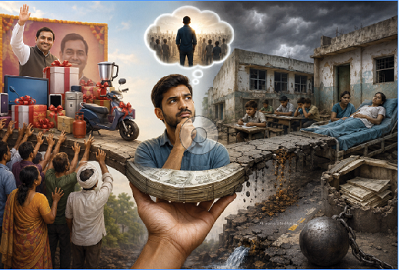
Freebies, Elections, and the Future of Democracy
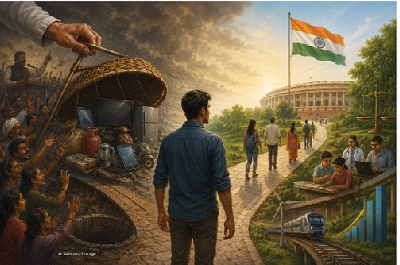
India’s democracy is at a crossroads. The relentless cycle of elections and the reckless distribution of freebies have combined to weaken both fiscal discipline and ethical governance. Two reforms stand out as urgent correctives: One Nation, One Election and judicial scrutiny of how taxpayer money is used by political parties.
One Nation, One Election
Synchronizing Lok Sabha and state assembly elections is not just about administrative efficiency. It is about breaking the cycle of constant populism. With elections happening almost every year in some states, parties are locked into a race of announcing short-term giveaways to secure votes. This erodes fiscal stability and crowds out investment in infrastructure, healthcare, and education. A unified election calendar would reduce the frequency of competitive populism, allowing gov-ernments to focus on governance rather than perpetual campaigning.
Judicial Oversight of Freebies
The Supreme Court of India has repeatedly expressed concern over the growing culture of elec-toral freebies, particularly in response to Public Interest Litigations (PILs) filed seeking regulation of irrational poll promises and fiscally irresponsible giveaways. The Court warned that indiscriminate freebies could threaten fiscal stability, distort democratic choice, and divert scarce public resources away from long-term development priorities. While clearly distinguishing legitimate welfare measures from politically motivated handouts, the Court proposed the creation of an expert body comprising institutions such as the RBI, NITI Aayog, Finance Commission, and Election Commission to recommend regulatory safeguards. At the same time, recognizing the constitutional sensitivity of electoral promises, the Court refrained from imposing an outright ban and emphasized the need for broader legislative and political consensus. Going forward, India requires a balanced framework involving transparency in manifesto promises, mandatory disclosure of financial implications, strict-er fiscal responsibility norms, and enhanced civic awareness so that democratic mandates are shaped by governance, accountability, and sustainable development rather than short-term in-ducements.
Why This Debate Matters to India’s Future?
The Economic Survey 2025–26 warned that unconditional cash transfers and persistent populist spending may weaken fiscal stability, raise borrowing costs, and reduce the government’s ability to invest in growth-enhancing sectors
Democracy in Top Gear Needs Informed Drivers: educating voters.
A strong democracy requires informed and responsible voters. It is worth considering that before issuing a Voter ID, citizens should undergo a basic civic-awareness programme on the functioning of democracy, constitutional values, and the rights and duties of a prudent voter. Some may object that voting is a fundamental right, yet even an illiterate person must pass a driving test before be-ing allowed to drive a vehicle on public roads. If training is necessary to handle a machine safely, a basic understanding should also be encouraged before helping steer the nation’s democratic fu-ture. Such awareness can reduce manipulation, corruption, and reckless populism, ultimately strengthening governance and democratic accountability.
Educating existing voters
The first step is awareness. Citizens must understand that every “free” gift is paid for by taxpayers, often at the cost of schools, hospitals, and infrastructure. Freebies create dependency, distort re-source allocation, and push states into debt traps. When voters recognize that these promises erode their own future, they will stop rewarding parties that indulge in them.
Learning from Singapore
Singapore manages the politics of "freebies" by strictly replacing unconditional, populist hand-outs with merit-based social safety nets and conditional, targeted financial assistance. This approach ensures that public funds are tied to measurable outcomes rather than short-term electoral gains.
The government balances social welfare and political stability through the following core strategies:
1. Targeted Relief and Conditional Vouchers
2. Mandatory Retirement Savings
3. Progressive Subsidies
Creating Accountability
Since no political party will “bell the cat,” civil society must step in. Continuous follow-up of the PIL in the Supreme Court is needed to restrict the misuse of taxpayer money for partisan agendas could be a turning point. Judicial oversight can distinguish between genuine welfare — like healthcare and education — and manipulative populism designed only to win votes.
Freebie Fatigue and the Rise of Governance
For decades, Indian politics relied heavily on the lure of freebies — cash transfers, free electricity, televisions, and similar giveaways — to attract voters. However, recent electoral trends suggest a growing fatigue with such populism. Increasingly, citizens appear more inclined toward credible governance, development, and administrative accountability than promises of “heaven on earth.” Even leaders associated with expansive welfare politics, such as Arvind Kejriwal, Mamata Banerjee, and M. K. Stalin, have encountered electoral resistance despite extensive welfare offerings. Many voters now recognize that unchecked freebies can strain fiscal stability, weaken long-term devel-opment, and foster dependency rather than empowerment.
The Way Forward
India’s future lies in strengthening institutions, educating citizens about the hidden economic and social costs of unchecked freebies, and fostering a culture where dignity, self-reliance, and oppor-tunity are valued above dependency. The electorate is increasingly sending a clear message: it seeks leadership defined by vision, stability, accountability, and sustainable progress—not short-term fiscal inducements disguised as welfare. The growing fatigue with freebie politics may well mark the beginning of a healthier and more mature democracy. At the same time, the Supreme Court must ensure that its efforts to address this issue do not disappear into the maze of bureau-cratic delay and inaction. Political parties across the spectrum must rise above competitive popu-lism, heed the voice of reason, and work collectively to reduce this growing menace before it weakens both India’s economy and democratic character.
(The content of this article reflects the views of writer and contributor, not necessarily those of the publisher and editor. All disputes are subject to the exclusive jurisdiction of competent courts and forums in Delhi/New Delhi only)




















Comments (1)
I
Very nice.