


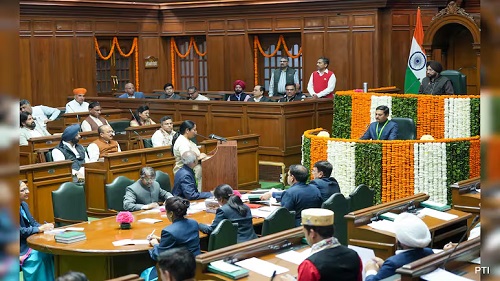
The first session of the newly constituted Delhi Assembly commenced on Monday, marking a significant moment in the capital's political landscape. The session was not only a formal beginning of the eighth Assembly but also a reflection of Delhi's rich linguistic and cultural diversity. Members of the Legislative Assembly (MLAs) took their oaths in six languages—Hindi, English, Sanskrit, Urdu, Maithili, and Punjabi—symbolizing the inclusive ethos of the legislature. This session also heralded the return of the Bharatiya Janata Party (BJP) to power in Delhi after 26 years, signifying a major political shift in the region.
The BJP's victory in the February 5 Assembly elections, where it secured 48 out of 70 seats, ended the decade-long rule of the Aam Aadmi Party (AAP), which managed to win 22 seats. This decisive mandate marked a new chapter in Delhi's political journey, with the BJP assuming control of the Assembly and shifting to the right side of the Speaker's chair—a symbolic representation of its newfound majority.
The session began with BJP MLA Arvinder Singh Lovely, the senior-most legislator, being sworn in as the pro-tem Speaker. Lieutenant Governor Vinai Kumar Saxena administered the oath to Lovely at the Raj Niwas before the Assembly convened. As pro-tem Speaker, Lovely oversaw the swearing-in of all newly elected MLAs, ensuring a smooth and orderly process.
The oath-taking ceremony was a vibrant display of Delhi's multicultural identity. Chief Minister Rekha Gupta was the first to take the oath, followed by her six Cabinet ministers. Notably, MLAs chose to take their oaths in languages that resonated with their personal and cultural backgrounds, highlighting the linguistic diversity of the Assembly.
Environment Minister Manjinder Singh Sirsa took his oath in Punjabi, while Law and Justice Minister Kapil Mishra opted for Sanskrit, showcasing the classical language's enduring relevance.
Karnail Singh and Tarvinder Marwah also chose Punjabi, with Marwah adding a personal touch by chanting religious slogans after completing the official oath. However, the Speaker reminded him that the Assembly floor was not a place for religious expressions, emphasizing the need to adhere to the official format.
Amanatullah Khan and Chaudhary Zubair took their oaths in Urdu, while Chandan Chaudhary and Anil Jha chose Maithili, a language spoken by millions in Bihar and parts of Nepal.
Ajay Dutt took his oath in English, and Gajendra Yadav and several others, including Sanjay Goel, Jitendra Mahajan, and Ajay Mahawar, opted for Sanskrit, underscoring the language's cultural significance.
The Speaker consistently reminded members to follow the official oath format, ensuring the sanctity of the process while accommodating their linguistic preferences.
The session also witnessed several firsts and notable moments. Gopal Rai, due to difficulty in walking, took the oath from his seat, assisted by Atishi, the Leader of Opposition and MLA from the Kalkaji seat. Mohan Singh Bisht was the last MLA to be sworn in, bringing the oath-taking ceremony to a close.
In a unanimous decision, AAP MLAs elected former Delhi Chief Minister Atishi as the Leader of Opposition, a role that will be crucial in holding the ruling party accountable. Atishi's election reflects the AAP's commitment to maintaining a strong and vocal opposition in the Assembly.





















Leave Your Comment