


The spirit and content of the Indian Constitution are distinct. The Indian Constitution is regarded as the ultimate law of the land and establishes the country's government. Leaders today are deceiving the public by propagating a false narrative that the Indian Constitution and democracy are in danger while brandishing copies of the document in their hands. It is my duty to present the public with the truth in this case. Members of the Lok Sabha waved copies of the Constitution during the oath-taking ceremony. These copies of the Constitution that were waved inside and outside the Parliament may have differed in hue, but they served the same function. That's to keep up the narrative of changing the Constitution. Rahul Gandhi, the leader of the opposition, Akhilesh Yadav, and his associates are mired in this narrative. It is unclear if the current administration is altering the Constitution or if it was altered in the past to serve its own interests.
The Constitution of India is a remarkable document that lays the foundation for governance, democracy, and the rule of law in the country. As the supreme law, it embodies the aspirations of a diverse population and serves as a guiding light for the nation. However, in recent years, opposition parties have often accused the government of endangering the Constitution and democracy. Leaders are seen waving copies of the Constitution, claiming that its sanctity is under threat. Yet, a closer examination reveals that such narratives are more about political rhetoric than substance. Ironically, the opposition, particularly the Congress Party, bears a historical burden of altering the basic structure of the Constitution to suit its own agenda. The most glaring example of this is the 42nd Constitutional Amendment Act of 1976, passed during the Emergency period, which introduced dangerous changes that shook the very foundations of India’s democratic framework.
From the very inception of independent India, the Congress Party, under the leadership of Jawaharlal Nehru, began altering the Constitution to suit its political agenda. The First Amendment of 1951, introduced by Nehru, significantly curtailed the right to freedom of speech and expression, allowing the state to impose "reasonable restrictions" and laying the groundwork for future curbs on dissent. Over the years, this pattern of constitutional manipulation intensified, particularly under Indira Gandhi, who exemplified this approach during the Emergency (1975-1977). Beyond the infamous 42nd Amendment, the Congress routinely misused Article 356 to dismiss democratically elected state governments that did not align with its political ideology. Between 1947 and 1984, Article 356 was invoked over 90 times, often targeting non-Congress governments. Notable instances include the dismissal of the Kerala government led by EMS Namboodiripad in 1959, the first communist government elected in India, and similar actions in states like Tamil Nadu and West Bengal. These dismissals, often based on dubious grounds, were a blatant assault on federalism and undermined the democratic mandate of the people. By using constitutional provisions as tools of political convenience, the Congress not only tampered with the basic structure of the Constitution but also set a dangerous precedent of central authoritarianism masquerading as governance. This history casts a shadow over the party’s current claims of championing democracy and constitutional values.
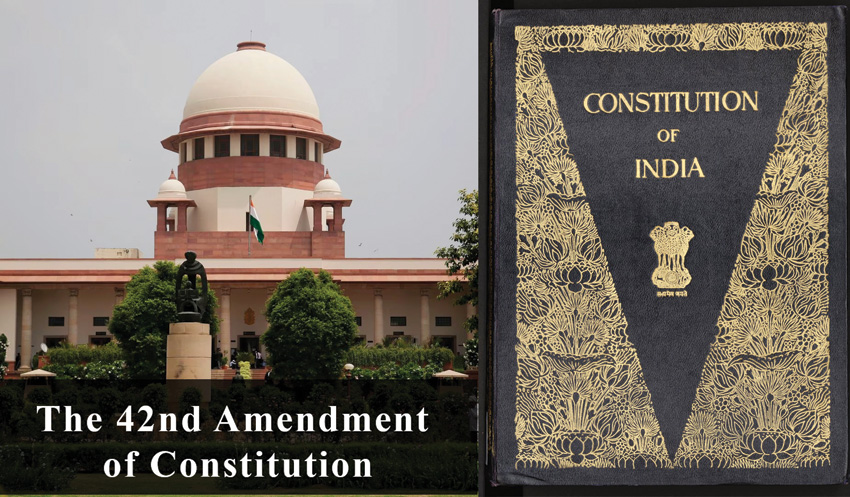
The 42nd Amendment Act: A Historical Context
The 42nd Amendment, often termed the "Mini-Constitution," was enacted during the Emergency imposed by then-Prime Minister Indira Gandhi. The period from 1975 to 1977 is considered one of the darkest chapters in Indian democracy, characterized by the suspension of civil liberties, censorship of the press, and the arbitrary arrest of political opponents. It was in this environment of authoritarianism that the Congress government pushed through sweeping changes to the Constitution, many of which were designed to consolidate power in the hands of the executive and undermine the judiciary.
This amendment, comprising 59 clauses, made substantial changes to the Preamble, fundamental rights, the powers of the judiciary, and the distribution of power between the Centre and the states. The Preamble, which originally defined India as a "sovereign democratic republic," was altered to include the terms "socialist" and "secular." While these additions were framed as progressive, they were introduced without public debate or consensus, raising questions about their legitimacy.
The 42nd Amendment 1976 added to the pre-existing major model of the Constitution, thereby changing the definition of India which was given in the Amendment to the Indian Constitution. It made sweeping changes to the Constitution of India, affecting its basic structure fundamental rights and federal balance. This Act, known as the Constitution Act, is considered one of the most controversial Acts in the history of amendments to the Indian Constitution.
In the preamble, for the words “Sovereign Democratic Republic”, the words “Sovereign Socialist Secular Democratic Republic” were substituted and for the words “Unity of the Nation”, the words Unity and Integrity of the Nation” were substituted. In the Seventh Schedule, five subjects were transferred from the State List to the Concurrent List- education, jungles, weight and measurement, protection of wild animals and birds and administration of justice. 10 fundamental duties for citizens were added in Article 51A. In Parliament, the President was made bound by the advice of the Cabinet; the Centre was allowed to depute the Central forces in the state to deal with controversial situations by law and order (Article 257A). The Speaker of the Lok Sabha and the Prime Minister were given special powers (Article 329A) and the Directive Principles were given priority over fundamental rights and any law made by the Parliament in this regard was kept out of the scope of judicial review by the court. The Judicial review power of the High Courts was curtailed.
Undermining Judicial Independence
One of the most alarming aspects of the 42nd Amendment was its deliberate attempt to curtail the power of the judiciary. The amendment sought to reduce the authority of the Supreme Court and High Courts in adjudicating the validity of constitutional amendments. Specifically, Article 368 was amended to prevent judicial review of constitutional amendments, effectively giving Parliament unchecked power to alter the Constitution. This was a blatant attempt to sideline the judiciary, which had previously acted as a check on executive overreach.
Furthermore, the amendment introduced changes to Article 226, which restricted the High Courts’ ability to issue writs for the enforcement of fundamental rights. By doing so, the Congress government severely curtailed the ability of citizens to seek redressal against state actions. These measures were clearly aimed at consolidating executive power and silencing dissent, exposing the Congress Party’s duplicity on the issue of judicial independence.
Today, the same Congress Party accuses the current government of undermining judicial autonomy. Yet, history shows that it was the Congress that took the most significant steps to weaken the judiciary’s role as the guardian of the Constitution. This hypocrisy becomes evident when juxtaposing the present government’s actions, which have largely adhered to constitutional norms, with the authoritarian measures of the 1970s.
Curtailing Federalism
The 42nd Amendment also altered the balance of power between the Centre and the states, tipping the scales heavily in favor of the Centre. By amending Articles 74 and 163, the role of the President and Governors was reduced to that of mere figureheads, bound to act on the advice of the Council of Ministers. This undermined the federal structure envisioned by the framers of the Constitution and eroded the autonomy of state governments. Such centralization of power ran contrary to the principles of cooperative federalism and created a legacy of mistrust between the Centre and states, which persists to some extent even today.
The Current Government’s Record
In contrast to the Congress’s legacy of constitutional overreach, the present government under Prime Minister Narendra Modi has largely respected the Constitution’s basic structure. Accusations of tampering with the Constitution often stem from misinterpretations or deliberate distortions of policy decisions. For instance, reforms like the abrogation of Article 370 or the introduction of the Citizenship Amendment Act (CAA) have been criticized as unconstitutional, despite being enacted through legitimate parliamentary procedures and subjected to judicial scrutiny.
Unlike the Congress’s actions during the Emergency, the current government has not sought to diminish the judiciary’s powers or bypass constitutional processes. On the contrary, it has emphasized adherence to the rule of law and sought to strengthen India’s democratic institutions. Claims that the Constitution is in danger under the present regime appear to be more about political posturing than grounded in fact.
The Congress’s Double Standards
The Congress Party’s duplicity on the issue of constitutional sanctity is evident in its shifting narratives. While it now positions itself as the defender of democracy and the Constitution, its historical record tells a different story. The 42nd Amendment represents a blatant attempt to rewrite the Constitution for political gain, undermining fundamental rights, judicial independence, and federalism. Even after the Emergency, the Congress continued to justify its actions, showing little remorse for the damage inflicted on India’s democratic fabric.
In recent times, the opposition has also accused the current government of eroding press freedom and curbing dissent. Yet, it was during the Congress-led Emergency that the press was subjected to the most draconian censorship laws in independent India’s history. Political opponents, including future leaders like Atal Bihari Vajpayee and Narendra Modi, were imprisoned without trial. Such actions were a direct assault on the democratic principles enshrined in the Constitution.
Reclaiming the Constitution’s Spirit
The 42nd Amendment was partially rectified by the 44th Amendment Act of 1978, enacted by the Janata Party government that succeeded the Congress. The 44th Amendment restored some of the judiciary’s powers, repealed the provisions that curtailed fundamental rights, and sought to reaffirm the Constitution’s original spirit. However, the damage caused by the 42nd Amendment left a lasting impact on India’s political and institutional landscape.
Today, as opposition parties wave copies of the Constitution and raise alarms about its perceived endangerment, it is crucial to separate fact from fiction. The real threat to the Constitution lies not in the policies of the present government but in the attempts by certain political actors to distort its meaning for partisan gain. By invoking the specter of constitutional danger, these parties seek to deflect attention from their own historical transgressions and regain political relevance.
Conclusion
The Constitution of India is a living document, designed to evolve with the times while preserving its core principles. It is a testament to the vision of the framers and the resilience of Indian democracy. However, its sanctity has been challenged in the past, most notably by the Congress Party during the Emergency. The 42nd Amendment stands as a stark reminder of how the Constitution can be manipulated to serve political interests, undermining the very principles it seeks to uphold.
In the present context, accusations of constitutional tampering by the government must be evaluated against the backdrop of history. While no government is beyond scrutiny, it is essential to recognize that the Constitution’s spirit is upheld not just through legal provisions but also through a commitment to democratic values and accountability. The false narrative propagated by the opposition about the Constitution being in danger serves only to obscure their own culpability and distract from genuine issues facing the nation.
As citizens, it is our collective responsibility to safeguard the Constitution, not by succumbing to political rhetoric, but by remaining informed, vigilant, and engaged in the democratic process. Only then can we ensure that the Constitution remains a beacon of hope and justice for generations to come.

By NILABH KRISHNA
(The content of this article reflects the views of writers and contributors, not necessarily those of the publisher and editor. All disputes are subject to the exclusive jurisdiction of competent courts and forums in Delhi/New Delhi only)
















Leave Your Comment