


This is a moment of immense pride for all of us—not only for our fellow countrymen but also for democracy-loving citizens across the world. This is an occasion to celebrate the festival of democracy with great pride. The journey of 75 years under the Constitution is a remarkable one, and at the heart of this journey lies the divine vision of our Constitution-makers, whose contributions continue to guide us as we move forward. Celebrating the completion of 75 years of the Constitution is indeed a momentous occasion.
The achievement of completing 75 years is no ordinary feat; it is extraordinary. When Bharat gained independence, there were numerous sceptical predictions about the country’s future. However, the Indian Constitution defied and nullified all such doubts, guiding us to where we stand today. For this remarkable accomplishment, Over the past 75 years, the citizens of Bharat have honoured the vision of the Constitution-makers.
The Constitution-makers were deeply aware of it. They did not believe that Bharat was born in 1947 or that democracy began here in 1950. Instead, they recognised the greatness of Bharat's ancient traditions, its profound culture, and its heritage spanning thousands of years. They were fully cognisant of this continuity and sought to build upon it.
Bharat's democratic and republican past is extraordinarily rich and has served as an inspiration for the world. It is for this reason that Bharat is known today as the Mother of Democracy. We are not merely a vast democracy; we are its origin.
I am proud to remember Rajrishi Purushottam Das Tandon ji, who, during the Constituent Assembly debates, remarked that after centuries, our country has once again convened such a meeting. This gathering reminds us of our glorious past, of times when we were independent, when scholars would come together to deliberate on the nation's most pressing matters.
Dr. Radhakrishnan ji, also a member of the Constituent Assembly. He observed that the republican system was not new for this great nation—it had existed since the dawn of history.
Baba Saheb Ambedkar ji, who declared that democracy was not an alien concept to Bharat. There was a time when many republics thrived across this land.

The process of framing our Constitution witnessed significant contributions from the women of this country. The Constituent Assembly had 15 honourable women members who played active roles, enriching the debates with their original perspectives. These women came from diverse backgrounds and fields, and their suggestions had a profound impact on the shaping of the Constitution. It is a matter of immense pride that, while many other nations took decades to grant rights to women, Bharat ensured their right to vote right from the inception of its Constitution.
We celebrate 75 years of the Constitution and women are at the centre of every major initiative. It is a great coincidence that during this historic milestone, a tribal woman holds the esteemed position of President of India. This is a true testament to the spirit of our Constitution.
Bharat is now advancing at an unprecedented pace. The country is making strong strides towards becoming the third-largest economic power in the world in the near future. Furthermore, it is the collective resolve of 140 crore Indians that, by the time we celebrate the centenary of our independence, we will transform Bharat into a developed nation. This vision is the dream of every Indian. However, the most critical prerequisite for achieving this goal is the unity of Bharat, which our Constitution upholds as its foundation.
In the making of our Constitution, the stalwarts of this nation—freedom fighters, writers, analysts, social workers, educators, professionals, labour leaders, farmers' leaders, and representatives from every section of society—came together with an unwavering commitment to Bharat's unity. These individuals, representing diverse walks of life and regions of the country, were deeply aware of the importance of this unity. Baba Saheb Ambedkar ji had foreseen this challenge and offered a profound warning, which I wish to read. He said: "The problem is how to unite the diverse Indian masses; how to inspire the people of the country to take decisions in harmony with each other, so that a sense of unity is established in the country."
It is with great sadness that I must state that, after independence, while the Constitution-makers had unity in their hearts and minds, this unity was later attacked due to distorted mindsets or selfish motives. Unity in diversity has always been Bharat's defining strength. We celebrate diversity, and the nation’s progress lies in embracing this diversity. Unfortunately, those bound by the mentality of colonial servitude, those who could not appreciate Bharat's welfare, and those who believed that Bharat was born in 1947, failed to see the inherent unity in our diversity. Instead of celebrating this invaluable heritage, attempts were made to sow seeds of discord in it, threatening the unity of the country.
I wish to underscore my point with reference to the Constitution. Over the past ten years, the people of this country have entrusted us with the opportunity to serve. In reviewing our policies and decisions, it is evident that we have consistently worked towards strengthening Bharat's unity.
Article 370, for instance, had become a significant obstacle to national unity, a barrier that needed to be dismantled. Guided by the spirit of our Constitution, we prioritised national unity and buried Article 370, ensuring the unity of our nation remains our foremost priority.
For a country of Bharat's size to progress economically and attract global investment, it requires favourable systems. One such significant reform was the introduction of GST, which had been discussed for years. GST has played a pivotal role in fostering economic unity. Credit also goes to the previous government for its efforts in this regard. In our tenure, we had the opportunity to advance this initiative, and we did so. The concept of "One Nation, One Tax" is taking that role forward.
The ration card has always been a critical document for the poor. However, previously, a poor person moving from one state to another could not access its benefits. In a country as vast as ours, every citizen should have equal rights, irrespective of their location. To reinforce this sense of unity, we introduced the concept of "One Nation, One Ration Card."
There have been many instances in our country’s history where electricity was available in one region but absent in another, leaving parts of Bharat in darkness. During the tenure of the previous government, such power shortages often resulted in international headlines portraying Bharat in a poor light. We have witnessed those days. However, inspired by the spirit of the Constitution and guided by the mantra of unity, we established the “One Nation, One Grid.” Today, electricity reaches every corner of Bharat seamlessly, ensuring that no region is left behind.
Times have changed, and we are determined to ensure that the digital sector does not become a realm of “haves” and “have-nots.” Bharat's Digital India initiative has become a global success story. By democratising technology, we have upheld the vision of our Constitution-makers. With the aim of bolstering the 'unity in Bharat', we have extended optical fibre connectivity to every panchayat, empowering the nation.
Our Constitution emphasises unity, and one crucial aspect of this unity is the recognition of mother tongues. A nation cannot be truly cultured by suppressing its native languages. In line with this understanding, the New Education Policy gives prominence to the mother tongue. Today, even children from poor families can aspire to become doctors or engineers in their own languages. Additionally, we have honoured various Indian languages by granting them due recognition as classical languages. To nurture national unity and inculcate cultural awareness among the younger generation, we have initiated the 'Ek Bharat Shreshtha Bharat' campaign.
Efforts like the 'Kashi Tamil Sangamam' and 'Telugu Kashi Sangamam' have evolved into significant institutionalised initiatives. These cultural endeavours are aimed at fostering societal closeness and celebrating Bharat's unity, which is deeply rooted in the core ethos of our Constitution.
As the Constitution completes 75 years, it is important to reflect on its milestones. Significant anniversaries, such as 25, 50, and 60 years, carry immense importance. However, history reveals a mixed legacy. When the Constitution marked its 25th anniversary, the country witnessed one of its darkest periods. The Emergency was imposed, constitutional arrangements were suspended, the nation was turned into a prison, citizens’ rights were stripped away, and press freedom was stifled. This grave injustice remains an indelible stain on the Congress party’s record. Whenever democracy is discussed globally, this betrayal will be remembered as an act of strangling our Constitution and the hard work of the constitution makers.
When the Constitution completed 50 years, under the leadership of Prime Minister Atal Bihari Vajpayee, the nation celebrated this milestone with grandeur on 26th November 2000. He delivered a special message emphasising unity, public participation, and partnership, thereby bringing to life the true spirit of the Constitution and inspiring the public.
I extend my heartfelt respect to the Constitution. It is because of the Constitution that individuals like me, without any political lineage or background, have been able to rise to positions of responsibility. It is the Constitution’s power and the blessings of the people that have made this possible. There are many here, like me, who come from humble beginnings. The Constitution has empowered us to dream and achieve. This immense love and trust bestowed upon us by the people—not once, not twice, but thrice—would not have been possible without the Constitution.
I have no intention of making personal criticisms today. However, it is my duty to present the facts before the nation. One particular family from the Congress party has left no stone unturned in undermining the Constitution. I mention this family specifically because, out of the 75 years of Bharat's independence, they have ruled the country for 55 years. The people of this nation have the right to know the truth about what transpired during that time and the negative traditions, flawed policies, and harmful practices established by this family, which continue to have repercussions even today. At every stage, this family has challenged and harmed the Constitution.
From 1947 to 1952, there was no elected government in this country. Instead, a temporary, selected system was in place, operating as an interim arrangement until elections could be held. During this period, the Rajya Sabha was not yet formed, nor were elections conducted in the states. There was no mandate from the people, despite the Constitution having just been created after extensive deliberations by its makers. In 1951, before an elected government was established, this interim system used an ordinance to amend the Constitution. The result? Freedom of expression was attacked. This act was a grave insult to the Constitution and its makers. The matters they failed to achieve during the debates of the Constituent Assembly were pursued later, through the back door, by exploiting their position. It is worth noting that this was not the decision of a democratically elected Prime Minister but of someone leading an interim government. This was, undoubtedly, a grievous sin.
During that same period, the then Prime Minister, Pandit Jawaharlal Nehru, wrote a letter to a Chief Minister stating: “If the Constitution comes in our way, then it must be changed at any cost.” These words, written by Pandit Nehru himself, represent a shocking disregard for the sanctity of the Constitution.
This unconstitutional act in 1951 did not go unnoticed. At the time, President Dr. Rajendra Prasad cautioned that this was a grave error. Even the Speaker of the Lok Sabha warned Pandit Nehru that he was acting against the principles of the Constitution. Prominent Congress leaders, including Acharya Kripalani and Jayaprakash Narayan, also urged him to stop. Despite receiving such sound advice from senior and respected figures, Pandit Nehru ignored their concerns, stubbornly pursuing his own version of the Constitution.
The Congress party developed an insatiable appetite for constitutional amendments, frequently targeting the Constitution to suit its political agenda. This relentless pursuit left deep scars on the spirit of the Constitution. The Constitution has been amended 75 times in about six decades.
The seeds of constitutional misuse were sown by the first Prime Minister of the country and were later nurtured and watered by another Prime Minister, Mrs Indira Gandhi. The misdeeds initiated by the first Prime Minister culminated in further damage. In 1971, a Supreme Court decision was overturned through a constitutional amendment. This amendment not only nullified the Supreme Court's ruling but also clipped the wings of the judiciary, asserting that Parliament could amend any article of the Constitution without judicial review. The rights of the judiciary were systematically curtailed. This grave act was committed in 1971 by the then Prime Minister, Mrs Indira Gandhi, whose government used this amendment to seize fundamental rights and exert control over the judiciary.
During the Emergency, people's fundamental rights were trampled upon, and thousands were jailed. The judiciary was gagged, and press freedoms were stifled. Mrs Gandhi advanced the notion of a "committed judiciary," a concept that undermined judicial independence. Justice H.R. Khanna, a judge who upheld the Constitution and delivered a judgment against Mrs Gandhi, was deliberately denied the position of Chief Justice of India, despite being the senior-most judge. This was a blatant assault on constitutional and democratic norms.
For the first time in history, the Constitution was undermined in such a profound manner. The very concept of an elected government and an elected Prime Minister was compromised. While we had a Constitution, it was subverted by placing an unconstitutional and unsworn National Advisory Council above the Prime Minister and even the Prime Minister’s Office. This gave the PMO an undeclared, diminished status, effectively undermining the principles of governance established by our Constitution.
The Congress party has repeatedly disrespected the Constitution, undermining its significance. The Congress legacy is replete with instances of constitutional violations and disregard for constitutional institutions. While Article 370 is widely known, very few are aware of Article 35A. Without presenting it to Parliament, despite the constitutional mandate, Article 35A was imposed on the country. This act bypassed the sanctity of Parliament, which is the cornerstone of our Constitution. Parliament itself was sidelined, its authority strangled. Article 35A was enacted without Parliamentary approval, through an order of the President, keeping the nation’s Parliament in the dark. If Article 35A had not been imposed, the situation in Jammu and Kashmir would not have deteriorated to the extent it did. This unilateral act violated the principles of democracy and constitutional propriety, creating long-term challenges for the country.
I do not wish to delve into the bitterness and animosity that existed towards Baba Saheb Ambedkar during his time. However, when Atal Ji was in power, a decision was made to establish a memorial in honour of Baba Saheb Ambedkar. This decision was taken during Atal Ji’s tenure. Unfortunately, during the ten years of UPA rule, this initiative was neither undertaken nor allowed to proceed. When our government assumed power, driven by our immense respect for Baba Saheb Ambedkar, we built the Baba Saheb Memorial on Alipur Road and completed the project.
We celebrated 125 years of Baba Saheb Ambedkar’s legacy across the globe, organising commemorations in 120 countries. Yet, during Baba Saheb Ambedkar’s centenary, there was a BJP government in Madhya Pradesh, led by Chief Minister Sundarlal Patwa, which undertook the rebuilding of Mhow—the birthplace of Baba Saheb Ambedkar—as a memorial. This honourable endeavour took place during his tenure.
Baba Saheb Ambedkar was a visionary, dedicated to uplifting the underprivileged sections of society and ensuring their inclusion in the mainstream. He firmly believed that for India to develop holistically, no region or community should remain marginalised. This vision led to the establishment of the reservation system in our country. However, those consumed by vote-bank politics exploited reservations for appeasement based on religion, causing the greatest harm to the SC, ST, and OBC communities.
There is a burning issue I wish to discuss, and that is the Uniform Civil Code! This topic was not overlooked by the Constituent Assembly either. The Constituent Assembly engaged in lengthy and in-depth discussions about the Uniform Civil Code. After rigorous debates, they decided that it would be better for whichever government is elected in the future to take a decision on this matter and implement the Uniform Civil Code in the country. This was a directive from the Constituent Assembly, and Dr. Babasaheb Ambedkar himself had said so. However, those who neither understand the Constitution nor the country, and have read nothing beyond their hunger for power, are unaware of what Babasaheb had actually said. Babasaheb had explicitly stated. And let me say this to everyone: do not take this out of context and twist it into misleading narratives by cutting and circulating selective videos!
Dr. Babasaheb Ambedkar had strongly advocated for the abolition of personal laws that were based on religious grounds. During the debates of that era, K.M. Munshi, a prominent member of the Constituent Assembly, emphasized that the Uniform Civil Code was essential for the unity and modernity of the nation. The Supreme Court, too, on multiple occasions, has stated the necessity of implementing a Uniform Civil Code in the country at the earliest and has even directed governments to work towards it. Keeping in mind the spirit of the Constitution and the sentiments of the Constitution's framers, we are fully committed and working with all our strength towards establishing a secular civil code. However, today, the Congress party is disrespecting not only the sentiments of the Constitution's framers but also the directives and aspirations of the Supreme Court. This is because such measures do not align with their political agenda. For them, the Constitution is not a sacred text; rather, it has become a tool for political maneuvering. They have turned it into a weapon to play political games and instil fear in people.
Playing with the Constitution and destroying its spirit has been ingrained in Congress's very nature. For us, the Constitution, its sanctity, and its integrity are supreme. This is not just rhetoric—our actions prove it. Whenever tested, we have come through with flying colours. Let me give an example. In 1996, the Bharatiya Janata Party (BJP) emerged as the single largest party in the elections. Following the Constitution’s spirit, the President invited the single largest party to form the government. The government lasted only 13 days. If we did not hold the Constitution's spirit dear.
After 2014, the NDA was given the opportunity to serve. The Constitution and democracy were strengthened. We launched a campaign to free the nation from the old ailments. In the past 10 years, we were also asked that we have also made constitutional amendments. Yes, we have made constitutional amendments—for the unity of the nation, its integrity, and its bright future, with full dedication to the spirit of the Constitution. Why did we make these amendments? For over three decades, the OBC community in this country had been demanding constitutional status for the OBC Commission. To honour the OBC community, we made constitutional amendments to grant it constitutional status, and we take pride in this action. Standing with the oppressed and marginalized sections of society is our duty, and this is why the constitutional amendment was made.
In this country, there was a large section of people who, regardless of the caste they were born into, could not access opportunities due to their poverty. They could not move forward in life, and this led to growing dissatisfaction and unrest. There were demands, but no one took a decisive step. We made a constitutional amendment to provide 10% reservation for the poor in general categories. This was the first amendment for reservation in the country, and there was no opposition to it. Everyone accepted it with warmth and understanding. Parliament passed it with unanimous consent because it strengthened the unity of society and reflected the spirit of the Constitution. Everyone cooperated, and that is how this amendment was realized.
Yes, we have made amendments to the Constitution, but we did so to empower women. The old Parliament building stands witness to this—when the country was moving forward to grant reservations to women in Parliament and state assemblies, and the bill was being introduced, one of their allied parties came to the Well, snatched the papers, tore them up, and the House was adjourned. This led to the issue being stalled for 40 years. And today, the same individuals who stalled progress on women’s rights are considered their guides. Those who did injustice to the women of this country are now their mentors.
We made constitutional amendments for the unity of the country. Dr. Babasaheb Ambedkar's Constitution could not even reach Jammu and Kashmir due to the barrier of Article 370. We wanted Dr. Ambedkar's Constitution to apply across every part of Bharat. To honour Babasaheb and strengthen the unity of the country, we made constitutional amendments and boldly removed Article 370. Now, even the Supreme Court of Bharat has stamped its approval on this decision.
We made the amendment to remove Article 370. During the partition, senior leaders, including Mahatma Gandhi, publicly stated that this country would look after the minorities in neighbouring countries whenever they faced any crisis. Gandhi Ji’s promise was never fulfilled by those who came to power in his name. We fulfilled that promise through the Citizenship Amendment Act (CAA). It was a law we brought forward, and with pride, we continue to uphold it today. We do not shy away from it, because we have stood firm in the spirit of the Constitution of this country.
The constitutional amendments we made were to correct past mistakes and to strengthen the path towards a brighter future. Time will tell whether we stood true or not. These amendments were not made for selfish power interests—they were made as a virtuous act for the nation’s benefit. Therefore, those who ask questions about these decisions should understand that they were made with the country’s welfare in mind.
The slogan of "Remove poverty" became just a slogan because of this. Our mission and commitment is to free the poor from this hardship, and we are working day and night towards this goal. Those whom no one listens to, Modi listens to and cares for.
Every day, our ‘Divyangjans’ (differently-abled citizens) struggle. It is only now that our ‘Divyangjan’ people have received a more accessible infrastructure, where their wheelchairs can go all the way to the train compartments. This system was created because we were deeply concerned about the marginalized, deprived members of society. It was our concern for their well-being that led to this change.
You taught me how to argue over language, but what about the injustice done to my ‘Divyangjans’? For example, the system of sign language, especially for the hearing and speech impaired! In Assam, one version of sign language was taught, in Uttar Pradesh another, and in Maharashtra, a third. For our ‘Divyangjan’ citizens, having a common sign language was crucial. Even after seven decades of independence, no one thought about it. We took the initiative to create a unified sign language system, which is now serving all ‘Divyangjan’ brothers and sisters in my country.
When we talk about "Sabka Saath, Sabka Vikas", it is not merely a slogan; it is our article of faith. That is why we have worked towards implementing government schemes without any discrimination, as the Constitution does not permit bias. We have embraced the idea of saturation in governance, ensuring that the benefits of every scheme reach 100% of the eligible beneficiaries. If there is true secularism, it lies in this saturation approach. If there is genuine social justice, it lies in ensuring that everyone gets their rightful share, without discrimination. It is with this spirit that we live and work—dedicated to true secularism and genuine social justice.
Another essential spirit of our Constitution is its ability to guide and steer our nation forward. Politics often remains at the centre as a driving force for shaping the country's direction. Today, we must reflect and deliberate on what the trajectory of our democracy and the future course of our politics should be in the coming decades.
Some political parties, driven by their self-interest and thirst for power, have created an environment where the true spirit of democracy has been overshadowed. I wish to pose a question to all political parties —shouldn't capable leadership, irrespective of family lineage, have a fair chance in this nation? Should the doors of politics remain shut for those who do not come from political families? Hasn't family-centric politics inflicted significant harm on the spirit of Indian democracy? Isn't it our constitutional responsibility to free Indian democracy from the grip of dynastic politics? Family-centric politics revolves solely around a single family—every decision and policy serving their interests. To strengthen democracy and encourage the participation of talented and capable youth, political parties must make deliberate efforts to welcome individuals without any political lineage into their ranks. From the Red Fort, I have repeatedly emphasized this issue, and I will continue to do so. My goal is to bring 100,000 young individuals into the political domain—those who have no political family background. The country needs a fresh air, a renewed vigour, and the youth who have new resolutions and dreams to take the country forward. As we celebrate 75 years of our Constitution, let us move decisively in this direction.
By Narendra Modi
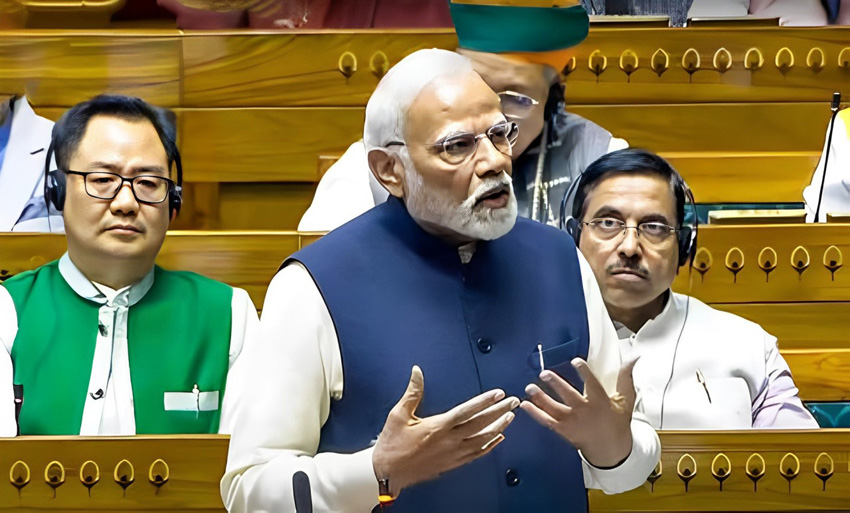
Above article is based on the address of PM Narendra Modi at LOK SABHA in the winter session of parliament during discussion on Indian Constitution.
(Full speech is available on weblink of uday india----
https://www.udayindia.in/news/pms-address-in-lok-sabha-at-special-discussion-on-75th-anniversary-of-adoption-of-constitution )














Leave Your Comment