


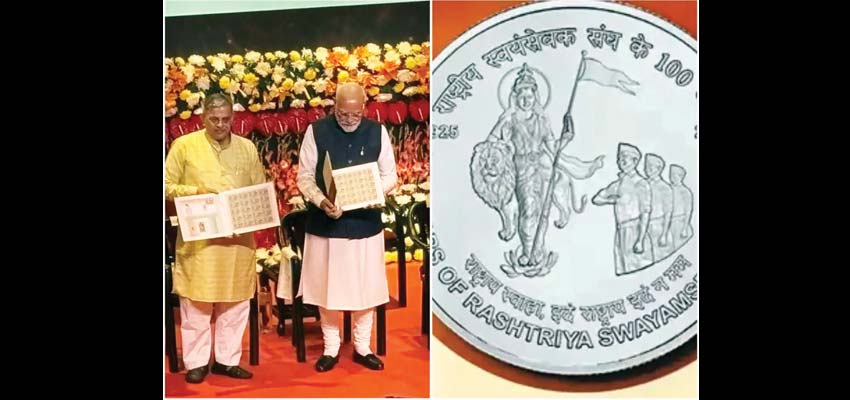
A friend recently objected to using Bharat Mata, RSS imagery, and the RSS motto on official coins or stamps, arguing that it promotes a particular ideology and blurs the line between the nation and one organization. I found this view rather extreme and asked him to clarify. He felt that such symbols, when placed on state instruments, equate the idea of India with one cultural-political identity.
When I probed whether his objection was to the coin commemorating the RSS centenary, to the depiction of Bharat Mata, or to the gesture of saluting it in an RSS manner, he admitted it was all three.
Historical context.
The image of Bharat Mata first appeared in Bankim Chandra Chatterjee’s novel Anand Math. Later, Abanindranath Tagore’s 1905 painting of Bharat Mata became a symbol during protests against the partition of Bengal. Interestingly, it was the Congress government that retained the name West Bengal even after East Bengal became East Pakistan (now Bangladesh). Similarly, Sindh remains mentioned in India’s national anthem, though it became part of Pakistan after Partition. For many Indians, these continuities reflect a deep, emotional connection to the idea of Akhand Bharat—a vision of cultural and civilizational unity.
The criticism.
Parties like the CPI(M) have criticized the release of the coin, calling it an insult to the Constitution and India’s secular values. They argue that it undermines the secular framework and violates the constitutional principle of equality among religions, since the RSS is viewed by them as a sectarian organization. Such critics often overlook that the concept of Bharat Mata originated from Bengal’s own liberal thinkers, and that millions once rallied around the cries of Vande Mataram and Bharat Mata ki Jai during India’s freedom struggle.
Who founded RSS?
Dr. Keshav Baliram Hedgewar (1889–1940), founder of the RSS, was expelled from Neel City High School in Nagpur for singing Vande Mataram against British orders. After matriculation, he went to Kolkata on the advice of B. S. Moonje of the Indian National Congress. In the 1920s, Hedgewar actively participated in the Congress and served in its volunteer wing, the Hindustani Seva Dal. Influenced by leaders like Tilak, Savarkar, Aurobindo, and Moonje, he believed India’s weakness lay in social divisions of caste, class, and creed, and sought to eliminate them completely. In 1920, he helped organize a corps of volunteers for the Congress session, overseeing lodging and food arrangements for thousands of delegates alongside Dr. Paranjpe.
For those questioning the sacrifices of the RSS founders, it’s worth recalling that Dr. Keshav Baliram Hedgewar was jailed for sedition while serving as a Congress member. In May 1921, he was arrested for his “objectionable” speeches at Katol and Bharatwada and sentenced to a year’s imprisonment by the British. Upon his release from Ajani Jail in July 1922, he was publicly felicitated at a gathering addressed by senior Congress leaders Motilal Nehru and Hakim Ajmal Khan.

Hedgewar and several early RSS members had been active Congress workers who grew disillusioned with what they saw as appeasement politics within the party. A major point of contention was Congress’s support for the Khilafat Movement—a cause intended to back the Ottoman Caliphate, even as it was being opposed within Turkey itself.
A progressive, secular nationalist movement emerged in Turkey under Mustafa Kemal Atatürk during the War of Independence (1919–1923). The revolutionaries replaced the Treaty of Sèvres with the Treaty of Lausanne (1923) and, through Atatürk’s reforms, abolished the caliphate in 1924. Yet, India’s misplaced support for the Khilafat movement had already fostered the illusion among many Muslims that restoring the caliphate was the key to solving all problems. The first casualty took place as:
‘Moplah rioters’ not freedom fighters: report
ICHR member Issac seeks removal of Malabar Rebellion leaders from martyrs list (The Hindu, September 06, 2020 )
Hedgewar saw the RSS as a tool to rebuild the social capital that had evaporated from Hindu society at-large. He did not wish for the RSS to engage in the day-to-day politics of his times. He distinguished between personal choice and organisational focus. Individuals, that is Swayamsevaks were free to choose to what extent they wanted to struggle for freedom from British tyranny, but the RSS was only focused on social capital through its shakhas. This fact can be proved when RSS responded to call given by congress.
“When the Congress passed the Purna Swaraj resolution in its Lahore session in December 1929, and called upon all Indians to celebrate 26 January 1930 as Independence Day, Hedgewar issued a circular asking all the RSS shakhas to observe the occasion through hoisting the Bhagwa Dhwaj (saffron flag), rather than the Tricolour.”
The reason for this is also interesting. A believed that report commissioned by the Congress, unanimously concluded that the national flag of an independent India should be a kesari with an Ashoka chakra in the corner. This conclusion was vetoed by Gandhiji and never saw the light of day.
Hedgewar and the RSS disagreed with Gandhi. 1930 was the only year when the RSS celebrated 26 January and it stopped the practice from the next year onwards. Post independence,Rashtriya Swayamsevak Sangh (RSS) celebrates Republic Day with events that include the unfurling of the national flag and addresses by its chief and others emphasizing national unity, constitutional values, and social harmony.
One can see that despite leaving congress in protest and founding RSS the founders did not enter in politics and focused on reviving Hindu culture and practically took over the Congress Sewa Dal model with hinduva written in capital letters.
With the passage of time congress kept distancing it from nationalist stance and opted for secularism which was seen as appeasement by many. RSS kept contributing to national calamities and crises without caring for who is in the government. From invasion of Kashmir in 1948 to 1971 war with Pakistan, RSS actively participated with might. It is first to reach in most of the calamities like flood, earthquake and tsunami. On the other hand congress chose to blame RSS for every violence including murder of Gandhi. Many times bans were imposed which were later revoked. This love-hate relationship continues.
Direct political involvement:
The formation of a dedicated political party stemmed from the difficulties the RSS faced after Mahatma Gandhi's assassination in 1948, rendering it a "political pariah". To extend its influence and navigate the post-independence political landscape, the RSS helped form the Bharatiya Jana Sangh (BJS), the predecessor to the BJP. The few parliamentarians promoted its philosophy by participating in debates and leading movements.
Support during the Emergency and 1977 election.
The RSS supported the Janata Party in the following ways:
= Political alliance: In opposition to Indira Gandhi, the RSS-ideology based Bharatiya Jana Sangh (BJS) merged with other anti-Congress factions to form the Janata Party in 1977.
= Underground mobilization: During the Emergency from 1975 to 1977, when the RSS was banned, its volunteers worked underground to create networks, circulate literature, and establish communication lines for jailed leaders. While rivals visualised it as active politics, RSS leadership treats it as standing for national cause.
= The friends became foes: despite all out support Contradictory demands emerged, Some Janata Party leaders demanded that former Jana Sangh members sever their ties with the RSS, citing the Janata Party constitution which barred members from belonging to another political or "communal" organization. The Jana Sangh faction maintained that the RSS was a cultural, not political, body and that dual association was acceptable. It was a reliving moment of leaving congress to form RSS. The split faction added the word ‘Bhartiya’ to the existing name Janta Party.
Many more such coins will have to be released!
If the RSS demands recognition for the work done by its allied organisations in the field of education,social work, students, tribals, pravasi bhartiy, health and many less known areas not only government but international agencies also will be eager to bestow awards and felicitations. The silent work done by lesser known organisation ‘NETRA KUMBH’ is an example.
During my one month stay in Kumbh 2025, I walked through Netra Kumbh complex which was unknown to me till then. Here is the one month performance:
= Massive Eye Care: Over 2.3 lakh people received eye check-ups.
= Free Spectacles & Medicines: More than 1.6 lakh pairs of spectacles and medicines were distributed.
= Surgeries: 17,069 cataract surgeries were conducted, with referrals for serious cases to hospitals for further treatment.
= Support and Collaboration: 52 partner organizations, 343 Eye Specialists, 489 Optometrists, and 2,700 Prabandhaks (managers). All of these were selfless silent performers.
= Record-Breaking Goal: Netra Kumbh aimed to set a record in the Guinness Book of World Records for providing eye care.
“For the opposition, Bharat Mata wears Sangh’s GanVesh. The political imagination believes that the RSS is the embodiment of the nation itself. ‘Jai Hind’ is being heard as ‘Jai RSS.’ Hatred is being used to hide incompetence. But unknowingly recognition has been bestowed:
1. Historical Authenticity.
RSS participating in the 1963 Republic Day parade: While official reports and archival records refute this, describing a "citizens' march" that the RSS joined without an official invitation. A layman can tell that participation in the Republic Day parade, whether with or without invitation is not possible until silent approval is there.
2. First-ever image of Bharat Mata on Indian currency.
The people who find it problematic that the coin is the first time Bharat Mata has appeared on Indian currency. They have to remember that RSS has adopted orphaned nationalist ideas and concepts abandoned by congress in its greed for appeasement.
3. About division / alienation
The critics argue that using symbols tied closely with one group may alienate minorities or those who don’t share the same political / cultural ideologies. It is an irony that these people forget the spirit of unity in diversity thriving for millennia.
4. Misuse of the Prime Minister’s office?
Some say that such gestures are not just symbolic but misuse of the sanctity of the office of the PM or government machinery — that issuing currency and stamps is a government prerogative, and doing so for an organization seen as politically partisan is controversial. The thought has no merit when we have precedence of doing the same for controversial people like Mother Teresa as well as Maulana Abul Kalam Azad who questioned the merits of Nehru being made the prime minister.
Arguments in favour.
= Supporters argue the RSS has contributed to social service, patriotism, nation-building, and deserves recognition.
= They claim this move is about acknowledging the RSS’s 100-year legacy.
= The government claims that many RSS members were jailed during the freedom struggle (or that RSS workers helped freedom fighters) and that this coin/stamp release is part of recognizing those contributions.
The RSS has quietly woven itself into India’s social fabric, influencing not just politics but also education, rural development, self-reliance, and national consciousness. Yet, the moment a coin bears its name, critics cry foul. The same establishment that celebrates poets, leaders, and film icons on stamps and currency suddenly invokes “secularism” and “constitutional propriety.”
If commemorating a century of civic work is deemed “politicization,” the problem lies not with the RSS but with our ideological rigidity. The coin is a historical acknowledgment, not a political endorsement. We’ve issued coins for Gandhi, Nehru, and Indira without controversy—why apply a different standard now?
For decades, the RSS has been viewed through a lens of suspicion, but perhaps it’s time to assess its role with perspective rather than prejudice.
Why Cry Foul When the RSS Helped Shape the Nation?
The outrage reflects political insecurity more than principle. Sangh has done what few organizations in India have — built institutions that endure beyond governments and ideologies.
The irony of Indian democracy is stark — those who once ignored Bharat Mata now pose as her saviours, while those who have served her selflessly are made to stand accused.
The Sangh’s swayamsevaks have worked in silence — teaching discipline, service, and national pride. From flood relief to education, from villages to cities, they’ve served Bharat Mata without expecting applause.
If a coin honours that spirit, why the outrage?
The image on the coin isn’t divisive — it’s a mirror showing who truly honours Bharat Mata, and who merely invokes her when it’s convenient.
By Rakesh kumar
(The content of this article reflects the views of writer and contributor, not necessarily those of the publisher and editor. All disputes are subject to the exclusive jurisdiction of competent courts and forums in Delhi/New Delhi only)














Leave Your Comment