


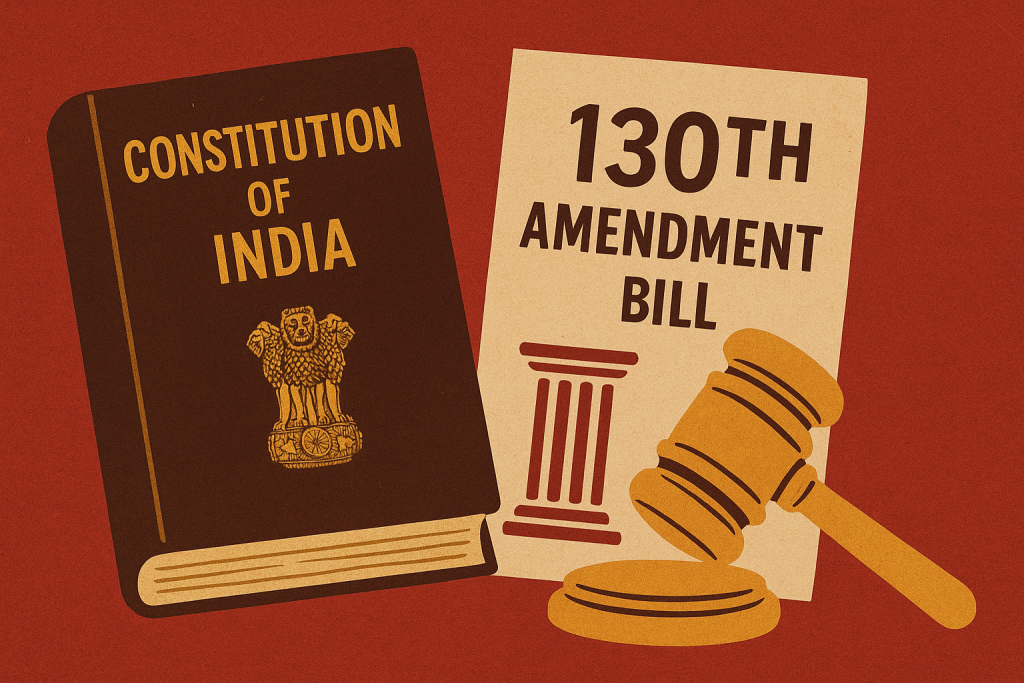
The 130th Constitution Amendment Bill represents a profound ideological clash at the heart of Indian governance. Its stated objective is noble and resonates deeply with a public weary of systemic corruption: to disqualify individuals with criminal charges from holding ministerial office, thereby cleansing politics and restoring faith in governance. Yet, this idealism is sharply countered by pragmatic concerns over potential misuse, the erosion of federal principles, and the fundamental tenet of "innocent until proven guilty." The bill, therefore, sits at a precarious juncture, and its ultimate impact will be determined by its final form—specifically, whether it incorporates robust safeguards against abuse. On its face, the Amendment is a powerful statement of intent. It seeks to address the glaring paradox of politicians facing serious criminal charges wielding executive power. By legally barring such individuals from ministerial berths, it aims to break the nexus between crime and politics, a long-standing demand for electoral reform. This aspiration taps directly into public sentiment, where frustration with corruption and criminality is palpable. Consequently, the political optics are immensely favorable for the ruling party. Prime Minister Modi’s brand, built on assertions of integrity and decisive action, is strengthened by championing such a measure, portraying the government as a relentless crusader against a corrupt establishment.
However, this very strength is the source of its greatest danger. Without careful refinement, the Amendment risks becoming a blunt instrument for political vendettas, undermining democracy rather than strengthening it. The most significant peril lies in its potential misuse by the central government against state-level opposition figures. A ruling party at the centre could, through centrally-controlled investigative agencies, level charges against a rival chief minister or their key ministers, instantly disqualifying them and destabilizing elected state governments. This strikes at the core of India’s federal structure and violates due process, substituting judicial verdicts with unproven allegations. The rational course, therefore, lies not in abandoning the bill but in refining it. The amendment must be coupled with institutional safeguards that protect against its weaponization. Three key mechanisms are essential: Fast-Track Courts: The amendment must mandate the establishment of exclusive, fast-track courts to adjudicate any case invoked for disqualification. A charge cannot be a life sentence without a trial; justice delayed is justice denied. A time-bound legal process is crucial to prevent allegations from being used as a permanent political tool. Appellate Review: An independent and empowered appellate authority, perhaps a bench of the Supreme Court, must be established to review disqualifications. This body would verify the legitimacy of the charges and ensure they are not frivolous or politically motivated, providing a critical check on executive overreach. Transparent Oversight: The process of filing charges that trigger disqualification must be governed by transparent guidelines and subject to judicial oversight, insulating law enforcement from political instruction. Ultimately, the debate transcends the technicality of eligibility. It is a philosophical battle for the soul of Indian democracy. Should we prioritize immediate moral accountability, even at the risk of occasional injustice through misuse? Or should we steadfastly safeguard procedural fairness and federal balance, even if it means tolerating tainted leaders until they are convicted by a court of law? The answer will determine the Amendment’s legacy. With prudent safeguards, it could be a milestone, signalling a new era of accountability. Without them, it may become a cautionary tale of good intentions paving the way for democratic erosion, deepening political mistrust, and institutional instability. The path forward must be paved with both principle and prudence.

By Deepak Kumar Rath





















Leave Your Comment