


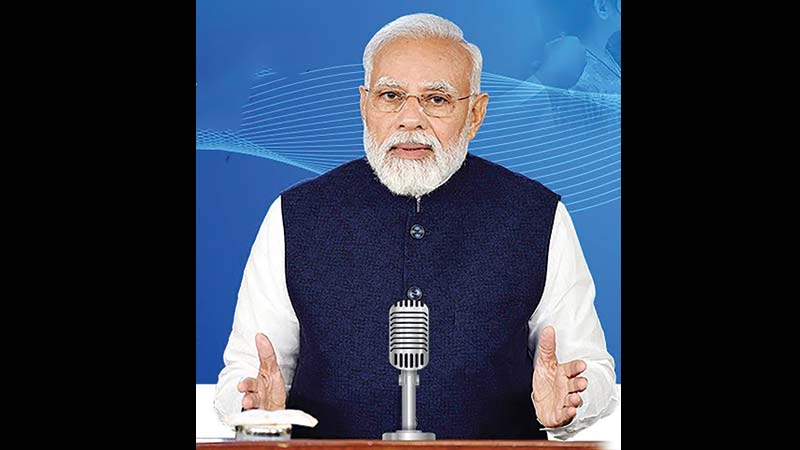
The Prime Minister Shri Narendra Modi addressed the nation via videoconference on May 12. In his address, he remarked that the nation has witnessed both India's strength and restraint in recent days. He extended his salute to the country's formidable armed forces, intelligence agencies, and scientists on behalf of every Indian citizen. The Prime Minister highlighted the unwavering courage displayed by India's brave soldiers in achieving the objectives of Operation Sindoor, acknowledging their valor, resilience, and indomitable spirit. He dedicated this unparalleled bravery to every mother, sister, and daughter of the nation.
Condemning strongly the barbaric terrorist attack in Pahalgam on April 22, stating that it shocked both the nation and the world, Shri Modi described the act as a gruesome display of terror, where innocent civilians enjoying their holidays were brutally killed after being questioned about their faith—right in front of their families and children. He stressed that this was not just an act of cruelty but also a vile attempt to fracture the nation's harmony. Expressing his deep personal anguish over the attack, he highlighted how the entire nation—every citizen, every community, every section of society, and every political party—stood united in demanding strong action against terrorism. He asserted that the government had given the armed forces full freedom to eliminate the terrorists. He warned all terrorist organizations, declaring that they now fully understand the consequences of attempting to harm the dignity of the nation's women.
“Operation Sindoor is not just a name but a reflection of the emotions of millions of Indians”, emphasised the Prime Minister, describing it as an unwavering pledge to justice, one that the world witnessed being fulfilled on May 6-7. The Prime Minister highlighted that the Indian armed forces executed precise strikes on terrorist hideouts and training centers in Pakistan, delivering a decisive blow. He remarked that the terrorists never imagined India would make such a bold move, but when the nation stands united with Nation First as its guiding principle, firm decisions are taken and impactful results are delivered. He stated that India's missile and drone strikes on terrorist hubs in Pakistan shattered not only their infrastructure but also their morale. The Prime Minister pointed out that locations like Bahawalpur and Muridke had long operated as centers of global terrorism, linking them to major attacks worldwide, including 9/11 attacks of US, the London Tube bombings, and decades of terrorist incidents in India. He declared that since terrorists had dared to destroy the dignity of Indian women, India had eliminated the headquarters of terror. The operation resulted in the elimination of over 100 dangerous terrorists, including key figures who had openly plotted against India for decades, he added, affirming that those who orchestrated threats against India had been swiftly neutralized.
Shri Modi stated that India’s precise and forceful strikes had left Pakistan in deep frustration, pushing it into desperation. In its agitation, Pakistan resorted to a reckless act instead of joining the global fight against terrorism—it launched attacks on Indian schools, colleges, gurudwaras, temples, and civilian homes, also targeting military bases, he added. He highlighted how this aggression exposed Pakistan’s vulnerabilities, as its drones and missiles crumbled like straw before India’s advanced air defense systems, which neutralized them in the sky. He remarked that while Pakistan had prepared to strike India’s borders, India delivered a decisive blow to Pakistan’s core. Indian drones and missiles executed highly accurate strikes, severely damaging Pakistani airbases that it had long boasted about. Within the first three days of India’s response, Pakistan suffered destruction far beyond its expectations. Following India’s aggressive countermeasures, Pakistan began seeking ways to de-escalate, appealing to the global community for relief from rising tensions. He revealed that, after suffering severe losses, Pakistan’s military reached out to India’s DGMO on the afternoon of May 10. By then, India had already dismantled large-scale terrorist infrastructure, eliminated key militants, and reduced Pakistan’s terror hubs to ruins. Shri Modi noted that Pakistan, in its appeal, assured that it would cease all terrorist activities and military aggression against India. In light of this statement, India reviewed the situation and decided to temporarily suspend its counter-operations against Pakistan’s terrorist and military installations. He reiterated that this suspension is not a conclusion—India will continue to assess Pakistan’s every move in the coming days, ensuring that its future actions align with its commitments.
The Prime Minister emphasized that India's armed forces—the Army, Air Force, Navy, Border Security Force (BSF), and paramilitary units—remain on high alert, ensuring national security at all times. “Operation Sindoor is now India's established policy in the fight against terrorism, marking a decisive shift in India's strategic approach”, he declared, stating that the operation has set a new standard, a new normal in counter-terrorism measures. The Prime Minister outlined three key pillars of India's security doctrine; firstly the Decisive Retaliation, when Any terrorist attack on India will be met with a strong and resolute response. India will retaliate on its own terms, targeting terror hubs at their roots. The second is No Tolerance for Nuclear Blackmail; India will not be intimidated by nuclear threats. Any terrorist safe haven operating under this pretext will face precise and decisive strikes. Third pillar being No Distinction Between Terror Sponsors and Terrorists; India will no longer see terrorist leaders and the governments sheltering them as separate entities. He pointed out that during Operation Sindoor, the world once again witnessed Pakistan's disturbing reality—senior Pakistani military officials openly attending funerals of eliminated terrorists, proving Pakistan's deep involvement in state-sponsored terrorism. The Prime Minister reaffirmed that India will continue taking decisive steps to safeguard its citizens against any threat.
He reaffirmed India's firm stance, stating that terror and talks cannot coexist, terror and trade cannot run parallel, and blood and water cannot flow together. Addressing the global community, he reiterated India’s long-standing policy that any discussions with Pakistan will focus solely on terrorism and any negotiations with Pakistan will center around Pakistan-Occupied Kashmir (PoK).
Operation Sindoor: A Defining Moment in India's Strategic Posture
Deepak Kumar Rath
In his address to the nation on May 12, 2025, Prime Minister Narendra Modi provided a comprehensive overview of Operation Sindoor, India’s decisive military response to the Pahalgam terrorist attack that claimed 27 lives on April 22. The operation, executed on May 7, targeted terrorist infrastructure in Pakistan and Pakistan-administered Kashmir, marking a significant shift in India's approach to cross-border terrorism and regional security dynamics.
Operation Sindoor was characterized by its precision and strategic clarity. Over a 23-minute period, the Indian Air Force deployed Rafale jets equipped with SCALP missiles and AASM Hammer bombs to strike nine locations, including Bahawalpur, Muridke, and Muzaffarabad. These sites were identified as hubs for terrorist groups such as Jaish-e-Mohammed and Lashkar-e-Taiba. The operation reportedly resulted in the elimination of over 100 militants, according to Defense Minister Rajnath Singh. Notably, the strikes were conducted without breaching Pakistani airspace, demonstrating India’s capability to execute precise operations while minimizing the risk of broader escalation.
The success of Operation Sindoor was underpinned by India's advanced military technology and intelligence capabilities. The Indian Space Research Organisation (ISRO) played a crucial role by providing real-time surveillance and communication support through a network of at least ten satellites. These assets facilitated accurate targeting and coordination during the operation. Additionally, the deployment of the Sudarshan Chakra air defense system proved instrumental in neutralizing over 80% of incoming threats during subsequent Pakistani retaliatory strikes, safeguarding key urban centers such as Amritsar and Jammu.
Prime Minister Modi’s address emphasized the broader implications of Operation Sindoor for India's national security and regional standing. He highlighted the operation as a testament to India’s resolve against terrorism and its commitment to protecting its citizens. The Prime Minister also underscored the importance of indigenous defense capabilities, signaling a continued focus on self-reliance in defense production. His remarks served as a stern warning to Pakistan and other potential adversaries, asserting that India would not hesitate to take further action if its sovereignty is threatened.
What captured the imagination of many observers was the timing and subtle symbolism in Modi’s speech—delivered on May 12, which coincides with National Technology Day, the anniversary of India’s first nuclear tests in 1998 under Operation Shakti, also known by its code name “Smiling Buddha.” While Modi did not overtly reference the historical event, his mention of India’s “scientific prowess,” “technological supremacy,” and “decisive will” echoed the spirit of that nuclear milestone. The allusion was unmistakable to geopolitical analysts: just as India had altered the strategic balance in Asia through Pokhran in 1998, it had now done so again—this time with conventional might and digital-age precision. The unspoken parallel between Operation Sindoor and “Smiling Buddha” was not lost on the domestic audience either, subtly reinforcing a narrative of national strength, pride, and technological assertiveness.
The operation and subsequent ceasefire, have significantly altered the security dynamics in South Asia. India’s assertive stance and operational success have established a new precedent, demonstrating its willingness and ability to respond decisively to cross-border threats. This shift has implications for regional stability, as neighboring countries reassess their strategic calculations in light of India's enhanced military posture.
UDAY INDIA BUREAU














Leave Your Comment