


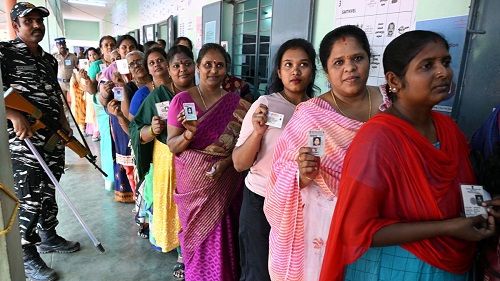
Polling for all 234 Assembly constituencies in Tamil Nadu began on Thursday morning under extensive security arrangements, marking a decisive moment in one of the most closely watched state elections in recent years. Voting commenced at 7:00 am and will continue until 6:00 pm in a single-phase election, with results scheduled to be declared on May 4. Voter turnout reached 70% by 3 pm in the state.
Early trends indicated enthusiastic participation across the state, with Tiruppur recording the highest turnout at 62.97 per cent, while Nilgiris saw the lowest at 50.42 per cent. The steady voter turnout reflects the intense public interest following months of vigorous campaigning by major political players.
Prominent leaders and public figures were among the early voters, setting the tone for the day. Chief Minister M. K. Stalin cast his vote in Chennai, accompanied by Deputy Chief Minister Udhayanidhi Stalin. On the opposing side, Edappadi K. Palaniswami voted in Salem. The presence of high-profile personalities such as Rajinikanth, Kamal Haasan, Ajith Kumar, and Vijay at polling booths added visibility and excitement to the democratic exercise.
This election in Tamil Nadu is widely seen as a crucial contest between the ruling Dravida Munnetra Kazhagam (DMK)-led Secular Progressive Alliance and the opposition alliance led by the All India Anna Dravida Munnetra Kazhagam (AIADMK) and the Bharatiya Janata Party (BJP). However, the debut of Vijay’s Tamilaga Vettri Kazhagam (TVK) has transformed the race into a multi-cornered battle, introducing new dynamics and voter choices.
A total of 4,023 candidates are contesting across the state. M. K. Stalin is seeking re-election from Kolathur, while Udhayanidhi Stalin is contesting from Chepauk-Thiruvallikeni. Edappadi K. Palaniswami is in the fray from Edappadi in Salem district. Vijay, making his electoral debut, has taken the unusual step of contesting from two constituencies—Perambur in Chennai and Tiruchirappalli East—signalling his party’s ambitious statewide push.
The stakes are high when viewed against the backdrop of the 2021 Assembly elections, where the DMK-led alliance secured a commanding victory with 159 seats, while the AIADMK-led coalition managed 75. As the current Assembly’s tenure draws to a close on May 10, voters are now deciding whether to extend the DMK’s mandate or pave the way for a political comeback by the AIADMK.
Campaign narratives have been sharply contested. The DMK framed the election as a fight between Tamil Nadu’s regional identity and the influence of the BJP-led central government, while the AIADMK countered with criticism of the ruling party over alleged dynasty politics, governance issues, and concerns around public safety and state finances.
To ensure a smooth electoral process, authorities have deployed around 1,700 companies of central armed police forces across the state. Mock polling exercises were conducted ahead of voting to minimise technical glitches and enhance preparedness at polling stations.
As millions of voters cast their ballots across Tamil Nadu, the outcome of this election is poised to shape the political direction of the state for the next five years, with implications that may resonate well beyond its borders.



















Leave Your Comment